
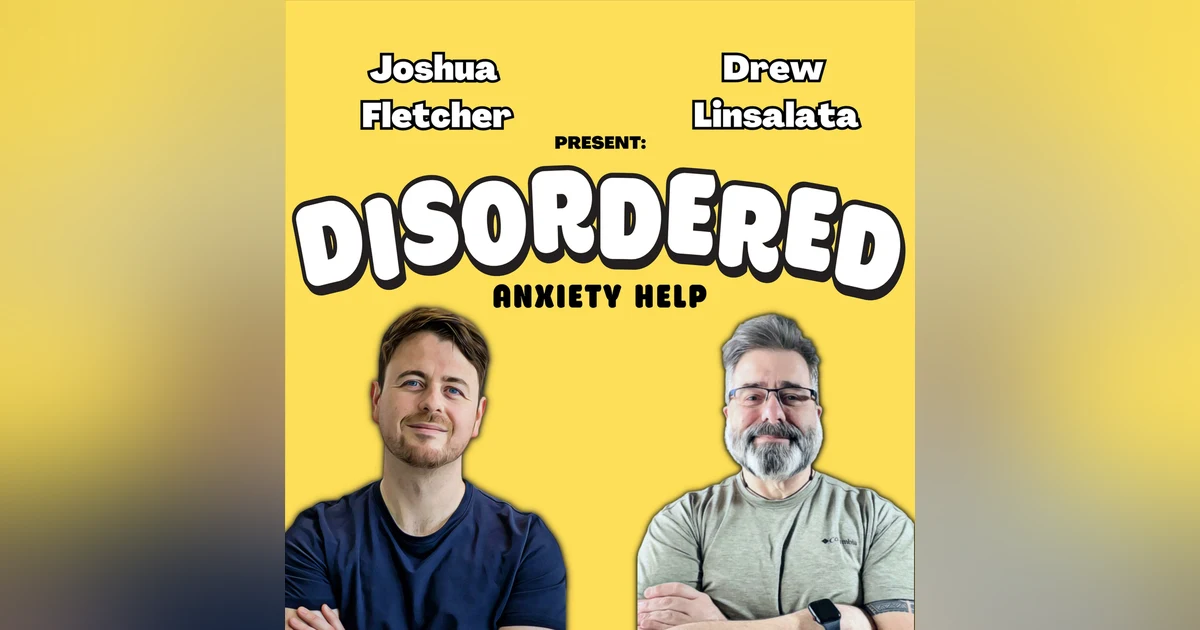
The Stress Jug Explained (Episode 146)

 Apple Podcasts
 Spotify
 YouTube
 Amazon Music
 iHeartRadio
 RSS Feed
 Want to talk about what you're hearing in this episode with Josh and Drew and others that share your experience?
https://disordered.fm/community
----
In this episode, Josh and Drew break down the "Stress Jug"—a metaphor designed to explain why anxiety and panic often seem to appear out of nowhere. The guys discuss how accumulated stress, both positive and negative, can cause your "threat response" to overflow, leading to sensitization and the search for a threat where none exists.
The Mechanics of Overflow: How the amygdala misinterprets a full "stress jug" as immediate danger, triggering unexpected fear and physical symptoms.
The Role of Meaning-Making: Why your brain creates narratives (like health anxiety or fear of "going crazy") to explain internal discomfort.
Beyond "Emptying the Jug": Why recovery isn't about avoiding stress or keeping the jug empty, but learning to tolerate the overflow when life gets heavy.
"Meta-Stress": Understanding the additional weight of being stressed about being stressed, and how that contributes to the cycle of disordered anxiety.
The "Gunk" at the Bottom: Addressing long-term factors like grief, self-esteem, or unprocessed emotions that occupy space in your jug.
We're also sharing "Did It Anyway" stories from the community, including a listener’s trip to Jamaica despite anxiety and a first-time solo drive after years of avoidance. These stories highlight the importance of taking action even when you don't yet believe you are safe.
---
The Disordered Guide to Health Anxiety is now available. If you're struggling with health anxiety, this book is for you.
---
Struggling with worry and rumination that you feel you can't stop or control? Check out Worry and Rumination Explained, a two hour pre-recorded workshop produced by Josh and Drew. The workshop takes a deep dive into the mechanics of worrying and ruminating, offering some helpful ways to approach the seemingly unsolvable problem of trying to solve seemingly unsolvable problems.
-----
Want to ask us questions, share your wins, or get more information about Josh, Drew, and the Disordered podcast? Send us an email or leave a voicemail on our website.
---
Disordered Roundtable is coming! Think of it as "Disordered Live", a way for members of our audience to spend time with us in an intimate virtual setting (attendance is limited) to engage in real time sharing and discussion on specific anxiety disorder and recovery topics. To be notified when new Disordered Roundtable sessions are scheduled, sign up for our email list using the form on this page.
We hold on to lots of stress, and when it builds up, and when things and life isn't sustainable, the stress jug overflows. The amygdala misinterprets that accumulated stress and just in case hits you with some unexpected and confusing uh fear. Desensitization does not mean I have to empty the stress jug and avoid it filling up.
SPEAKER_03We have an overflowing stress jug and a brain whose job it is to make meaning out of our internal experiences. And it only cares about what's easily accessible and easily believable. And then your mind is going to create some sort of narrative to explain it. So the same rules of response are going to apply, but it does give us a reasonable explanation as to what this is.
SPEAKER_04When your stress drug overflows, your threat response will find a threat. This is episode 146 entitled The Stress Drug Explained. I'm Joshua Fletcher, also known as Anxiety Josh, and I'm a psychotherapist who specializes in the world of anxiety and anxiety disorders. I'm based in Manchester in the UK. I've been a therapist for 10 years now, and I really enjoy hosting this wonderful podcast and this community.
SPEAKER_03And I'm joined by my esteemed co-host. Uh I am Drew Linsolata. I am coming to you from New York, Long Island, as a matter of fact, where I am also a therapist that specializes in treating anxiety and anxiety disorders, and an author on this topic, a psychoeducator, advocate, social media guy, former sufferer of the things we talk about on disorder, but better now. And this week we're going to talk about, welcome, by the way. Today we're going to talk about the stress jug, which is, dude, that's like your your thing. I love the stress jug. I use it, I stole it from you, and I appreciate you inventing inventing it.
SPEAKER_04You're always stealing my kitchen utensils. Constantly. That's my job. Um this the stress jug, yeah. I mean, uh this this came up because I get a a lot of questions, and people, when they're very obsessed about recovering in air quotes, or they're too they're they're thinking about you know, desensitizing and stuff. The what I usually say is that when people ask where does anxiety come from, you know, where the moment I got sensitized. I remember you talking the other day uh in the disordered community app about you yours, you you were you were pretty happy, so and then from somewhere you don't know why it happened.
SPEAKER_03No idea.
SPEAKER_04Um, you just had a panic attack one day, felt he realized. For me, and what I hear a lot as a therapist or talking to others in this space is usually panic attacks and anxiety come after a prolonged bout of stress, a built-up stress drug. Now, that stress drug could have started filling up from when you were younger, um, and it builds up, and then more responsibilities occur when you're an adult and stuff like that. But for me, I use it as an explanation to suggest that we hold on to lots of stress, and when it builds up, and when things and life isn't sustainable, the stress drug overflows. The threat response um involving a part of the brain called the amygdala misinterprets that accumulated stress and just in case hits you with some unexpected and confusing uh fear and adrenaline and cortisol. So I say that as an explanation as to why it's happening, and I wanted to do this episode today because we did one of the early episodes on the stress drug, but I wanted to clarify a bit today, explaining the stress drug, that people, when I say that as an explanation as to why, I didn't further clarify that the aim isn't to empty the stress. Well, it is. We want to empty the stress drug, we want to live a nice life, but sometimes the stress drug does overflow. But desensitization does not mean I have to empty the stress drug and avoid it filling up, because sometimes life gets in the way and it will fill up. And so you're missing the bat there.
SPEAKER_03Does that make sense? Yes, it makes perfect sense. In fact, it's funny now that you think about that, if if you want to conceptualize that, well, it's a stress drug overflowing, I will always contend that I I don't know what prompted my first panic attack, and everything was going great. But even happy stress is stress, like a new baby or buying a new house, or getting your dream job and starting on your first couple of days and not being sure. Stress is stress. It doesn't always have to be negative stuff. Things were going really well, but maybe that's what it was. I I think what's important about the stress drug too is that it it recognizes and inserts into the process a very normal. Oh, I thought those were off. I don't know why I'm hearing that. Sorry. Um, the very normal, very expected, like part of being alive, psychologically, socially, physiologically. We all have a stress drug, and sometimes stuff is going to get poured in there. Like we can't eliminate that. That's just the way it is.
SPEAKER_04Yeah. And and think about all the stories that you as a therapist and a practitioner uh drew. Like one story that comes to me, and I've had a few very similar like this, is that um I I once I have permission to kind of say this story, and it's it's not uh one person in particular. But I worked, um I worked with a nurse and worked in a hospital, and they'd been there for 10 years, no disordered anxiety, worked on an oncology ward. And in their life, stress built up. They were, like you said, positive stress, they were getting married, they were buying a house, they were selling an old house, there was family issues, distant relatives, arguments, logistics, then going to work, the stress of being a nurse on an oncology ward, and the stress that comes with that. And that's arguably positive and negative stress because nurses love doing their job, but it's difficult working in a hospital. You see some great things, you see some difficult things, and that's all building up and all building up. And then one day the their metaphorical stress job gets too much, overflows, and they enter the sensitized state. They enable this threat response that just starts firing off, going where's the threat? Million dollar question, Drew. What do you think a nurse working on an oncology ward after 10 years suddenly assumed after their stress drug filled up?
SPEAKER_03Do I win anything if I guess correctly? Have I no, no, uh well, I'll guess anyway. I suspect.
SPEAKER_04Yeah, no, you you you win one free pass at any button on the sound effect machine.
SPEAKER_03Oh, I mean, I'm gonna save that because I want to make sure that I I use it correctly and to the best effect. But I'm gonna take a wild guess and say it was something medical, probably cancer related. Yes, what a surprise.
SPEAKER_04What if I suddenly got cancer? Yeah, despite 10 years working on an oncology ward, all that stress, and then and and they would ask, like, why now? And that's when I use the stress drug. You know, it's an explanation as to why. If you're someone who needs to know why, like me, I needed to know why it was happening. Why is this happening to me? Why last week I was fine. This week I feel like something awful is gonna happen. I'm sensitized, having DPDR, weird symptoms, racing thoughts on edge. Why is that happening to me? And that's why I use the stress jug. But what over the years and what I've realized, and working in this community um and interacting with lots of people in the community, is and and with clients over the years, is that it always, almost always, kind of is the result of a buildup of accumulated stress. Yeah. And you throw in things like genetics as well, like my mom's anxious, dad's anxious, it could runs through the family, maybe you're neurodiverse, and that throws itself into the stress drug, too, it comes with its own stresses, and it ends up there, we end up in this sensitized state that we don't know how to interact with. Yeah. And so the aim is okay, my stress drug's overflowing. That's why this is happening. But at no point in the stress drug analogy is it quick, empty out your stress drug.
SPEAKER_03Yeah.
SPEAKER_04Because that can be counterproductive, because then you get stressed that your stress drug's overflowing, and that in itself adds to the stress drug. Yeah, just use it as an explanation. Yeah. I don't know. Does this resonate with you, Drew? I in my side of things, it does.
SPEAKER_03I mean, I think it does because it offers us a framework that can we we can lean on. Um I will even add to that. So if we want to conceptualize it that way, there's some variety of stressors, some of which we are not necessarily even aware of. Like for me, I wasn't even aware that I was under any kind of stress. And it boils over. So now we have this response, which is an extreme stress response, and we don't know why. So now remember, we have an overflowing stress stress jug and a brain whose job it is to make meaning out of our internal experiences, really all of our experiences. And it only cares about what's easily accessible and easily believably. Easily easily believable. So for the oncology nurse, what is easily accessible to her? Medical issues related to cancer. It's easy to access, metabolically cheap, and believable because she that's what she knows. It's the framework that she's in. So an overflowing stress drug makes this, and then your mind is going to create some sort of narrative to explain it. My narrative was I guess this is what it I remember clearly this feeling of spacey out of my body, which I had never experienced before, this is what it feels like to die. I don't know why. Stories from when I was a kid and being in church, and your soul goes up to heaven, and I conceptualize this as I'm separating from myself, and that's what it is to die. And that starts the ball rolling. Even if somebody had said you're having an overflowing stress jug, too late. Because now I've decided that the feeling itself is the problem. And I just what do you mean it's just my stress drug therapist, Josh? Like, I don't know, but what if I really am having a heart attack? So the same rules of response are going to apply, but it does give us a reasonable explanation as to what this is, what's going on here?
SPEAKER_04Yeah. And you see it a lot as well. Like when your stress drug overflows, it will your threat response will find a threat. It will, its job is to find suggestions when there isn't an immediate one.
SPEAKER_03That's right.
SPEAKER_04You'll find this as well a lot like people with low C D or people with fear of going crazy. The stress drug overflows and it just needs to find a threat. If I had a what currency do you use over there? If I had a dime for every time I heard, yeah, but my second cousin went crazy. Right. If they can go crazy, then surely I can. I was like, were you thinking about that a few weeks ago? No.
SPEAKER_03Yeah.
SPEAKER_04Oh, so you think about that when you're sensitized, yeah. That's your threat response, trying to find something, you know, and it will find something in your memory, in your experiences, because it's trying to make sense of something that doesn't make sense.
SPEAKER_03Yeah. And that's the curse of being human. I mean, it's a lovely part of being human. So if you look at like the theory underneath act and everything, symbolic thinking and representational thinking, best thing that ever happened to us was language. Worst thing was language, because we as humans not only can feel things, we also can try to explain why we feel things. And I'm pretty sure that Copper ain't doing that, my dog. Like, and it's lovely, he just knows he's scared and that's it. And then he's not, and he moves on. So it's really right to be a dog, right? But yeah, I hear you. I miss those things, right? I miss being a dog. So but I think it's it speaks to also why, you know, um, when we look at like prevalence statistics, at least in the West, the number of adult Americans in the next 12 months that will experience at least pan one panic attack is enormous. Like upwards of 15% of all American adults will probably experience a panic attack, but only 2% will develop panic disorder because their meaning making was different. Like, oh, I'm I'm so stressed. I'm having I had a panic attack. And okay, they know what it was. End of story. That's it. Maybe it happens tomorrow. Maybe I hope it doesn't happen tomorrow, but they don't become afraid of the the event, and so they don't develop the disorder. Interesting, right?
SPEAKER_04Yeah, yeah, yeah. No, I find it really interesting. Yeah, anyway, enough of us rabbiting on. What have we gotten from the community?
SPEAKER_03Uh well, if I can get my cursor over there, I think we could play a Did It Anyway because it's pretty good.
SPEAKER_00Hi, Drew and Josh. I'm Anna. I'm calling in from New York City. I wanted to share uh Did It Anyway because I've had a lot of pretty debilitating anxiety from a medication withdrawal. I just took my family to Jamaica, which is the place I studied my college semester abroad 28 years ago. And so it's a really beautiful, special place in my heart. But this newfound anxiety has made me scared to go in crowds, scared to go on planes, my body hurts, I want my creature comforts, I want my cool room all by myself. But I went for eight days, went on the beach. I wasn't, you know, the super fun parent. That's what my husband was for, but I did participate as much as I could, ate all the food, and really stretched myself and challenged myself in ways that were hard. And the plane ride back, there was a screaming baby next to me, and you know, it was it was rough, and I was irritable and anxious, but I did it, and I'm so glad and I'm so grateful for your podcast because it's all about like just allowing for these feelings and not scratching the itch and looking too deeply into it, and I just kept taking one step at a time, so I just wanted to share that with you.
SPEAKER_03Good job, Anna. Well done.
SPEAKER_04I love that. That was so lovely, wasn't it? Absolutely. Uh well I like the little inflection in her voice when she was like laughing at my my creature comforts. So no, I can't have those.
SPEAKER_03I need my cool room. I could relate, like, oh, it's too hot, I'm gonna freak out, yeah.
SPEAKER_04Although I I am kind of part of that. If I'm in a hotel and there's no air con, I lose my mind. Yeah, not I'm not afraid of panic attacks, I just turn into a horrible person.
SPEAKER_03All right, fair enough. Remind me never to go anywhere with a noise.
SPEAKER_04I'm the dude in winter going into the hotel and putting it on fridge mode. Uh and yeah, I love it. So I don't know what it is.
SPEAKER_03You're not gonna freak out, you're just gonna be unbearable to be with. No, just uh irritable and annoyable. Yeah, cool.
SPEAKER_04Yeah, not not having panic about it.
SPEAKER_03Yeah, I love how she says, like, I wasn't the cool fun parrot. That's what my husband is for. And it was really great. So yeah, and it goes to Jamaica, which is in the West Indies. Did she have 50 Bentleys there, though? I'm gonna say no.
SPEAKER_04No, I'm saving it.
SPEAKER_03I'm saving it. No, I'm not gonna save it. All right, it's good. It's my favorite sound we got. Abandoned song. Oh, so good. Anyway, thank you, Ann. I appreciate you sharing.
SPEAKER_04Um where do you think people where do you think people trip up then on the stress drug? Where do you think they misconceptualize that?
SPEAKER_03Sometimes I think that you I think touched on it first. There's a couple of ways, but the first one I'll hit is what you were talking about. You don't want to turn this into a technique or like, no, no, the stress drug is this is how I control my panic, my anxiety, my OCD, by making sure I never, my stress drug can't have anything in it. Because then you run into now you're an optimizer or a wait, regular I'm killing it today on the soundboard, but like, yeah, you run the risk of getting into that. Like, oh, I can only be okay if I'm perfectly calm with no stressors and no triggers and super boundaries, and I say no to everybody and I isolate and I just treat myself, I wrap myself in bubble wrap physically, emotionally, mentally, and then I'll be okay because then nothing gets in my stress drug. That's that's impossible.
SPEAKER_04Yeah, because it can, and as I've learned over time, become an avoidance strategy. Yeah. If your stress drug is full, and we were talking about the golden rules from before, like I can feel my stress drug full, but I've been invited to go on holiday to Jamaica and take my family. That is inevitably going to be more stressful. The analogy is there to help you realize why you might be stressed and anxious. So, but some people might go, my stress, my stress drug is full. I'm now gonna avoid what non-anxious me was gonna do and cancel my trip to Jamaica.
SPEAKER_03Yeah.
SPEAKER_04That's not what it's there for. It's to go, oh, I'm I'm having a panic attack in the hotel room. Ah, it makes sense. Things have been stressed so recently. Back to the principles of what I'm doing.
SPEAKER_03I think there's also a certain amount, I'm gonna call it this might be a new term, by the way, TM trademark, meta stress. So, like life will pour stuff into your stress jug, just work and finances and relationships and the weather and all that stuff. Fine. And then there's the stress over being stressed, which is the disordered anxiety part. Like, that's like meta-stress. So now don't forget that you're also what's pouring into your stress drug is the fact that you are afraid of how you feel and what you think and you know what emotions you experience. So that's okay. Let it pour in there, but recognize that, like, oh yeah, I was already elevated because life was really hard, and now I'm super worried about going to this wedding because I think I'm gonna make a scene, and now that's meta-stress and brrr and it boils over. That's okay. It doesn't mean it's a disaster, it just means how much can you handle? It's okay. I like how you trademark that I did immediately. Before I even said the word, I trademarked it.
SPEAKER_04I was thinking of trademarking uh uh a theory. I'm gonna write a book. It's called the um the tet Lem Theory by Rel Mobbins.
SPEAKER_03Is that gonna be your pen name? Yeah, I think that's a good strategy. It's working well for some people. We're just gonna take principles that everybody already knows that we learned in like the second grade and call them our theories and just start writing books about them.
SPEAKER_04Yeah, yeah, yeah. The one technique.
SPEAKER_03Yeah, love it. Yeah. Anyway, I think another place, and I don't know what what your thoughts are on this that people either misinterpret or maybe just don't understand the stress drug, is how about the person who is far down the road? They're quite desensitized. They maybe it's a therapy client, they've been working hard and they're they're having a much better life, less restricted. And then it's, I don't know what's going on. Like I've been really anxious again the last week, or I had a couple of panic attacks, or my OCD is flaring up. And if you just ask a few little questions in a session, you discover like, oh, my dog is sick, and like my husband lost his job, and my kids are making me crazy, and my mother-in-law is a raging bitch, and blah, blah, blah. And like, okay, well, d not all anxiety is disordered anxiety. The stress jug, you know, theory here or the metaphor, the analogy can really come in handy. Just because you're feeling stressed and it you know shows up physiologically or mentally, doesn't mean that it's a setback. Your anxiety is coming back.
SPEAKER_04Exactly, exactly. And and I've no and learned over the years as well, like for people who this applies to, it's not everyone. Yeah, like some people get it, some people like my fault. It was very vague when I said it, but like when I approach my driving anxiety and I get on the motorway or the highway, and I've I've got four kids, and I've got this, and my partner's away, and I'm juggling work, and then I'm doing an exposure. My stress drug's gonna overflow. To which I say, yes, go practice with your stress drug overflowing, because there's no better attitude approach to being like, Well, I'd rather my stress drug not overflow, but I can hope if it does. Yeah. That's the difference.
SPEAKER_03You have said all the time that like you cannot you can't teach your amygdala unless it's activated, which is true. So, in emotional processing theory, we would call that like the fear blueprint. We have to unroll that blueprint to draw new things on it. You can't draw new things on the fear blueprint if it's still rolled up and tucked away in your desk. So, like, oh, I like that analogy. I think we can use that. Yeah, that's uh I mean, I can't take credit. That's Ed Nafoa at out of UPen, the old emotional processing stuff. Like the fear blueprint, that's how I was taught uh the principles of ERP. The fear, but we have to unroll the fear blueprint so we can write new new stuff onto it with experience. Yeah. So like we almost kind of need to work with our stress drug overflowing, depending on what your presentation is. That's okay. Like we need that, yeah.
SPEAKER_04Yeah, and it's basically for people like, why am I freaking out? Your stress drug's overflowing. That's okay. Yeah, that's totally okay. And I think for general wellness and mood, so let's say you have desensitized fully. Yep. What I often do in therapy afterwards is like, well, let's see how we got here. What doesn't need to be in the stress drug for your overall wellness and your mood? Yeah, maybe you've got an internal critic, maybe you've not processed grief, maybe you've just not processed a lot of emotions. Maybe you've got holding on to some anger towards someone. Maybe you've got identity issues. Maybe you don't put your stress drugs there because of a multitude of factors. You know? That's certainly what happened to me. And actually the stress drug overflowing was a good thing because then it allowed me to see what sediment was already in it that was built, that was building on top. And I addressed loads of things. Grief, who I am, self-esteem, how I see myself, uh, unprocessed anger and emotions and all that stuff. Then I was like, ah, it's cool. So then when I know if I ever feel sensitized or anxious now, I'm like, hold on, what's in the stress drug? Actually, yeah. If I look back over the last month, two months, there's a hell of a lot that's gone in there. So don't be surprised. And I I I do genuinely think that like looking back, I don't think my anxiety's ever kicked off where the stress drug has not, there's hasn't already been some pre you know, predating stress that that has got me there. Yes, not to the exact moment, you know, because often it feels like, oh, anxiety hit me from nowhere. I might just be in the shower chilling or something like that. But up until that day, there was always something.
SPEAKER_03I love sediment, by the way. I'm stealing that too. It's the sediment, the gunk at the bottom of your stress jug. Like it's always there. It actually is contributing, right? So and I think what's what's tough about that is so much of general wellness, and like even therapists that maybe don't specialize in anxiety disorders insist that somebody who says, Oh, my panic came out of the blue. No, it didn't. We need to know what you were thinking, what were you feeling? What was the trigger? And some in an anxiety disorder, the trigger is that I'm afraid to be anxious. But it is true that the the gunk at the bottom of your stress drug may have contributed to that, just that we can't operate on that, the gunk.
SPEAKER_04Welcome to therapy where we de-gunk your stress drug.
SPEAKER_03We are legitimately just working with like the garbage at the bottom of your stress jug. It's so gross, but it's actually real, right?
SPEAKER_04Afterwards. And I'm relating to your analogy of you know, the the the fire people don't turn up and when like fire service don't turn up and be like, you know, I I wonder what foundations this building was was built on and why it caught a blaze. No, they're like, Yeah, let's put this out. We gotta put it at the fire, then we'll figure out an analysis of why what that happened.
SPEAKER_03Yep, that was my my therapist was awesome, and she wasn't even an anxiety specialist, she was uh an ER nurse that she started as a emergency nurse.
SPEAKER_04She's like, She sounds great, she sounds amazing.
SPEAKER_03She was awesome, and she was like, Hey, listen, we don't have to dig for anything, like you're in charge, which was great. We're a great therapeutic relationship. And she was like, first thing we did if somebody came into the ER and they were bleeding, is we got to stop the bleeding before we can treat whatever's underneath and first stop the bleeding.
SPEAKER_04So Yeah, yeah, I like that. I like that a lot. Yeah. Uh, do we have another community did it anyway? I've got a written one.
SPEAKER_03Yeah, let's let's read a written one.
SPEAKER_04Okay, it's a very British one. This is from Laura. Hi, Drew and Josh. Laura here, you can use my name. My did it anyway. After months of suffering with anxiety and being stuck at home, I went into Sainsbury's with my little boy, grabbed my shopping, even though I felt on edge, hot and lightheaded. I kept telling myself I'm not in any danger. When I came out, I felt very proud of myself. I even went in, I went, even went into can we have Billy Mays? Have we got him?
SPEAKER_03Uh he's in here somewhere. Is it this one? But I'm not done yet.
SPEAKER_04There you go. When I came out, I felt very proud of myself, and I even went into the charity shop and bought myself something afterwards. Amazing. The anxiety is starting to lift. It's all thanks to you guys. Well, we appreciate that. Loving the podcast, and also a personal thank you to you, Josh. I contacted you via your website and asked a question, and I sent a voice note back, apparently. Like, all right, good. I'm glad that was helpful. You never know with those things. Yeah. Um, and I use it to give me a boost. Can thank you enough and keep up the good work. Well, well done to you, Laura. That's fantastic.
SPEAKER_03Absolutely. Round of applause for Laura. And thank you for sharing.
SPEAKER_04I just wanted to know what she bought from the charity shop. You're like the music gig did it anyways. You've you're providing all the important stuff, but I want the minutiae. What gig did you see? And what did you purchase from the charity shop?
SPEAKER_03Did you get the t-shirt or what did you buy? Did you buy a CD? Nobody buys CDs as a gig anymore. What am I kidding?
SPEAKER_04A 1972 original Cluedo. Missing Colonel Mustard.
SPEAKER_03It's always missing something. I'm amazed at how valuable those things are. People collect those things. Amazing, right?
SPEAKER_04So uh I used to collect Subutio. In fact, I still have Subutio somewhere in my auntie's basement.
SPEAKER_03I don't know this. What is that?
SPEAKER_04Subutio, the little football, like actual football, not that silly thing that you go out by.
SPEAKER_03Oh, that's why I don't know.
SPEAKER_04No, and the little footballers on a on a pitch is like miniatures, and then the game is you flick the footballers to kick the ball into the goal. But there was like complex rules like you're only allowed two flicks and you have to have certain touches of the ball. It was great, and you controlled the little goalkeeper with a stick, and they were great. You could build like whole stadiums with floodlights, but they're all miniature. Oh, I loved me and my dad used to play, but we used to play our own version where you ironed a crease in the middle of the pitch so you could take long shots. So if you kick the ball, it would hit the bump and fly up in the air, and then you're like this with the goal. Oh good, that was a good memory of me. That sounds like a good time, man. Yeah, it was really fun. Um, but yeah, uh any any subbutio enthusiast.
SPEAKER_03Join in. I mean, I'm sorry I missed that trend. So uh where are we? We how about we do uh another audio? What do you say? Cool, let's have it.
SPEAKER_01Hey Josh, hey Drew, my name's Logan. You can absolutely use my name. So when I was about seven, I was diagnosed with GAD and panic disorder, and I ended up getting into drugs and alcohol, which seemingly now it was escaping the feelings, right? Anyway, I ended up getting sober about three and a half, four years ago, joined a 12-step program. Everything was great. It was fantastic until about September 2025. I met a woman who's also in recovery. We ended up moving pretty quickly. Uh, we moved in together. We were going to a bunch of concerts, just living life, you know, all positive things. And then around September, I started getting weird physical symptoms, and I had a panic attack because of them. And I think it was kind of all downhill from there, or all uphill, major depersonalization, health anxiety, obsessive compulsive tendencies, Dr. Google, the whole shebang. I went to countless doctors, neurologists getting MRIs, thinking I have ALS, MS, all this stuff. Um, so it's been a real struggle. But you know, a big part of what non-anxious me would do, uh, me and my girlfriend both love raves, uh, EDM, right? And um, you know, we do it sober, of course, but uh that became a huge trigger for me. I even I thought I was gonna develop epilepsy, which I have no history of that, all kinds of stuff. Um but anyway, just a week ago, uh as an exposure, you know, and because it's what not anxious me would do, we went to a rave, and it was very stimulating, but I did it anyway. And um, you know, a lot of depersonalization, derealization going on even days after, you know. But I just I feel really good about it, and I wanted to share that with the community. So thanks for everything you do.
SPEAKER_03Good job, Logan.
SPEAKER_04That was awesome. I love that. Well done. You're getting the credit. Yeah, a little bit of a time.
SPEAKER_03100%.
SPEAKER_04Yeah. Um, I I also went to a rave.
SPEAKER_03When I was listening to it, I'm like, wait, you were just talking about going to a rave. So good. Maybe we're at the same rave. Oh, it's very possible. Um hey, Logan.
SPEAKER_04I was the guy being ejected by the security stuff.
SPEAKER_03Well, Logan was doing it anyway. You were getting bounced out on your butt like on sermon sitting in the parking lot for the second.
SPEAKER_04So you can't order another drink. I'm gonna do it anyway. I'm gonna do it.
SPEAKER_03I'm doing it anyway. Do you know who I am? Oh my god. Um, little like a minor programming note. We're actually live streaming as we record this into the disordered community space. So I do notice people in the comment section, and if you do exposures like this, because this question is coming up live, and you can't seem to get the lesson or the or the feeling of like, oh, I well, you know, I don't feel any pride, or I just feel like it was horrible. This week on my podcast, The Anxious Truth, I'm talking about exactly that. That's that thing where like there are other factors that sometimes come in that block you from getting that. So you can listen to that. But anyway, um yeah, it's fun to have people watching us record right now. It's really cool commenting as we go.
SPEAKER_04It is it is fun, which probably underwhelming.
SPEAKER_03I'm sure it is. Like, I don't know how everybody hasn't fallen asleep watching us do this, but okay, cool. Um, anyway.
SPEAKER_04What was the biggest thing in your stress drug?
SPEAKER_03That's a good question. When it well, honestly, when it I went through like three different times in my life. Interesting. The first time I was at I was doing my undergraduate work, so like that that's stress. Like I was doing really well.
SPEAKER_04Were you sleeping well and eating well and doing all these?
SPEAKER_03No, a hundred percent no, a hundred percent no. I had no wellness habits. I was, you know, I was a college kid. What the hell do I know about wellness, right? So, no, I was living a terrible life for sure. And I was doing really well in school, but like it was super stressful. I was uh I got an architecture degree, and it's a lot of long nights, and you're not sleeping a lot, and I'm like, huh, that could have been part of it, don't know. Second time I was building my first company, it was one in the big beginning of the dot-com boom. We were doing great guns, but I took five years off of my life by just never sleeping for days on end. We would stay up all night writing code and doing shit, and like it was so exciting, and bam, it came back and bit me again. So, and then the third time who saw that coming, and then the third time was the stress of like I had kids, like I was coming off my antidepressant, and I had two little kids, and I was not being a good parent for a variety of reasons, and like I just had a long litany of stress jug items that now that I think back on it, yeah.
SPEAKER_04Yeah, that's why I always stand by. It never comes from nowhere. Yeah, I agree, and even if it I don't think anyone has had the the most stress-free year, yep. Lying on a beach in Tahiti and then suddenly whack just from nowhere. I I I would challenge that. I wager if if you're a listener and you've been to Tahiti recently and you've had no stress the entire year and the panic hit you, we'd love to hear from you.
SPEAKER_03Well, I I think you know, we before I I told you trademark meta-stress. Like, if you have an anxiety disorder, you have stress walking around with you every day because you're always worried about when you're going to feel something bad that's not allowed. So, like, even if everything is going really great in your life, if you are worried about the next thought you might have or the next thing your body might do, there congratulations. You're you're walking around with a stress jug that's always being filled. So it's not no other thing.
SPEAKER_04The biggest thing that refills the stress jug is fear of fear. Yeah. Fear of the next symptom. Yep. Monitoring and scanning, yeah. Making anxiety the center of the room. That fills up the stress drug very quickly. And that's why often anxiety disorders feel cyclical.
SPEAKER_03So in desensitization or recovery, whatever word you want to use, like people were like, okay, well, how does then what's really happening is then your own body and mind stops becoming a source, is stops pouring into your stress jug. Like life will still pour into your stress jug. But if I'm not afraid of my heartbeat anymore, then my heartbeat is no longer a source of stress. It might be an indicator of externally generated stress because I'm alive and life is sometimes stressful, but your own body and mind stop becoming sources of stress that fill your jug. That's how the how that works.
SPEAKER_04So yeah. I'm glad we spoke about that today. Would you like a community win? And we'll uh we'll answer a question as well.
SPEAKER_03Yeah, sounds good. Yeah, let's read something. What do you got?
SPEAKER_04Okay. Uh, this one's from the community app that we've got. If you want to join, just go to disorder.fm. Don't have to, but um, here it is. I enjoy this one. I read this one about a couple of hours ago. Um, here we go. Hi all, here's my did it anyway. I've had my driving license for about eight years and have never driven on my own. That's a big thing. Although I do drive, it's only rare, and on roads I'm familiar with, and with my fiance, my safe person in the car with me. Well, ever since listening to the podcast, I've come so far in a lot of areas of my life impacted by anxiety, like flying boats, driving overall, and much, much more. Recently, I found a great therapist in my area, recommended by Joanna Hardis, she's really cool. Um, and she's amazing. We're working on driving exposures, and this is what helps me hold myself accountable. I love that. This is my first week, and tonight I drove around my block all by myself. Not gonna lie, I avoided the moment a lot, felt a lot of anticipatory anxiety, and even had my partner on the call um during the drive, but I did it. Something I thought I really could never ever do. Tomorrow I plan on driving to go to my sister's, which is only a couple of blocks away, and I'm actually excited to keep increasing the distance. There's that attitude shift. I'm excited to keep increasing the distance and eventually not needing to be on the phone with someone to feel comfortable driving alone. I felt independent and I felt like I can tackle this little by little each day. I felt proud of myself. Good. Even more, I finally gave myself the credit for doing this on my own. It was a small step, but a huge win for me tonight. Thank you guys for helping me believe in myself again. Tick, tick, tick, tick, tick.
SPEAKER_03That I love how you comment down the shift, the attitude shift. Oh, yeah, yeah. I I I this is I'm I want to do more of this. So, like five stars. Yep, a hundred percent. Absolutely love it. Yeah, that's a really good one. Thank you for sharing. The person is actually in the chat right now, so good job.
SPEAKER_04Oh, sorry.
SPEAKER_03Okay, no, that's fine. Uh we didn't say, you know, we'll we'll never say your name, you know, unless you tell us to.
SPEAKER_04Yeah, but uh yeah, that was uh that was absolutely superb. And what I like about it it was the it was the acknowledgement of where they're at at the moment. Like I'm excited, I realized that it's not going to all be done now. There's no immediacy or urgency to get rid. It's this is where I'm at, and this is the trajectory of me going forward, and I love it. And I did that as well with my driving anxiety. It was always little graded exposures, compassion, yeah, not getting impatient, realizing more tricky things are coming up. Love it.
SPEAKER_03I drove around my block a lot. I mean, my first driving exposures were so short. I mean, eighth of a mile, maybe. Like it was, but it was in a it mattered. It got me to where I am now. So, like, don't minimize that stuff. It's all good.
SPEAKER_04For some reason, imagining you driving around your block, I have the Sopranos theme tune in my head.
SPEAKER_03Woke up this morning.
SPEAKER_04Driving around the block. I I wish I had thought of that.
SPEAKER_03Now, was the Sopranos? Sopranos was on when I was doing that. I missed a huge opportunity. Damn it. I'll have to restag some of those with a cigar. Driving past Pizza Land.
SPEAKER_04Hey, is that your dad?
SPEAKER_03Oh, very good, very good. Should we do a question? We got time to answer this question. It's a really common question, so I'll play it and then we'll answer it. Here we go.
SPEAKER_02Hi guys, I'm a new listener to Disordered FM. Anyway, the podcast has been really helping me just sort of like um face my fears. I've had health anxiety. I'm 29, I've had it for about 20 years. Um, on and off. It's not just been a constant battle with it. Um, thankfully. But yeah, I remember it's past me when I was about 10 years old and um sort of spiraled from there. I used to walk around with my hand on my heart, like Joe said, making sure that it was still beaten, which is crazy because if it wasn't beaten, then I wouldn't even know about it because, well, for obvious reasons. Um, so yeah, I've done many, many crazy things. I've also, because it's been gone on so long, had multiple health checks. Um, I've been to AE quite recently, actually, multiple times. I've had ECGs, blood tests. Um, I've been told that my heart is fine, but how do you believe, like, how do you believe the health professionals when they tell you that? Because I always seem to find a way around it by saying, like, oh, but maybe I didn't have that exact heart palpitation when they were doing the ECG, or like when I've done exercise and I do CrossFit, so like my heart can, well, it can beat up to 200 beats per minute, for example, and that really scares me, but like there's nothing physiologically wrong with my heart. So, like, how do I believe them and that something isn't just gonna creep up on me or they've missed something?
SPEAKER_03It's a good question. What do you think? Yeah, Drew, what do you think? Oh, you kick it to me. First of all, thank you for asking the question. Person didn't want her name used.
SPEAKER_04Good question. How do you believe it?
SPEAKER_03This is one of the more unpopular things I say, but I'm standing by, I'm gonna die in this hill. You don't. You don't believe it. Stop trying to believe it. I think the mistake that, and I was that person too, right? The mistake that we often make in this context is first I have to convince myself and believe that my heart is okay. For example, in this, it's a hard thing. And then I can let go and accept and surrender and willfully tolerate. Nope. So when I talk about a courageous, informed leap of faith, it's because we let go and take what feels like a huge risk, even though we don't believe it. So the belief is going to come on the back end of behavioral change. Don't try to believe new things, then act differently. Act differently even though you don't believe it's safe to do that, and the belief will follow behind. And that's just the way this works. That's a shitty deal, but it's a deal we got.
SPEAKER_04Also, as well, the when you say how do I believe it, what you're actually saying is, how am I be a hundred percent certain? Right. Anxiety is a doubt response. Imagine, you know, rose-tinted glasses. You put rose-tinted glasses on, the world is rose-tinted. Yay! Put your doubt-tinted glasses on, everything is tinged with doubt. And you're staring at the world through the lens of doubt, hoping that suddenly you can see through the lens clarity. But you've not removed the lens. When you're anxious and when you're doubtful, you're not waiting to believe something, you're testing the theory until you can, you know, eventually over time, like Drew said, to believe it. It comes with your behavior. What you've got to be careful is with your attention and the uh compulsion compulsive attention. So you're compulsively testing to see, do I believe it yet? Do I believe it yet? Do I believe it yet? If I check my heart, am I okay with that yet? Am I okay with that? But all you're doing is feeding this doubt response. Reframe what you're you're asking. You're not waiting to believe it, you're staring until you're 100% certain. And that won't come when you are anxious and looking at the world through doubt-tinted glasses, which is not your fault, but when you're anxious and you're triggered, those glasses whip on. Do what Drew said, and suddenly the glasses will just slip down your face and fall onto the floor.
SPEAKER_03Yeah, that's that I that glasses analogy is really good. And then if you're I gotta wait to get that hundred percent certainty because I don't recognize I'm looking through doubt-colored glasses. What color are those, by the way? I don't even know.
SPEAKER_04I guess black, murky brown. The same colors that of Man United. I don't know.
SPEAKER_03But then if you, well, I don't recognize that the doubt is there for a reason, it's trying to protect me, and I'm trying to get absolute certainty, but I can't. I have to act first, even though I'm afraid. If you don't recognize that and and try that, I have to try something brave, you will get stuck doing the compulsions or hanging on or hanging on tight, or I don't know, I just can't do it when I get so afraid. I know. And then you get stuck. And you so it will, if you don't remember this, you will get stuck in the whole, I don't understand why I just can't believe it. I know you don't believe it. Like I thought the right thing to do 100% was to check my pulse when I felt an ectopic beat. I had all the tests, there's not a problem. I know there every heart does them, but it still used to scare the hell out of me. And the right thing to do, I thought, was until I could believe that my heart was okay, stop dead, sit on the sofa, deep breath to slow my heart down and check my pulse like all the time. That was not correct. I had to stop doing that. And even though it felt wrong to not do that and unsafe, over time that behavior Fed wrote new things on the fear blueprint. I enrolled the fear blueprint, it wrote new shit to it, and the blueprint changed. So, like, oh, those are uncomfortable, but not scary anymore.
SPEAKER_04And you're chasing the illusion of certainty there as well, aren't you? Like each pulse thing, each checking, each stopping, each inwards. They're all tools to chase the illusion of certainty. But it's always an illusion, it's like a desert mirage. You think you're getting closer, you're not.
SPEAKER_03That's what I wrote. I wrote that in the the community space a couple of days ago, like a long litany of things. Touching your face doesn't keep you from going crazy, it just doesn't. Like, but that's uh that's just that automatic. Oh, I feel safer if I just touch my face and pull in my no blah blah blah blah. No, it actually has nothing to do with anything.
SPEAKER_04So yeah, cool. Great question. Thanks for discussing that um subject with me today, Drew. And really good question. Yeah, you know, definitely. Uh yeah, there's not you don't wait to believe, you know, we're seeking certainty. Um, if other listeners want to ask a question, leave a voice note, share a did it anyway, where can they do that?
SPEAKER_03They could do that at disordered.fm. You could send us an email message or a voicemail. There's all kinds of goodies there.
SPEAKER_04Yeah, and if you feel like you need a bit more extra support and a space to go to, you can join the disordered community. Uh, big thanks to the people that have tuned in today. Um then just watch the live stream. That's what we do. And uh yeah, but it's not essential, you know. If it's just extra if you want it, but we're not gonna hide anything on our episodes or anything like that. Or spam it with Huel ads, which is one of the things I I just bothered about. Huel is everywhere. We're the last podcast. Powdered greens.
SPEAKER_03We are 100% the last podcast not sponsored by Huel or Squarespace.
SPEAKER_04Athletic greens.
SPEAKER_03And I promise we won't be anytime soon. Anyway. Uh, thanks for listening, guys.
SPEAKER_04Yeah, thank you very, very much, Drew. Uh, thank you for everyone listening, and we'll catch you every Friday.
SPEAKER_03Yeah, we're back next week. We're out of the way.