
What Kind Of Anxiety Do I Have? (Episode 02)
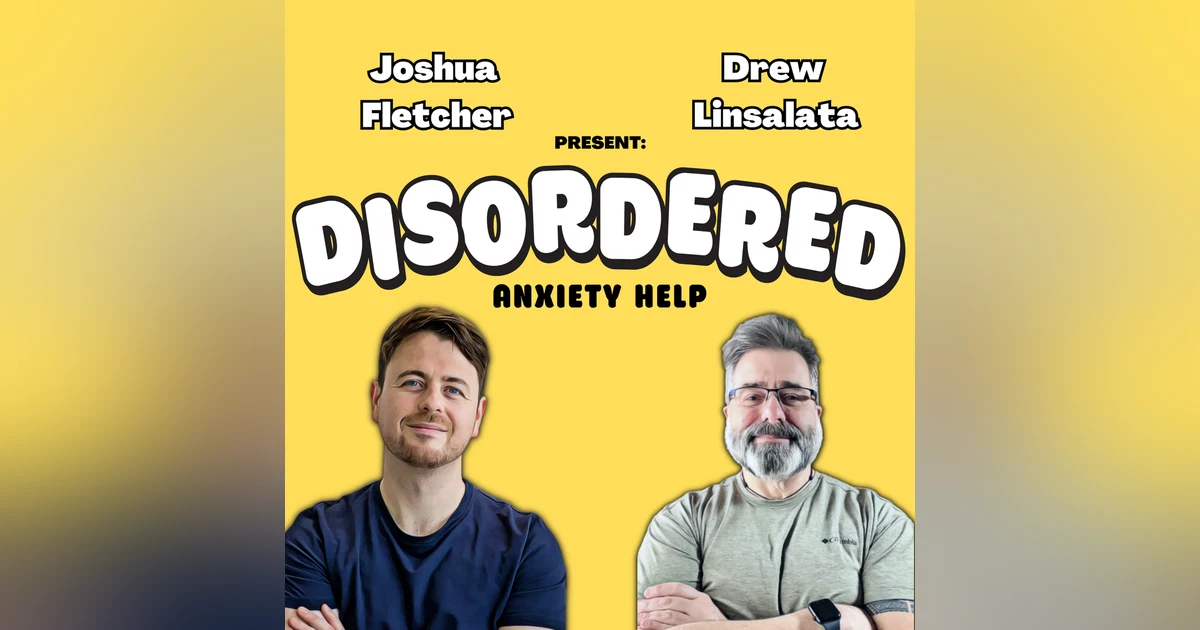
Drew and Josh take a whistle-stop tour of some of the most common forms of anxiety disorder. The guys take time to explain the difference between regular anxiety that all humans experience, and disordered anxiety which becomes a major life-impacting mental health issue.

 Apple Podcasts
 Spotify
 YouTube
 Amazon Music
 iHeartRadio
 RSS Feed
 Drew and Josh take a whistle-stop tour of some of the most common forms of anxiety disorder. The guys take time to explain the difference between regular anxiety that all humans experience, and disordered anxiety which becomes a major life-impacting mental health issue. In this episode Josh and Drew talk about:
- Panic Disorder
- Generalized Anxiety Disorder
- Agoraphobia/Monophobia
- OCD
- Health Anxiety
- Social Anxiety
This episode also answers the question, "Is it normal to be afraid when thinking about or planning anxiety recovery?"
For more on Drew, Josh, and the Disordered podcast, visit us on the web at https://disordered.fm
----
Disclaimer: Disordered is not therapy or a replacement for therapy. Listening to Disordered does not create a therapeutic relationship between you and the hosts of the podcast. Information here is provided for psychoeducational purposes. As always, when you have questions about your own well-being, please consult your mental health and/or medical care providers. If you are having a mental health crisis, always reach out immediately for in-person help.
---
Disordered Roundtable is coming! Think of it as "Disordered Live", a way for members of our audience to spend time with us in an intimate virtual setting (attendance is limited) to engage in real time sharing and discussion on specific anxiety disorder and recovery topics. To be notified when new Disordered Roundtable sessions are scheduled, sign up for our email list using the form on this page.
Panic disorder is when you view the panic attack as a thing that should never ever happen again. And it's really a disordered anxiety condition of avoidance and hypervigilance to make sure your body isn't going to do that again.
SPEAKER_00And there's a difference between checking in and monitoring yourself with your rational brain than there is compulsively and obsessively kind of looking out for the disaster because you feel like you have a premonition.
SPEAKER_01Look, if you've been pointed in that direction, then literally the first step is to turn around and point in another direction. Pointing in a new direction is scary in and of itself, and it's really hard, and it's a small step, but it counts. It counts. Welcome back to Disorder. This is podcast episode number two. I am Drew Linsolata. I am a graduate student and therapist in training here in the US, in New York specifically. And with me as always is my co-host on Disorder, Josh Fletcher in the UK. Hey Josh.
SPEAKER_00Hi everyone. I'm Josh Fletcher, also known as Anxiety Josh. I'm a qualified psychotherapist specializing in anxiety and anxiety disorders, and also a previous sufferer of several anxiety disorders. One of the questions that both Drew and I get asked quite a lot is what kind of anxiety do I have? Anxiety is a broad topic. You know, you must have heard this. And if you're someone who struggles with quite acute anxiety, it's very frustrating when someone says, Oh, I've had anxiety, you don't know what that's about. But then actually what they say doesn't resonate with you, and vice versa. Maybe your experience with anxiety doesn't resonate with them. What would have really helped me, and I don't know about what you think about this to Drew, but I'm gonna I'm gonna t take kind of an attitude and intention towards this podcast as if I was talking to my younger self, and I want to do the podcast that I wished I heard back at a time where I felt very confused about what on earth was going on with me.
SPEAKER_01Yeah, that's a big deal.
SPEAKER_00Yeah, uh so let's do that. And again, following the theme of compassion as well. Uh what kind of anxiety do you do do you have? Did you have, Drew?
SPEAKER_01Well, you know, I I think for for me, technically, I would have been, and I was never officially diagnosed, um, because I did most of this on my own, which in retrospect I wish I hadn't, but that's okay. Um, I would have been diagnosed with panic disorder with agoraphobia, and 50-50 if I had been diagnosed with OCD. I was also clinically depressed. So I had those kinds official of anxiety. Yeah. Yeah. Yeah. Yeah. But then there's the difference between that and you know, just life anxiety. I think life is gonna trigger anxiety for almost every human at some point.
SPEAKER_00Yeah. Uh what when I work with clients in my practice, um, or if I'm doing talks and things like that, I I want people to know like kind of what anxiety applies to them. Now, please don't go away and diagnose yourself. I mean, if you can if you want or whatever, but it didn't come from me. But what I will what we will do is like a whistle stop tour of kind of how each anxiety presents. The first uh thing that you should always do is for me is separate it into conventional anxiety and disordered anxiety. So conventional anxiety is any anxiety that anyone can relate to that doesn't come with any societal taboo or shock or any kind of emotionally conservative reaction to it. So this could be um well, we'll provide some examples for you now. So, Drew, I'm really nervous because I've got a first date coming up.
SPEAKER_01Yeah, that's pretty normal. Or uh I have a job interview coming up, or maybe I'm having some financial troubles. Like those would be normal times when anybody would sort of experience anxiety. It's a normal part of life, conventionally.
SPEAKER_00Yeah, yeah. And and I've got I've got a medical appointment coming up, and I'm not a bit worried about that. Uh, my boss wants to give me an appraisal. Um, I'm worried about just things on the news, wars, uh uh economics, things like that. Yeah, you know, this stuff that you know, if you told someone you worried about it, they'd be like, Yeah, I can kind of relate to that.
unknownYeah.
SPEAKER_00And know what it was like on my first ever driving test. And everyone can kind of relate to that. You can you can that's the barometer of conventional anxiety when you ask anyone who's passed their driving test and they'll tell you, you know, it was really, really nerve-wracking. And yeah, that is anxiety. That's exactly anxiety. Uh, physiologically, it's the same anxiety um as anyone else's. But the difference is you didn't fear or misinterpret your anxiety. Yeah. You know, if you sit outside a job interview, you're not really questioning why you're anxious. You kind of know, you know, you kind of know, and it's kind of helpful to an extent. Well, I'm worried I might fail my driving test. Well, make sure I'm, you know, I I go over my notes and and don't make a mistake. Or I'm worried I won't get this job promotion. Well, I'll make sure that I I rehearse what I'm gonna say and do my homework. You know, um, I'm worried about what the doctor's gonna tell me. Well, I'll make sure to ask him questions, make sure the surgeon knows everything we're doing, or whatever. These that's kind of conventional anxiety, and yeah, it's a real thing. It's uncomfortable, but it's usually fleeting and it's usually quite episodic in nature, in the sense that you'll have an episode of that anxiety and then it will pass because you're not really worried about it. Um we will kind of look at stuff like that, but mostly if you've guessed by the title of this podcast, is that we will be exploring a lot of disordered anxiety, which is uh fun bus in itself. Uh, what's disordered anxiety, Drew? How do you describe it?
SPEAKER_01Well, to me, I'll add one quick thing that might help people understand also is if we have common phrases like there were butterflies in my stomach, or I thought I was gonna hurl, or the room was spinning, or my heart was fluttering, you know, those are those are the sensations of anxiety, those are the experiences of anxiety that we all understand. We build, we build little phrases into the language that we all get to to share that experience. You felt sick with fear. Correct. I felt sick with fear. When I heard the news, I thought I was gonna pass out. Like, you know, these are common human experiences that everybody would relate to.
SPEAKER_00Took my breath away.
SPEAKER_01Yeah, yeah. We could probably focus just on those, right? Like the anxiety, yeah. But I think to me, where it went off the rails and when it becomes disordered is you stop identifying it as, oh, I'm anxious because of my driving test or my job interview, or I really like this person, and you know, he hasn't called me, or she hasn't called me yet, and I really hope that she doesn't. I'm anxious about that. You start, you you you can't pin it to an external source. And just the fact that you are anxious itself and you are thinking and you're ruminating and you're afraid of your thoughts or you're afraid of your body, it becomes the source of the problem itself. The feeling itself becomes the problem.
SPEAKER_00And when you've noticed as well, just to add to that, when you've noticed that all your effort goes into neutralizing or getting rid of fear and this and the what if thoughts that come with anxiety. Yeah, and I think that pretty much applies to every disordered anxiety kind of presentation, whether it's OCD, whether it's GAD. I don't like how this makes me feel, whether it's fear, terror, guilt, whatever, and I want to get rid of it as soon as I can. And you notice that it kind of affects your behavior. Um, of different anxious presentations. This isn't um kind of to be taken as medical fact, it's just my interpretation and Drew's interpretations, both through personal experience and anecdotal, as well as us, you know, having the pleasure of studying some of the DSM V, um, which was like pulling teeth, but very important. Um so we'll start with the first one, you know. The most common one in the UK that kind of gets diagnosed is um is generalized anxiety disorder, which I always joke about when you're going really anxious, you you kind of dump a load of problems on on the on the doctor. What if this happened to so much more? And they just go GAD. I know, I don't I don't know what to say. Maybe it's generalized anxiety. There you go. Have some searchaline, six rounds of CBT, out you get. And um that's kind of uh for me who struggled with GAD, it's it's when you have a lot of scary what if thoughts combined with a lot of I should thoughts. You find it very difficult to sit still. You're drawn to the catastrophe of multiple scenarios. You can't stop ruminating and thinking your way out of these catastrophes, but these catastrophes seem to change quite a lot. So it's like maybe it's that, maybe it's that, what if that happens? I'm really worried that that's gonna happen. What if that happens, what if and and the what ifs just seem to be continuous. What's your experiences of GAD, um, Drew, either through working with people, um working in your groups or or even yourself?
SPEAKER_01Yeah, I think um I'm not sure that I would ever qualify to be diagnosed with generalized anxiety disorder, but I agree, GAD is a thing that people think that, oh, if I'm just anxious all the time, that means I have GAD, which isn't necessarily true because people who have other forms of disordered anxiety are also anxious all the time. But the GAD people in my community uh represent very well, they're loud and clear, and GAD usually looks like I'm anxious all the time and I can't figure out why, and I can't make it go away, and but I'm focused on it all the time. And I but I but I don't have panic attacks, so I don't understand this. But I also worry, I also worry about everything. I worry about my kids, I worry about my health, I worry about money, I worry about my husband, I worry about the thing I said 16 years ago at at a birthday party. I worry about, you know, and I uh people who have gathered in my experience in a large population tend to have that that habit of going to thinking as the default way to interact with everything and then realizing that's not working out for me so well. So I should stop doing that. But I don't know how to stop thinking that, how to do that. So I'll think about how I'm thinking, and it just gets this worry about worry and thinking about thinking.
SPEAKER_00Yeah, it's a really good way of describing it. Uh defaulting to thinking about it as and when I was saying before about when we change our behavior to not feel that a lot of people ruminate and think as a compulsion because they believe that, well, you know, if I can work this out or think about it, I'll somehow become desensitized to it or or work out the solution. When actually all we're doing is giving it focus, yeah, a lot of focus, a lot of focus and teaching the brain this is scary. So, yeah, that that that's generalized anxiety. I know in the UK, you know, and I'm only going through hearing people's experiences and stuff here, but like I see a lot of people with GAD and a lot of people who misdiagnosed with GAD, and some people that kind of self-diagnose with GAD, you know, the the people that are highly anxious a lot but don't really experience panic attacks, uh, the people who hyperfixate on just anxiety being a problem and they're hell bent on trying to get rid of it, whether it's to appease a perfectionist mindset, or just, you know, I just don't ever want to feel anxiety anymore. And if I'm if I'm not, if if I'm feeling anxiety, then I'm failing in some way. And that's what Craig the Craig would say.
SPEAKER_01The only thing I will add about GAD is people, in my experience with a large population, again, people who have GAD want to fix their anxiety, but they often don't ever want to think about the underlying habits of perfectionism, people pleasing, overthinking, over planning, type A, overachiever. Those seem to be common threads for in the GAD community. And like, well, no, I I don't have to I don't have to change that. That's real. I have to be a perfectionist, but it's hard to reconcile. We'll talk about that.
SPEAKER_00Yeah, and and and GAD is again quite a vague kind of um it in my opinion. Quite quite a bit, it's a catch all, uh, but in my experience in the practice, a lot of people with GAD are very self-critical, usually have a lot of esteem issues. Um, but it can be very complex. You just don't know. Sometimes it could be various things. Um, the next one is um panic disorder, fear of fear. How would you explain that, Drew? I know you're uh a wizard at uh describing this.
SPEAKER_01That was that was my jam, man. That's how it all started for me, I think, was panic disorder. Panic disorder is it's panic, this is it's important to say panic disorder isn't that you have panic attacks, and people often confuse that. There are many, many people in the world. And I I just went over some statistics not too long ago in my stuff that have panic attacks more than once in their life and never develop panic disorder. So it's not if you have panic attacks, you don't necessarily have panic disorder. Panic disorder is when you view the panic attack as a thing that should never ever happen again because it's an indicator of some other danger or some other feared outcome or something that you are sure you won't be able to handle or will drive you into an unrecoverable state of some kind. And so you're constantly worried about the next attack, you're constantly worried about what triggers it, you're trying to figure them out, you're trying to avoid anything that might trigger panic. And it's really a disordered anxiety condition of avoidance and hyper-vigilance to make sure your body isn't going to do that again. Um again, so people have a lot of people have panic attacks on a regular basis and never get into that. Each one stands alone, they move on, they don't think about it, but people with panic sort of begin to fixate on it constantly.
SPEAKER_00Yeah. Uh, and in the last episode, you know, we spoke about you know you got anxiety when some of them actually derive from panic disorder. It's like, um, I'm having panic attacks. Um, I hate them so much, I actually fear them like I'd fear any other phobia, and my life has to change from that. So you might be experiencing lots of panic attacks a day, you might be um fearing them, confused. So a lot of my panic disorder actually was was me being confused. When someone explained to me what was happening, actually, I felt a lot better. But panic disorder is you're in a cycle. I call it, I call it the loop of fearing, loop of peaking anxiety, where you know you experience lots of intense anxiety, but fear not, because you know, high anxiety can't last forever. It's biologically impossible. It'll come down again, but then we fear it striking back up again, and so we go around and round a loop or a bit like a wave, like a wav kind of if you visualize that, it's like up and down, up and down, up, down, up, down, like a roller coaster. Um, yeah, yeah, panic disorder is that. Um, it's often and even in the DSM 5 done with uh put alongside uh agriphobia or agoraphobia, and um which is the here's the thing, uh agoraphobia is the definition is is is is quite basic and rubbish, it's a fear of open spaces. Yeah, that's not right. For disordered anxiety, and particularly for this podcast, we redefine it as the fear of not being able to cope away from my safe place. And if you're someone who struggles with monophobia, uh the fear of not being able to cope without my safe person. Very simple, the same thing, just different props. One's a house, one's a person. Uh I'm going crazy. The amount of questions I get, Drew, about or we get, uh, whether we do lives, whatever. Any tips on DPDR, derealization? Yeah. I don't feel that myself. I mean, that's probably one of the most common. I don't know about you, Drew. Oh, yeah.
SPEAKER_01Maybe at the top of the list. Any tips for DPDR? Any tips for air hunger? Any tips for cardiophobia, fear of my heart? So everybody thinks that their specific presentation needs a special tip, but that's that's where things start to run into. When you're looking for those tips, that's where you run the risk of turning panic disorder into something like agoraphobia, because now I need to keep avoiding more and more things, contexts where I might trigger that thing that I fear so much in my life gets.
SPEAKER_00And that's and they are all quite common with panic disorder, aren't they? Tips, tips for this scary symptom, skip tips for this scary symptom. Um, will I go crazy? Is it possible to go crazy from anxiety? I used to say that quite a lot. Um, and my usual answer to that is no, it's not possible to go crazy from anxiety. But obviously, your anxiety thries off doubt, so your your brain will just go, but what if I'm the exception to the rule? We'll talk about that another time. Uh, the next exhibit three, um obsessive-compulsive disorder, uh, something I'm very uh familiar with. Um, it's it's a strange one. It just when your brain becomes very sticky on a thought slash feeling. It's not just a thought, it's a feeling. It's mostly your body making you feel like a thought is more important than it is. Uh, people with OCD will often not resonate with the with the sentence thoughts are just thoughts, because some thoughts most thoughts don't evoke like an absolute carnage physiologically in your body. Um, so OCD, people with OCD like like me, you'll have a little flap in your brain, and no matter what rhyme or reason or rationality you apply to this very unlikely thought, whether it's an intrusive thought, whether it's just a feeling that you're trying to satiate, you'll spend a lot of time trying to not feel that fear um or or that guilt. Uh, OCD can be quite nasty, particularly with the with its themes. It's usually broken into themes. One of the most common themes of OCD um is health anxiety, which is actually now classed as a branch of OCD. Just because you have health anxiety doesn't mean you have OCD, but there's a huge crossover. I think everyone can relate to Googling their headache and planning their funeral immediately. But in general, no, people with OCD are like, you know, that's one of them. You could have intrusive thoughts about violent intrusive thoughts, sexual intrusive thoughts, um, socially taboo intrusive thoughts that include violence and sexual stuff, uh, religious scrup scrupulosity, um, you can have uh just catastrophe, losing control, you know, and stuff like that. Um, but yeah, that's OCD. We'll cover loads of on OCD at some point in in this audit podcast. But that's just that's another one. And you know, if you relate to that, that's okay. Um, what's the next one, shall we do, Drew?
SPEAKER_01Well, we could talk about health anxiety, although I, you know, I I would probably make the argument that when we talk about GAD health anxiety and OCD, we're god, they're they're very, very similar. They look very similar, but uh health anxiety is what happens when people get really fixated on their health. And so I could see where we get glued together with OCD. I'm obsessed about my health. Uh now, you know, if you have a real health issue, then of course you're going to have pay attention to that naturally. That would be normal. But people with health anxiety that I see often either have a health condition that they then magnify out of proportion, or they have no health condition and they're just concerned that they might develop a health condition, or they might have one that's undiagnosed, or a loved one has a health condition that isn't diagnosed. Or I've even seen people attach health anxiety to their pets, and they become completely involved in a cycle of checking and checking and rechecking to make sure that that isn't true, or trying to get insurance.
SPEAKER_00Checking, researching in in air quotes. Yeah, that's so true. Um, and yeah, it it's now been moved as a branch of OCD because it's obsessive and it's and the compulsions are checking, she's seeking reassurance, etc. These are the people that go to the doctor, and in America you spend a lot, you know, you you have to pay for a lot. Um, but these are the people that you know end up at the doctor a lot, even though they've been given a clean bill of health. You know, it's that they they try to chase that 100% reassurance that this is going to be okay. Um, again, a bit similar to GAD, there's usually a backstory with health anxiety. It's usually, I found it's usually a mixture of kind of esteem. Maybe there has been a bit of grief there and trauma. It was for me particularly. Um, but yeah, I mean, we'll we'll we'll cover that at some point as well. Yeah.
SPEAKER_01Um in the show. I find health anxiety, I don't know your thoughts on this, but I almost find it to be the most frustrating one to speak not about, but with. When you interact with somebody with health anxiety, you know, that OCD thing where a person has a varying level. Of insight as the yes, I understand this is irrational, even or but for a person with health anxiety, that is very stubborn because often a person with health anxiety, when you begin to uncover the irrationality, will argue with it. No, no, no. It's my health. I have to advocate for my health, it's the most important thing there is. So health anxiety is particularly nasty when it comes to justifying itself.
SPEAKER_00Oh, yeah, and it will. I've heard all that. You know, I've I mean, I lost my brother when he was very young, and my father when he was very young, uh, and my grandfather. So the men in my family don't do that well. And so it's like health anxiety will use that, goes, Well, you know, you keep you gotta keep an eye on yourself because you know you you could die. But at the same time, like their early death was nothing to do with they didn't fail to not check in with themselves. Right. You know, it just it just happened, like there's nothing to them checking in with themselves had nothing to do with that. It was just unfortunate, you know, and um, and there's a difference between checking in and monitoring yourself uh with your rational brain, then there is compulsively um and obsessively kind of looking out for the disaster because you feel like you have a premonition. You know, people with a health anxiety feel they've got a premonition that's like awful's gonna happen, or just in case this this has I let me check it just in case this happens, you know. And uh, but that but that's that's a lot different to say I've got a history of high blood pressure, and actually I'm gonna check in with a doctor every month or two just to see, you know, because yeah, that's fine, you know. Or if you've more importantly, if you've got a chronic condition, like tricky questions like, well, actually, I I have diabetes or Addison's disease, or I've got um Crohn's or something that requires me to check in. Yeah, that's fine, that's not compulsion. No, but um it it goes down to one of my golden rules that we'll kind of talk about somebody, which is you know, do what non-anxious you would do. Non-anxious you would would check in just because your rational brain would as well. Yeah. Um another one is uh and it's a it's a it's a quite a big, kind of complex, gray area topic, but um PTSD. So post-traumatic stress disorder, these are people who have been through a traumatic episode and the brain hasn't quite processed the thoughts and the experiences and the stimulus around it. Uh, won't get too drawn into it, but in general, if you've got PTSD, it's you usually struggle with flashbacks. You have intense anxious triggers when you have a reminder through your senses. So it could be you've seen someone that reminds you of a traumatic time, maybe you've smelt something like that reminded you of a really traumatic time. Uh, maybe someone's tone of voice inflection makes you feel more kind of on alert than it than it should. Uh, maybe you have yeah, you have dreams, uh night terrorism, these certain things. Um this is interesting, though. The the the vast majority of people who go through something traumatic do not get PTSD. Yeah, um, it's just sometimes the brain, nothing to do with weakness. If you struggle with PTSD, it's not not your fault. You wouldn't say that to a soldier who's just seen, you know, his fellow soldier be harmed. You wouldn't say that that person was weak. It's nothing to do with that. It's just sometimes experiences and memories get shoved so quickly into the hippocampus in your brain that some just get forget to be filed away. So it feels like it's happening now, and that's a lot with PTSD. Then you've got complex PTSD, which is you know, around less intense feelings, but still around kind of prolonged lower level trauma, um, particularly growing up, developmental trauma and stuff like that. You know, maybe if you've got a very volatile, non-predictable household or parent or been in an abusive relationship, etc. Again, this is a whistle stop tour, but you know, we we will be doing episodes on this and stuff. Uh, we'll also look at the definitions of trauma as well. There's a big, massive uh multi-million pound kind of industry around the word trauma, what it means. Um, we'll never ever tell you what you can't define as trauma or personal trauma, but we will inform you that people do, we feel, I feel anyway, uh, play on it how vague it is in order to promote stuff, you know, promote stuff, you know. And um, you know, there's very famous books out there that actually don't help a lot of people with disordered anxiety. Personally didn't help me, made me very ill. You know, telling me there was uh trauma trapped in my body made me feel like I was possessed in some way, or I was ill and I needed to banish um my demons, you know, or exercise my hidden trauma or whatever. And actually, I was really happy, I was just a bit stressed once, you know, but story for story for another time. There's quite a lot of people. We'll talk about talk about these things in more detail down the road for sure.
SPEAKER_01Yeah, and uh Drew, how would you describe depression? Uh depression, I've lived it. Depression is an interesting thing in the community because so many people fear depression. And uh, you know, I know your other podcast, The Panic Pod, you did a really good episode on that, fear depression. And we'll talk about that here. But depression to me is I mean, you know, the clinical definition is that persistent low mood, lack of interest, lack of motivation, low energy, disengagement socially in your relationships. Depression to me was like the meaning was flushed out of the world. The meaning, the color, everything has a meaning, everything has a context you don't realize until it's gone. So depression for me wasn't sad. And I think a lot of people worry because if I'm sad, does that mean I'm getting depressed? Depression is not sadness. Depression is a loss of connection, it's a loss of meaning in almost anything. And it's really it's a difficult place to be. Um, and it's very common. People, many people in the world do go through periods of depression. It's one of the most common mental health conditions in the world. Um, you know, a lot of people will experience it maybe at least once in their life, but uh to varying degrees. But that's depression in my personal experience. It wasn't had nothing to do with a low mood or being sad, nothing at all.
SPEAKER_00No, I I hear that quite a lot. It's when I feel nothing. Yeah, you know, um, or if you are, you can feel stuff you can feel very if depression is when you feel very teary. What's the point? Craig the critic is screaming at you. Yeah. You know, you're what's the point in you, you're a burden on people. That's for very serious depression. What's the point? A very nihilistic point of view sometimes. Now don't get me wrong, you can be a nihilist and be happy. I know people that do that, but uh, but in general, yeah, depression can be with that, and it comes with its physical symptoms, um, fatigue, appetite, low mood, etc. Uh, and it can coincide. Also, in in importantly, Drew pointed out, you know, a lot of anxious people fear depression because what they fear is, what if this gets too much and I can't cope? And I mentioned that in episode one. That's the staple of most anxiety. So when they hear depression, a lot of anxious people will say, Well, what if I get so depressed that I can't cope and I and I go and harm myself or end myself? As well, if you're worried about that happening, it's probably not gonna happen. You know, uh uh, you know, and and depression can come with things like suicidal ideations and suicidal fantasies. Um, again, they're not actually major red flags. Don't get me wrong, they're they're red flags, but not major red flags. As a therapist, I'm not gonna run out of the room because that's things, but then you've got um like uh suicidal kind of plans and suicidal intentions. That's it. And that's when the majority of people that listen to this podcast are like to think that you're not in that place, but if you are in that place, just know that it's okay and that you should go and speak to someone, uh let your let your doctor know, let someone know that you love. Um, but yeah, um, also on the other side, people with anxiety might be like, oh my god, what if I get to that point or whatever? But in general, I found in my experience no, people with anxiety are more fixated on the concept and the fear of that happening, right, as opposed to actually feeling that. Can anxiety and depression coexist? Of course they can. Um, or if you're like my lecturer during my master's, she actually said to me, You can't have anxiety without depression. I was like, Wow, I'm learning this at master's level. I was like, that's just not true. But um, but yeah, that there's just another one that we'll talk about and stuff.
SPEAKER_01Um, for sure. I think uh the other the only thing I'll throw out about depression is I know for anxious people, you will immediately go to the worst possible case. What if I do develop a clinically diagnosable depression and it gets too much and it ends in the worst possible outcome, which is I take my own life? And while certainly that is a concern with depression, it's not automatic. And I think just recognizing your brain is twisting things and telling you stories where you will automatically wind up that way. And that's not the way that works at all.
SPEAKER_00And anxiety will always show you the worst case scenario. That's what the threat response is designed for. Uh, maybe we can talk about the threat response in an upcoming episode. I think it's very important, Tree. But like, yeah, it will take that, and the threat response will show you the worst case scenario. Yeah, you know, if if I, you know, if for ancestors running past a pride of lions, it's gonna show us images of us being torn to shreds by Simber and his and his lad mates. But um the same applies with, well, what if that lion eats me? What if I get depressed? So then you'll have all these images, conventional images of you, you know, alone in a dark room and and and with nowhere to go, whatever. And of course, yeah, you know, people do get depressed, but generally, people with anxiety disorders and fear of fear, in my experience, and I know in in Drew's experience, um, it's very rare for that to happen. So just just kind of um rest assured there. Um, yeah.
SPEAKER_01So one more one more quick stop for the social anxiety people before we oh yeah.
SPEAKER_00Social anxiety, of course.
SPEAKER_01A quick whistle stop tour of the usual anxiety forms of disorder anxiety would be social anxiety.
SPEAKER_00Social anxiety, yeah.
unknownYeah.
SPEAKER_01The more I get into social anxiety, the more fascinating it became to me because most people look at social anxiety as, oh, I get anxious in social situations. Oh, that's because you're afraid people are looking at you or judging you, which is true. Those are generally the triggers, you know. But uh what I've learned a lot about social anxiety over the past couple of years is it isn't so much don't judge me as it is don't see me, because I don't like to see me. So many, many people who deal with social anxiety get very anxious in situations where they are exposed, where they have to interact with other people, where they may be seen, opinions may be formed about them. Uh, and most people will try to approach social anxiety and tell that person who's suffering, like, well, who cares what they think about you? And that's true, that there's a point there. But uh more so it's well, what do you think about you? It seems to be underneath a lot of social anxiety. Yeah, yeah. What does it mean?
SPEAKER_00I'd agree. Yeah, I'd agree. And uh, but also it depends. We mentioned that anxiety is a threat response. I've seen social anxiety have a different kind of origins. So for some people, social anxiety might be because they're in an abusive relationship and they don't want to feel that threat from maybe say a loud person who makes them feel unsafe. Maybe I've seen social anxiety overlap with uh PTSD and and and complex PTSD in a sense that you know I my only experience of interacting with people who're supposed to love me and supposed to accept me has been nothing but volatility, nothing volatility and cruelness, but then sometimes kindness and or whatever. And when I've been conditioned to find that people aren't stable, they're not trustworthy, there's no predictability and safety in working with people, I can't be bothered meeting new people. And if I have to, if I have to do that at work and stuff like that, it's very exhausting for me to do that. And so social anxiety can be that too. It just depends. Also, some people could just be shy, and that's totally okay. Like, there's nothing wrong with if you're shy, you you don't need to be that really obnoxious ass in the middle of the room, you know, spewing his NLP stuff, you know, just because you can't no, that that's okay. You can just be shy, and I say to people in here, like, if you're shy, that's not a problem. But social anxiety is when you totally avoid or you're consumed by this fear of yeah, either kind of being seen or whatever. And things like imposter syndrome go under that as well. Fear of being seen, fear of being found up, yeah, yeah, and stuff like that.
SPEAKER_01But I I'd like to make a uh a note 36 minute mark of the episode two, the first shots are fired at the NLP guys.
SPEAKER_00So yeah, first shots fired at NLP. First shots fired 36 minutes into episode two. Um yeah, I I like and I'm not I'm not dissing neurolinguistic programming. I'm just saying some people misuse it. Yeah. We'll talk about those things.
SPEAKER_01Uh uh have we got some celebrations to throw in at the end of this? Oh well, you know, I we the did did it anyways. We don't have any did it anyways for this one, but we do want to do a regular thing where people can ask us questions and we'll answer them at the end of every episode. So we'll do we'll share wins and did it anyways and we'll answer questions. So stick around for the end of every episode. Um, today we can you want to answer a question? We have tons of them. Yeah, we'll take one. We'll take one and then we'll as our time management gets better, we'll we'll be able to and I promise we will give you a way to ask these questions. This is a question that was in my Facebook group, and we're gonna answer it. So we'll we'll answer that one. So this was asked. Is it normal to this is somebody who's looking at uh recovery from panic disorder on, I believe, agoraphobia, uh, working on like filling out their fear ladder and their exposure plan. Is it normal to fear and avoid filling out the fear ladder and the exposure planner? I noticed this resistance and fear to write it down and to make my goal specific.
SPEAKER_00That's a great question. I think we can both answer that. Uh, for anyone who doesn't know what a fear ladder is or an exposure planner, uh it's um it's a tools used in cognitive behavioral therapy where they believe that the more you kind of expose yourself to a fear, a fear that you know is, you know, yeah, pretty much safe, uh, that you know is quite irrational. Um, if you build yourself up to that, you challenge the amygdala, you challenge the threat response and the brain rewires itself. But to do that, sometimes you fill out a fear ladder. So rather than going straight towards your biggest fear, you you build it up a little bit at a time. I remember mine, it was like uh go outside to the park, um, drink a coffee, you know, all these things that were that were scary. Um, is it normal to fear even filling that ladder out? Yeah, damn right. Of course it is. Of course it is. As soon as you put pen to paper, you're doing a really good job. And don't listen to Craig the critic, because they were like, Oh, look at you, you used to be able to fly on holiday, and now you can't even, you know, take your kids to the park. Tell them to shut up. You've got this. And if your pen is on that paper, well done. Yeah, that's easy.
SPEAKER_01Yeah, that's a first step. It counts. And to me, I always tell people, you know, look, if you've been pointed in this direction, which is the wrong, you know, air quotes the wrong direction, it hasn't really been helping you. The first step is to literally turn in a different direction, and sometimes writing that down and specifically say, I will commit to walking around my neighborhood for five minutes tomorrow. That's really scary. And you're right, Craig the Critic, you know, he's all over the place, and he will chime in. It's Craig the Critic. And he's gonna tell you you're failing because you're afraid, you can't even fill out the plan, you can't commit to exposure. It's not cool, but uh it's that's supposed to happen. Just turning in the right direction is scary by itself, but it counts.
SPEAKER_00But if we if we've got any listeners called Craig, like there's nothing personal towards you, if anything, message we're completely destroying the Craig demographic. Actually, no, it applies more to you because if you're struggling with an inner critic or Craig, it's almost like, oh, oh my gosh. Yeah, no, no. Uh, we'll answer more of those questions and share some success stories as well. Because this is what we're about here is going to be sharing the the steps. And what a great first question about the exposure ladder. Because no matter where you are on your journey, sorry to use the word journey, but I'll stay with it. Wherever you are on your journey, uh thanks, Drew. Um, then um, yeah, we want to celebrate that because you know we know what it's like. But yeah, without a doubt. Thank you for thank you for tuning in today.
SPEAKER_01And uh we can't wait to catch you next time. See you next time. Come back. We'll probably have a little audio thing at the end of this too that tells you how to leave us messages and ask questions. So stay tuned for that. Yeah, uh yeah. We'll figure that out. All right, see you guys next time. Hey, it's Drew. Thanks for joining us for this episode of Disordered. Josh and I both hope that you're finding it helpful in some way. For more information about Josh or me or the Disordered Podcast, find us on the web at disordered.fm. That's disordered.fm. Hop on over and find links to our social media platforms, join our mailing list so we can let you know when new podcast episodes are available, and we'll send you easy ways to ask us questions and share your wins so we can answer questions on the air and share your successes with the community. And if you're listening to the podcast on Apple Podcasts or Spotify or any platform that lets you rate a review, do us a favor and leave us a five-star rating and maybe write a review if you're digging disordered. It really helps us out and we appreciate that. Thanks again for coming by, and we'll see you in the next episode.