
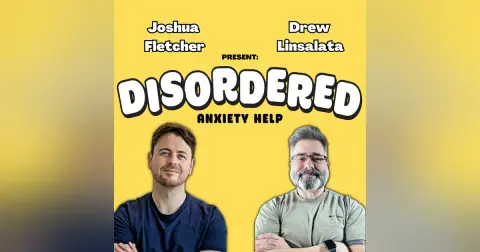
Sleep Anxiety. I'm Anxious About My Sleep!!!! (Episode 028)

 Apple Podcasts
 Spotify
 YouTube
 Amazon Music
 iHeartRadio
 RSS Feed
 I'm having problems with my sleep and I'm super anxious about it. HELP!
Anxiety focused on sleep and sleep problems is one of the most common complaints in the Disordered community. Often, anxious people experience sleep disturbances or even periods of insomnia and wind up extremely anxious and afraid over this issue. Lack of sleep gets attached to fears about being even more anxious, never being able to recover, not being strong enough to resist anxious thoughts, or doing some actual physical or mental damage.
This week on Disordered, Josh and Drew explore sleep and sleep-focused anxiety to ease some common misconceptions about sleep anxiety. The guys examine the usual suspects (resistance, avoidance, and compulsive problem-solving) as keys when approaching sleep-related anxiety.
----
If you love Disordered and think you might benefit from spending 30 full days in an everyday intensive small group recovery support group led by Josh and Drew, check out Disordered Boost at https://disordered.fm/boost
-----
Want to ask us questions, share your wins, or get more information about Josh, Drew, and the Disordered podcast?
Visit us on the web at https://disordered.fm
Disclaimer: Disordered is not therapy or a replacement for therapy. Listening to Disordered does not create a therapeutic relationship between you and the hosts of the podcast. Information here is provided for psychoeducational purposes. As always, when you have questions about your own well-being, please consult your mental health and/or medical care providers. If you are having a mental health crisis, always reach out immediately for in-person help.
---
Disordered Roundtable is coming! Think of it as "Disordered Live", a way for members of our audience to spend time with us in an intimate virtual setting (attendance is limited) to engage in real time sharing and discussion on specific anxiety disorder and recovery topics. To be notified when new Disordered Roundtable sessions are scheduled, sign up for our email list using the form on this page.
If you're worried about not getting sleep, you know, you've created a catch-22 there because then you're gonna feel stressed and you know you're less likely to fall asleep straight away.
SPEAKER_04If I don't get enough or proper sleep, then I will never ever be able to recover because it's a critical required component of healing. Or conversely, if I don't get enough sleep, I'm damaging my body. Didn't you read the book about how sleep deprivation causes everything from your carburning oil to cancer?
SPEAKER_01I'm anxious because I'm not getting enough sleep. I mean, yeah, it'll contribute to your stress levels, but when you have the attitude that, oh, right, well, there's my quick fix. Fix my sleep, never feel anxious again. You're still signaling to the brain, look, I'm I'm afraid of anxiety and I'm willing to do anything but face it to get rid of it. Welcome to episode 28 of Disordered. My name is Joshua Fletcher, and I'm a psychotherapist specializing in anxiety disorders, and I'm based in the UK.
SPEAKER_04And I am Drew Linzellata. I am a graduate student in clinical mental health counseling, a therapist in training, a former sufferer, anxious person, depressed person for many, many years, and co-host of this fine podcast based in New York in the US of A.
SPEAKER_01In today's episode, we're going to look at the topic of sleep anxiety. It's something that I hear a lot from people. It's something I've experienced personally. Um, Drew, did you ever worry about sleep, fixate on sleep, see it as the as oh, if I fix my sleep, it's the cure for everything.
SPEAKER_04Well, I was, I mean, I had some serious sleep problems. Those of you who listen to the podcast for a while know I don't sleep much anyway, but um, I'm doing better at it, by the way, lately. I'm improving that habit. But um I I would sleep for 20 minutes at a time, an hour at a time, maybe, wake up, try to go to bed at 12:30, 1 o'clock in the morning, sleep a grand total of an hour and a half, broken up, up again at four, couldn't go back to sleep. I had horrible sleep disturbance when I was, you know, in the midst of anxiety. And I it would the thing that I had a problem with was I would always interpret it as now I'm gonna be really tired, which I was. I was dragging all the time, which means now I'm gonna be even more anxious. I didn't, I was so afraid of that feeling of of being so tired. It felt really fragile to me that that would amp up, you know, I would get anxious about that. So that was my big issue with sleep anxiety.
SPEAKER_01Yeah, I'm I I used to get pulled into a lot of that. Uh, I'll explain a bit more about the most common things I hear associated with sleep anxiety. But uh, first of all, again, we like to celebrate the community wins. There's a little theme, just some did it anyways this morning. We're just gonna play two short ones. The theme is going back to work. Let's do it. Let's see what you think about these. There we go.
SPEAKER_06Hey Josh, hey Drew. Um, love the podcast. Thank you so much for sharing everything. Um, my small win for today was that I was recently signed off work with stress and anxiety. Um, been off work for about six weeks and have gradually gone back. But today was my first day back in the office in person um with an hour, an hour and 15 commute. Spent the day feeling a bit peculiar, detached, but I did it. And now I'm home. I'm feeling accomplished.
SPEAKER_04Love it. Applause from the studio audience.
SPEAKER_03I like that so much. I want to hear another back-to-work story. Should we do another back to work story? Let's do it. Let's do a really quick one.
SPEAKER_05Hello, Drew and Josh. Um, thank you so much for your amazing podcast. Honestly, it has uh helped see me through since I um was hospitalized for um generalized anxiety disorder and all other kind of manner of fun things. Um, my did it anyway this week is that I have been on uh long-term sick from work for nine months. Um, and I did my first full day back in work yesterday. Um, anxiety was peak. Um, I kind of even considered leaving a couple of times. I really had to do some breathing, um kind of sit-through meetings and things like that, and uh my workplace hasn't been very supportive of my returning either, so it didn't feel like a great atmosphere to come back to, but I did it anyway. Um at this moment I am planning to go back in on Monday. That may change. Um, but it was honestly, it it it was really difficult, but I did it anyway, and I didn't realise I was supposed to be proud of that. I thought I'd failed because I was anxious at work, um, and then actually chatting it through with my kind of family and friends. They were like, no, that's a big achievement, so share it. Thank you so much for your support, guys.
SPEAKER_04Oh, that's another really great one. More applause.
SPEAKER_01That's brilliant. Well done to both of you, and um yeah, I I echo your your family sentiment that you should be very proud of doing that. Um I mean, especially facing fear, doing lots of these things, spending so much time away from it. It must have been felt very challenging. And and yeah, you should be proud of yourself. We're proud of you. Um, well done to both of you. That's absolutely brilliant.
SPEAKER_04Yeah, I love it. I love how uh she caught that. Like, oh, I thought I failed because I was anxious, and then realized, wait a minute, I did it while I was anxious. I'm proud of that.
SPEAKER_01Oh, yeah. We want to know what you can do whilst you're anxious. That's the that's the whole point. No doubt about it. Sleep anxiety. Okay, um how many I hear this a lot. I've got I'm doing well with my anxiety, but I just fixate on my sleep. Um, this can usually blend with again perfectionism or wellness perfectionism or just avoidance or even passive avoidance. If I get my six to eight hours or even ten hours a night, I'll feel good, I'll feel optimum, I'll do all these things. But also if I don't get that, then I risk maybe being anxious the day after. Um, and that's something I hear a lot. But obviously, if you're worried about not getting sleep, you know, you've created a catch-22 there because oh, then you're gonna feel stressed, and you know, you're less likely to fall asleep straight away. There are some people out there with OCD tendencies that hyperfixate on sleep to the point where the whole day becomes worrying about getting sleep that night. Um, and then that can tie into fears of, you know, what if I lose control? What if this gets to the point where you know I can't cope, even though they've always coped with everything and they're fine, they're just tired. Yep, you know, it becomes a thing. You know, they start to imagine themselves, you know, two years down the line, they've they've still not slept, you know, their eyes are bleeding, they're rocking back and forth in the corner. Yeah, I mean, that doesn't happen. Um, but you know, it's it's um it's something that I hear. So there's arranging levels of sleep anxiety. I would like to address some misbeliefs and misconceptions around it, um, and ultimately convey the message that guess what? Sleep ain't as important as you think.
SPEAKER_04Yeah, I think that's a big one. I could one of the things I hear is if I don't sleep enough or properly, there's also fixation on proper sleep. You know, there's the quantity of sleep and also proper sleep, the uh, which I'm not sure that I understand the amount of deep sleep, REM sleep, people get fixated on like, did I have enough REM sleep? Did I have enough restorative sleep? Yeah, they get really stuck in that. Because if I don't get enough or proper sleep, then I will never ever be able to recover because it's a critical required component of healing. Or conversely, if I don't get enough sleep, then I will damage, I'm damaging my body. Didn't you read the book about how sleep deprivation causes everything from your car burning oil to cancer? And they get fixated on that. So that's tough.
SPEAKER_01It's really interesting as well, because every year, around the same time, the same sensationalized headlines, lack of sleep is linked to early death and all this kind of stuff. And yet, actually, if you dig deep, yeah, there is no empirical direct evidence to suggest that. It's just it's been linked. Yeah. Oh, it's been linked. Oh, like tenuously linked. But I'm yet to see a paper that says, Oh, yeah, me getting three hours sleep a night makes me more susceptible to dying than someone who's getting seven hours of sleep a night.
SPEAKER_04There was a there's well, we should probably talk about that. I mean, if you want, well, what the hell? I mean, it's a public discussion anyway. This is nothing new, but there's a really popular book called Why We Sleep. You ever have people quote that book at you? Yeah, yeah. And that book was written by a guy who's legitimate credentialed scientist with lots of respect in his field, but he went way beyond and overboard on the claims and the things he said in that book. And sell books. To sell books, absolutely sensationalized. In fact, at one point he said, the World Health Organization has said that, you know, sleep deprivation is a cause of cancer worldwide. And the World Health Organization had to come out and say, um, excuse us, when did we say that? And he just sort of quietly made an apology and retracted a bunch of stuff in his personal blog on like blogspace.com that no one's reading. No one's reading. And of course he made all he was on all the podcasts, he's been on all the podcasts. I'm sure he's been on with Huberman and Rogan and as if and it became this sensationalistic like sleep is will kill you if you don't sleep enough. And so many other researchers were like, wait a minute, hang on, we don't we've never said that. And even his university kind of was like, yeah, he might have gone a little overboard, but I know the university probably made money on that book too, because he works there and wrote it while he worked there, and they usually take a piece of that. So I'm not accusing anybody of malfeasance, but maybe I am, I don't know.
SPEAKER_01Well, we like to look after our community, and it's very important to to to know that you know just because you see something and it's popular doesn't mean it's true, and that doesn't just apply to that book. There's uh many other very things floating around in the popular sphere that enrage me, but I won't go down that uh down that route now. Uh but this is one of them. Um I I remember I I didn't sleep for like a year. Yeah, you know, I dozed a bit, I led down, I read, and I you know, and I was all right. I was just tired. I think my body just adapted to not sleeping. You know, don't get me wrong, my mood probably wasn't great, but I remember in the midst of panic disorder, agrophobia, and OCD, I just have loads of sleepless nights. I did have the fixation on the sleep thing then. I'd go out, I'd get all the lavender oils and all that, and the breathing and the downloading rain sounds and all these things. Uh trying to force sleep, but if you try to force sleep, you you ain't gonna get anywhere. Um I only started to begin to sleep again when I said to myself, I don't care if I'm up all night. Yeah, and then as soon as you take away the resistance, it changed, right? Yeah, yeah, yeah. I'm open to the fact that I I can survive whether I sleep or not. So, and immediately that's the that's the resistance because people with sleep anxiety often have a fear of not sleeping, and what we propagate on this podcast is go towards your fear, right? So, when in the past when I've worked with clients, they're like, um, you know, what's my homework? And I'm like, Okay, what do you fear? Not sleeping. I was like, Brilliant. Your first homework is to stay up all night. It's like what? Yeah, okay. I came here to to get better sleep. He's like, that will come, but you need to realize what your fear is, not sleeping. And guess what? You're gonna function the next day, you're gonna be okay. Are you gonna be optimum?
SPEAKER_04No, I think that's part of it. I mean, we don't wanna listen. I get that. I didn't sleep for a year. I I relate to that. That was a long road of not getting a lot of sleep, but and I felt like crap. There's no doubt about that. I let's not invalidate that experience. But I wasn't optimal, but I was still functional. Not at the way I would have hoped to be, but it didn't kill me. And it didn't. This is not to say that you don't feel badly. You do. That's okay. You do feel badly. Tired is no fun, but it it really was that. I remember just throwing my hands up. Honestly, for me, I think I might have told the story. There was a woman who pulled up next to me in the parking lot. I was out doing my driving exposures, no more than 30 seconds from my house in this little dairy shop around the corner from me. And I'm sitting in the parking lot shaking because I know I have to drive further. And this woman got out of the car next to me. She looked exhausted. She's absolutely she was walking in to buy whatever she was buying on her way to work, probably had to bring the milk in for coffee or something. Oh, I've told the story. And I'm like, okay, she feels as bad as I do right now. She's just not afraid of that. That was such an eye-opener for me. Yeah. And that was the time that I started to drop the resistance. Like, look, I guess I guess I'm gonna sleep when I sleep. I just couldn't fight it anymore. And it made a difference, huge difference.
SPEAKER_01So yeah, I I remember, yeah, what helped me was that for my insomnia, um, was that I put on an episode of The Anxious Truth, and by the fourth word in, I've fallen asleep.
SPEAKER_04100% out. Oh, is that guy again droning away? That is so funny because over the years I've done that podcast, I have one the most common comment I get from people is I listen to you when I go to sleep, or I sleep with you every night, and I'm like, is that good? Why do I feel like I'm putting you to sleep?
SPEAKER_02Anyway, it's fine.
SPEAKER_01Rest. It's just, and this is someone someone told me this. I think it was yeah, it was my therapist at the time many years ago. He says, as long as you're simulating sleep and rest and allowing your body to be in first gear, that can be helpful too. Sure. You know, like okay, I maybe I didn't sleep tonight, but I rested. You know, allowed my body to physically rest, you know. Maybe I dozed off and had 10 minutes now and then. Maybe it was scattered. When Drew said before about, and this is very similar to people who you know obsess with their heart rate, stuff like that. Fitness watches are great, particularly for the you know, the neurotypical, the non-disordered anxious, but it they can be quite counterproductive here. So, you know, if you're anxious and you're fixating on your watch and you're dropping O2 levels and heart rates and REM sleep and deep sleep and not just take the watch off and delete that out for now. You know, to come back to that later. It doesn't matter. Yeah, it's just fuel because your anxious brain just wants to find the anomaly and what's wrong, it's not interested in the stats.
SPEAKER_04I I'm using a sleep I I mentioned before, like I'm trying to improve my sleep habits. So I do use an app now called Auto Sleep, pairs with my Apple Watch, and it's so useful because I can see oh, if I don't eat so much, you know, if I if I stop eating two hours worth, I do sleep better. Okay, cool, I can do that. In the state I was in, I would have never ever been able to use this app because all I would have saw saw was like I only got 14 minutes of deep sleep. Oh no, I would have never ever been able to use this app. So you gotta get rid of they're not helping you to sleep any better, they're making it worse. Yeah, yeah, you can use it one day, one day you can come back to it, not now.
SPEAKER_01Yeah, no, not while you're in the loop and the and the when it becomes a point of fixation, uh you're fixating on it. Have you found Drew as well, uh people yeah, start to use it a bit like other things, like well, if I can perfect sleep, anxiety will disappear.
SPEAKER_04Yeah, I've heard people say to me that they are convinced that the the only problem they have is this sleep problem. If they could, if they could just figure out a way to fix their sleep, they would get better. And I mean, I I can't say that isn't true because I don't know the person individually, but uh some people do get stuck in that. This is it, I know this is it, and they put so much emphasis on it.
SPEAKER_01I'm anxious because I'm not getting enough sleep. Yep. Um I mean, yeah, it will contribute to your stress levels, sure. But when you have the the attitude that, oh, right, well, there's my quick fix, fix my sleep, never feel anxious again. You're still signaling to the brain, look, I'm I'm afraid of anxiety and I'm willing to do anything but face it to get rid of it. Yeah. Um I remember what what's your go-to to go to sleep? I remember when I used to listen to David Attenborough. I used to have an Attenborough documentary on or something, or even uh a podcast. Oh, that would send me to sleep. Well, he does have that voice though. Oh, he does. Yeah, this one, yeah, this one.
SPEAKER_02No attitudes have changed.
SPEAKER_01And what Attenborough was referring to there directly was that my attitude towards sleep has changed. It's not about, oh, you know, I will feel amazing and never experience anxiety again if I get my eight hours solid. You know, wait, wake up, what is it? Wake up at the peak of my circadian psych. Whatever, man. Just just I'll sleep, I'll wake up. You know, 10 minutes later after a coffee, I'll be all right. Yeah. So what you're saying is that Sir David Attenborough was your sleep coach.
SPEAKER_04Cool. I'm not saying that for legal purposes. I'm kidding. But everybody's gonna be reaching out. Your imagination is running away with you. He was right. You know, he was right. It's true. I think um, you know, that whole like, oh, the circadian rhythms also, like, oh, if I you know, people get stuck on that, or their cortisol levels. Oh, people get stuck on and then they try to find right. Oh, so cortisol is the waking hormone, and it's higher in the morning, so they will go through great lengths to try to somehow manage their cortisol levels. They'll buy supplements and and change their diet in extreme ways. Hopefully, that they think they're gonna lower their cortisol levels so they'll sleep more, and that becomes a fruitless search, too.
SPEAKER_02It's not pleasant at all.
SPEAKER_01Well, I'll stop with these. I can't promise. I can't promise. I'll stop with these. There'll be more. I want to hear more. Um, this is not pleasant at all. He's describing our podcast. Yeah. Uh yeah, fixing on that and stuff. Um really difficult. For me, the the the big one I hear about is it's just the fear of not sleeping. Yeah. Yeah. What if I never sleep again? Do you ever hear that?
SPEAKER_04Yes. What if I never sleep again? And I've I've heard that taken to the extreme. What if I never sleep again and I'm dead in three weeks? Because you know, sleep, you'll kill you. I'm done. Yeah. Yeah.
SPEAKER_01People who have the loss of control. What if I never sleep again, become delirious, go crazy, lose control, do something stupid.
SPEAKER_04Oh, that's a good one too, because people that gets particularly insidious because if you're dealing with maybe some OCD or you're having those disturbing thoughts that keep recurring, and for those C did oh my god, I am gonna go crazy. Exactly. The next step. And you think you're keeping them at bay somehow, like you're keeping them from coming true, or keeping actively preventing yourself from acting on what you think is an impulse. Not sleeping, sometimes for those people will equate to I won't have the strength to resist this scary thought, and I will that do this horrible thing. Yeah, yeah. And that's that's not a thing.
SPEAKER_01That's I'm not crazy now, and I don't want to go crazy. Yep, but if I never sleep again, then maybe I'll go crazy.
SPEAKER_04I will have a break, I will have a psychotic.
SPEAKER_01Yeah, I've never I've personally never seen or experienced that. Um because I I just don't think the brain works for that. But yeah, also if you're worried about stuff like that, then it's not gonna happen. Right because you're worried about it. Yeah, you're worried about it.
SPEAKER_04You're so aware of it that yeah, that's that's a thing. Uh people also get really stuck on the whole, you know, if I the the the I it will make me go insane is definitely a thing, and all kinds of feared outcomes. I had that one as well. That's it.
SPEAKER_01That it would make ill monitor insanity. Yeah, you yeah, it used to be a theme fixation where if sleep was one of them, or it would be like maybe we could even just do that. A fear of going crazy could be is a really good episode to that where it's like, yeah, um, I think it's called uh Dementophobia, isn't it? There's a there's a there's a fear of that psychotic, yeah. Uh but not only that, but I'd monitor my moods. I'd be like, Oh, why am I suddenly in a good mood at 10 p.m. before I go to sleep? Yeah, does this mean I'm manic? Does this mean I'm going crazy? It was just constant internal monitoring, yeah. Um, you know, and and actually, no, it's it's all right, you know, the the body is never in a permanent state of uh emotional homeostasis, right? You're gonna feel good, you're gonna feel rubbish, you know, and that's fine.
SPEAKER_04Yeah, it's interesting. Then people get really stuck too on the solutions. It's funny you would say you listen to you know at Attenberg documentaries to fall asleep. I somehow, this makes zero sense, by the way. If you lived in the US in the early 2000s, late 1990s, in the big shock jock radio, you know, shock jock craze, Howard Stern fueled that, and we had Opie and Anthony here in New York, they became national, and then there was a show called Ron and Fez. By the way, I will contend that Ron and Fez was better than Opie and Anthony. Fight me on that. I know you don't know what I'm talking about, buddy, but I got fixated on listening to the replays on satellite radio of these shock jock radio shows. That would be my go-to, like, oh, I maybe I'll fall asleep if I listen to the replay of Ron and Fez, which makes no sense. There's nothing calm about it at all. But my anxious brain somehow thought that would be the thing. It never was. Never was. You know, I mean it made me laugh, so that was nice.
SPEAKER_03But that's no, that's good.
SPEAKER_01That's not a disturbing amount of people that fall asleep to true crime documentaries. Yes. I'm like, what really? I fall asleep, you know, you know, yeah, yeah, yeah. One. It's always a master. Exactly. And yet these are the same people that are like, I'm worried that I might go crazy. Why are you watching? Yeah.
SPEAKER_04But I think it's a good illustration of how like an anxious brain will latch onto anything. So a lot of people get latched onto the traditional sleep hygiene routines. I have my blue light blocking glasses and I put my phone in the other room and I keep my bedroom exactly at 68 degrees Fahrenheit and this humidity, and I have white noise. And it gets so ritualistic and compulsive.
SPEAKER_01Oh, yeah. I've got all I've spent $50 on some binaural beats and a magic gadget. It's me. All these things. I'm the problem. It's me. And yeah, but but the but again, our friend the amygdala is watching all this, going, What on earth are you doing? Yeah, you know, like we could like your ancestors could just walk in a cave and fall asleep. Why do you look like someone from Star Trek? Why have you got all these things going on to try and force sleep? That was me. That was me. And it doesn't well, I know I had that, you know. Don't get me wrong, there's some basic stuff, you know. Don't walk next to a highway and fall asleep. Right. You will not, you're not gonna, yeah, you know, uh, and stuff like that. Uh, for me, it's okay. I don't eat too late. Sometimes I do. If I've had a couple of beers and a yeah and a pizza, I'm like, all right, oh, this is gonna mess up my sleep, but it's fine, whatever. Um, but in general, yeah, I do that. I I do I'm guilty of it. I scroll my phone for bed, I still go to sleep, you know, whatever. Is it maybe it stopped a certain REM cycle? I don't care. I was enjoying playing the game on my phone. I don't care. Yeah, you know, sometimes I do put the phone down and I'm like, no, no, it's too much stimulation right now. Uh I don't have caffeine after a certain time because I know I'll just be wired. Yeah, sure. You know, lying there and stuff. But hard to sleep. For me, the and here's my rule the less I tried and the less I cared about sleep, ironically meant I slept better.
SPEAKER_04You know, at some point we could maybe have him on. I'll reach out. I I did do an episode of The Anxious Truth for people who were managed to stay awake to listen to it, and I had Daniel Erickson on. And Daniel's a great guy, you would actually really like him. Um he speaks our language 100%. It's like a cognitive behavioral approach to sleep problems. He was a physician who specialized in sleep disorders, and he his statement is great. Sleep is effortless, is what he says. And if you are listening now and you have sleep anxiety, you'd be like, that guy doesn't know what he's talking about. Clearly, sleep is not effortless. And his point is bodies know how to sleep if we get out of their way. And interestingly, yes, other physicians who specialize in sleep disturbances and sleep disorders echo that sentiment. Like your body knows how to sleep if you get out of its way. The problem always comes down to trying to manage your body's natural process of sleeping and getting ritualistic and compulsive about it, which means you don't sleep. And the old psychology trope, what what you resist, you resist. That is actually true. It's a cliche, but it it it matters here. But that means that we're telling people that they have to be willing to be tired, you know, and and uncomfortable and less than optimal. But it's true. Um I wouldn't dream of putting my hand anywhere near it without proper protection. Yeah, I just you guys don't see the video. I watch him get all excited as he puts his phone up to the mic. Like a kid with a new toy.
SPEAKER_01It's good. That had nothing to do with what we're talking about either. Um, oh, apart from Attenborough having a really soothing voice. Yeah. Um, but whatever kind of works you there's a lot of um those relaxing things like rain sounds, stuff like those apps, they're great. Um they're usually for people who don't struggle with disorder anxiety, you can knock them out in the flash.
SPEAKER_03Yep.
SPEAKER_01Don't feel bad if you feel incongruous or weird and that it's not working for you. Because that is the resistance. What your resistance persists persists. I'm afraid that I'm not gonna get enough sleep. And what do we kind of promote on this podcast? Well, then go towards what you are afraid of. Yeah. Oh, well, I'm will okay. I'm gonna go lie in bed and simulate what I'd like to do for sleep. But if I sleep, I sleep, I don't, I don't, you know. Um also, this has happened to me loads of times, and and loads of people I've spoken to, particularly people with disorder and anxiety, Drew. Yeah, is that sometimes you can have the worst night's sleep ever and have the best day of your life.
SPEAKER_04It makes no sense, right? I get that. Yeah, yeah, yeah. Sometimes the sleep app that I'm using will tell me, like, I had terrible sleep, and I'm like, I feel great today. Or I wake up and it's all green, I got a hundred percent sleep score, and I'm like, I'm dragging today.
SPEAKER_01So there's no, you know, it's this is not a solid eight hour sleep, but woke enough, I felt groggy, yeah, horrible, the world needs to burn. And yet sometimes you're like, yes, it's just it's okay. You can you can and will function.
SPEAKER_04I know it sounds like we're minimizing it. If you are in the grips of disordered anxiety and it's focused on sleep, it sounds like we are just shrugging our shoulders and like, oh, you're fine, it's nothing. I know to you right now it feels like everything. So take understand that what we're saying here is it feels like it's everything and so important. We used to feel that way too, but it's kind of not. Like your body will know how to sleep, just like in we talk about this all the time. Your body knows how to go back to a state of a baseline state after a panic attack if you let it. And the same thing happens with sleep. So the story is over and over, like when I dropped the resistance. So here's some of the things that I've heard the tips that seem to work for people. Go to bed when you're ready to go to bed.
SPEAKER_01Like like the the sleep expert said, um, I would I'd say more it's more resistance. Yeah, dropping the resistance. Is that a word? Resistance loss? No, it's not, but it is now.
SPEAKER_03It's effortless.
SPEAKER_04It's like your body knows how to sleep, it will sleep when it needs to if you let it. You can't demand sleep.
SPEAKER_01I know when I'm falling asleep when my brain starts to like semi-lucid dream, and I'm like, Yep. Um, which which again, which you could mention uh hyp hypnoja and hypnopomp. Oh, yeah, yeah. Some people don't like the these sensations. I love it, everyone has it. It's when you start to hear like little voices from your dream as you fall asleep or as you wake up. You know, uh again when I had uh that theme of OCD of going crazy and stuff like that, as I went fell asleep, it was like I just started to hear those full-on conversations in my head between like like and I'm like, I really enjoy that now because that means oh oh, I'm falling asleep. This is great. Well, you're starting to dream, but you're starting to. Yeah, yeah, it was it was frightening. So oh my god, this is see, this is my brain, this is what's actually happening on. It's like no, it's completely healthy enter into REM sleep, and and I quite like it. I find it fascinating because I'm hearing these voices in my head talking, yeah. Uh, and and I'm starting to see it as well visually now because my eyes are closed. Yep. And I'm like, I'm not intentionally thinking this. This is fascinating. This is someone having a full-blown conversation with someone else. Yeah, I don't think, and I'm like, that's amazing because that's my brain going into sleep. It's crazy.
SPEAKER_04Even or on the other side of the sleep cycle, too, you wake up and you're still dreaming, but yet you know you're waking up and you're still dreaming, you're aware of that. It's fascinating.
SPEAKER_01Is that Pompia or God? I was I can't remember the names. Yeah, hypnagnogia, ogogia, and hypnopompia. One's for as you go to sleep, one's for as you wake up.
SPEAKER_04But people will misinterpret that also. Or I sometimes I get questions like, I had a really bad nightmare, you know, and now that now I'm afraid to go to sleep, and now it's interrupting my sleep. What do I do about what do we do about that nightmare? Well, what can you do about it? It's it's a isn't you can't stop from having it. So again, it becomes a I have to fix that. I'm having I had a dream I didn't like, and now I now the dream is disturbing me. So now my sleep is disturbed and snowball effect. Yeah, you know, one way or the other.
SPEAKER_01You should talk a bit about dreams and stuff. Um, I mean, in general, view dreaming is good, it's filing away stuff. Yeah, it's filing away emotions, it's filing away memories, it's filing away lots, and yeah, sometimes you get an insight into that process as you sleep. Oh, that memory's there, that's there. Yep. Um, I'm not gonna go all Freudian and interpretation of dreams and stuff like that. But sometimes they can be symbolic and sometimes that they're not. It's okay. Um, for those who're struggling with PTSD um and been through a trauma, if you're getting a recurring dream, yeah, that can be that feels very real, that really wakes you up with the sweats and the pounding hearts and stuff, like proper night terrors. Do take that to therapy, particularly um someone who's trained in EMDR. I've heard some lovely stories about EMDR and people having nightmares, yep, and and trauma in general, people who struggle with flashbacks, things like that. Eye movement desensitization therapy for that type of trauma is has got evidence to back it up as well. A lot of evidence. Um yeah, also I've got some psychologist friends who do really like it. They're like, oh yeah, that you know, it worked on me personally so much that I trained in it. So, yeah. A note on dreams, you know, we all have nightmares and stuff like that. If you've got a very recurring one, maybe it's a flashback, maybe it's about a memory, you know. I I I would recommend do it going down that path.
SPEAKER_04Yeah, and I I think uh, which is great advice, exactly. I would you can't add anything to that, but also people who are stuck, whether you have OCD or not, those themes you know, they come and go throughout all the different variants of disordered anxiety. So it's there's no cut and dry, like, oh, if I'm if I'm scared of an idea, then I must have OCD. Well, maybe you do, maybe you don't, but people who are nervous about maybe they have you know some disturbing thoughts about the status of their relationship or their sexual identity or whatever it happens to be, and then they have a dream about that theme that can start to trigger that reaction to the OCD. Looking after the OCD side, yeah, because you know, if what if I have a sexual orientation OCD or what gender identity OCD, whatever it happens your theme happens to be, and you dream about that, now you start to think, well, that must mean that yes, it means this, and then their sleep gets even more.
SPEAKER_01I'm so glad you said that. Yeah, like um like the amount of people I work with with harm OCD. Yep, yeah, and they have dreams about dreams of harming people, well of course, because this is like what your OCD's been annoying you with all day. Sure. Um, it's okay, you know. And I think when I dream of Drew, and I'm quite aware because I can lucid dream, I happy to kick his head in. It's great. I mean, there's been a way to do it.
SPEAKER_04It's a dream I can get away with it, so but you know, it's so funny because people will say if you have a fight with your partner or something at night and you dream about that, you wouldn't question that. Like, oh yeah, we had a big uh disagreement, it's been on my mind. I was dreaming about it. Like you wouldn't that would everybody be like, yeah, of course. If whatever theme, OCD theme, is on your mind all day long and then you dream about that, that gets interpreted by the person with OCD as a sign. It's not like, oh yeah, it's on my mind, so I dreamt about it. It's no, this is a signal, it's a hidden message, it's uh yeah, yeah.
SPEAKER_01Uh and and again, uh another for the OCD crowd, if you're if you're fixated on on sexual thoughts and you do have sexual dreams that you don't deem appropriate, or they the OCD and Craig the Critic uses as to bully you with. It's Craig the critic. And then you you might wake up with your body having a m mammalian biological reaction, you know. Um, you know, for for for men, it's like morning wood. Yeah, for for women, it's I don't know the name. Uh, but you know, you might wake up uh with a groin or response and think, oh, see, I am my deep desires are deep in my head. No, no, that's not what happened. No, we're not, that's not what it is. You're okay. Doesn't mean anything.
SPEAKER_04Yeah, I hear it. So let's talk before we get into questions and things like that. Let some of the advice that I've heard, I mean, look, there's a lot of sleep hygiene advice and advice that isn't terribly helpful in the online wellness community because it's not anxiety disorder informed. We've talked about that. But some of the most common advice that does seem to help people in this situation would be the that's the dropping resistance advice. So guys like Daniel Erickson and other sleep physicians will say you don't have to plan a bedtime. If you're listening to this podcast and you are insistent that you must be in your bed by 8 p.m. so that you get enough sleep, go to bed when you're tired. If that's at 8 p.m., do it. Fantastic. If it's 11 o'clock or 1 a.m., do it. That's fine. Yeah, that's one thing.
SPEAKER_01I only ever go to bed when I'm tired.
SPEAKER_04Yeah. The deciding that I must be in bed. And I used to do that. I'm gonna get in bed at me. I mean, you know me. I'm the dude that doesn't sleep, but I would get in bed at nine o'clock at night, eight o'clock at night.
SPEAKER_01Like, well, since I'm not sleeping, you're missing all the best TV.
SPEAKER_04100%. And I that my natural tendency is not to be in bed at eight o'clock at all. It goes against everything that's just natural in me, but I would do that hoping that I could make up for the poor sleep and volume somehow. And it made things worse.
SPEAKER_01You get go to bed when you're tired. That's it. Sometimes sometimes I'm wired in the evening. Maybe I've watched something really cool on TV. I'm like, oh, that was so cool. Yeah. And then suddenly I'm wired. Why would I then go to bed then? Right. And demand to sleep.
SPEAKER_04It's absurd.
SPEAKER_01It's not gonna happen. Uh my bedtime range is between 11 p.m. and and sometimes 1 30 in the morning. It's funny because you know what?
SPEAKER_04If that wasn't your normal, we would not be doing this podcast if both of us didn't have the sleep habits that we have, probably, because yeah, I've you know, I might get a message from Josh at 8 p.m. New York time. Like, dude, it's it's 1 a.m. What are you doing up? Well, that's just normal for him. Okay, I'll answer because he's up. So with a lot of podcast planning and things like that happens in times when most of the world is probably asleep. It's really weird. This wouldn't exist if it wasn't for bad sleep habits.
SPEAKER_01Yeah, what am I doing? Uh yeah, yeah, yeah. So nice one. Uh get to the point of the podcast now. Really fun. We have questions. We've got another did it anyway. Well, what should we do first?
SPEAKER_04Um, how about we do a couple of questions and then we'll wrap up with our final audio did it anyway? Because those are always okay, cool. Sounds good. Do you want to go first? Yeah, I'll go first. We had a question come in. I won't use the person's name because they didn't ask us to, but this is a good question. I have been struggling with anxiety for about a year. I have an extremely stressful job that requires me to travel, which makes this even more challenging. This is where the the it takes a left turn, but it's still a good question. What are your thoughts on journaling? That came out of left field. I'm like, oh, okay, it's a journaling question.
SPEAKER_03Oh, let in with the jab. Love it.
SPEAKER_04Totally like went left and it zigged and then zagged, but that's cool. It's still a good question. Thoughts on journaling. I have thoughts. Do you have thoughts on journaling? What are your third journaling thoughts?
SPEAKER_01Yeah, it depends on your relationship with journaling. Why are you journaling? Um, I think journaling can be fantastic. I think it's good for overall holistic emotional well-being. Um, it's a good way, it's can be cathartic, it's a good way to get your thoughts down and ordered on paper so that you're not constantly burdened by them. Journaling can be a fantastic um resource, particularly if you're processing stuff about your identity, events. Maybe there's just getting things on paper because you're trying to get your head around it. Um people um like to practice gratitude, and that can be very healthy too, as well. Yeah, um, but like I said, it all depends on your relationship and the intention behind journaling. Uh, what do you think I mean by that, Drew?
SPEAKER_04Well, I think probably people in our community tend to turn to journaling to alleviate their anxiety, and sometimes that's driven by traditional, again, non-anxiety disorder informed advice, which is use your journal to get in touch with your feelings. And that's not bad advice universally, but they think that if they dig, I know you've talked a lot of time, I could find the magic thought, you know, that that will fix me. And they're and I think a lot of people will even sometimes get told by professionals make some time for journaling, get into your feelings, get in touch. What are you feeling now? What are you thinking now? And for a person racked with disordered anxiety, that can become a carousel of torture that never ends. So I've had people that like I was taught to write down my feelings, so they just have pages and pages about how terrified they are and and their OCD themes and just repeating what they think and feel all day long. That's could be bad.
SPEAKER_01Yeah, yeah, yeah, definitely. Um yeah, it's it's a bit like with disordered anxiety, you're so inwards focused. Yeah, it's about learning to not be inwards focused. For people with conventional anxiety, yeah, which can go along with disordered anxiety, believe it or not. Yeah, um, but for conventional anxiety, I think yeah, journaling stuff's great. I could be super keeping in touch with your feelings. Right. Where's the anger coming from? Yeah, where's the upset coming from? Well, yeah, great journal. Go ahead.
SPEAKER_04Sometimes a journal could be like that that conversation you have in a shower that you couldn't you won't have in the real world because you want to say nasty things to somebody, you get it out in a journal. That's there's nothing wrong with that.
SPEAKER_01Also, if you struggle with obsessive compulsive behaviors, do not journal. Because I I know some people with OCD that have to write everything down.
SPEAKER_04Yep, or else it's a problem.
SPEAKER_01Yeah, if I don't write this down, it's a problem, something bad will happen, or I might forget it.
SPEAKER_04Yeah.
SPEAKER_01Uh if that's you, and I know there's plenty of you out there. No, no, no, we don't, we don't journal yet. Yeah, maybe later, not now.
SPEAKER_04The only thing I like about journaling, and I'm a big fan of this type of journaling, is a success journal. So if you're if you're trying to overcome an anxiety disorder, I'm a big fan of short, factual, not digging deep journal entries. Oh, your diary felt like I was going to die all day today, didn't die. See you tomorrow. Because you can take that success hit, that little factual, just the facts, ma'am, and come back to it. So when you feel like you're gonna die or have a psychotic break a week from now, oh let me go back into my journal. And oh geez, I felt I felt like that 16 times in the last two months, and it never happened. I'm out. I love that.
SPEAKER_01Yeah, no, I'm I'm with that 100%.
SPEAKER_04So anyway, uh, you have a question too, don't you?
SPEAKER_01Yeah, hi Drew and Josh. I have a question. I've been on my recovery journey. You guys have helped me out a lot. Y'all are literally badasses. Y'all, thanks, and I'm wanting a tip on how to overcome the constant feeling of feeling like I'm gonna pass out lol, which has never happened, but I feel like it's a crutch in my recovery journey. Fear of passing out, even though it's never happened.
SPEAKER_04Yeah, that's incredibly common. Top one of the top five, I think, fears probably is the fear that you're gonna pass out. And it's the I think I feels like I'm gonna pass out. And I always tell people, like, one of the things that the phrases that has to be banished from your vocabulary in recovery is feels like. Feels like feels like is your enemy. It feels like I'm gonna pass out. And often I will ask, have you ever passed out? No. Well, then how do you know what passing out feels like?
SPEAKER_01No, and if you're someone who does pass out, maybe due to a medical condition, or you have to factor that into certain things. But in general, when you're anxious, your blood pressure shoots up, right, not down. Yeah, uh, and unless you struggle with vasovaco, yeah, vagal. Vasovagal response, yeah. Something happens. Uh some people do have that, but you would know that already. If that was you, you would know it already. Yeah. You'd already have contingencies for stuff like that. Correct. You would know. Um, but yeah, it's interesting. It feels why does it feel like Drew? Well, what does it mean?
SPEAKER_04I don't I it's hard because sometimes, you know, you try and in a way you try and push the anxiety into a corner, like, yeah, explain yourself to me, anxiety. So it's like, well, what is it? What do you mean it feels like you're gonna pass out? Uh well, it just felt like I was gonna pass out. It felt weird. Okay, so it it felt weird, and then you interpreted that as I'm gonna pass in. And sometimes I'll say, Well, you know, the person next to you interprets that as insanity, and the person next to you, next to them, interprets that as death. So you just interpret it as passing out. What's the difference between the three of you guys? And they'll be like, Oh, I don't know, none, just what I think. So, you know, again, not to invalidate it, but sometimes you have to really challenge that.
SPEAKER_01Yeah, I have to do it loads, feeling lopsided, feeling lightheaded. Sure. With the overstimulation, oh, something bad's gonna happen. And and usually it's the the threat response saying, Well, maybe gonna pass out because I can't actually see any dangers. So I'm just gonna point to the most explicit anxiety symptom that's presenting right now. Yep.
SPEAKER_04Um we have another audio did it anyway. Should we play it? Oh, yeah.
SPEAKER_00Yeah, let's do it. Hi, Drew and Josh. My name is Spaith. You can feel free to use my name on the podcast if you like. Um, I just wanted to share an I Did It Anyway uh success story of mine. So I've been dealing with anxiety my entire life. I'm now 29, and I was first diagnosed when I was 11. Um, and recently I've been having a tough time over the last couple months um just with getting off an antidepressant and kind of dealing with all of the uh the feelings that it was depressing. But my I did it anyway was that my best friend was getting married in uh a province other than my own. So I had to get on an airplane, travel out there, spend a couple days in this province, go to the wedding, go travel around, and I was incredibly anxious to, of course, do that, um, as it's been a challenging couple uh months for me. But got on the plane, I was out there with some family and friends, and we didn't miss anything. We took full advantage of traveling around, being in the car, being on other people's schedules. Um I'm glad that I was out there to see my friends and spend time with my family. And even though there were times of anxiety, I uh I wouldn't look back on it and say that it ruined anything. So did I feel a hundred percent? No, but I did it anyway. So thanks very much, guys. I appreciate the podcast and all you do. Um, don't stop.
SPEAKER_01Oh well done, Faith. Good job. Well done, Faith. That's uh superb, and we really appreciate appreciate your kind words as well. Um, excellent. And if you have a story or or question that you want to vocalize, um, you can log on to disorder.fm uh and submit a voicemail there or drop us a message. Um we we do read and and and listen to them all. Um thankfully we get quite a lot. And unfortunately, you know, sorry if we can't reply to them all straight away. Yeah um some of them we actually have stored for like future episodes. So if you're like, oh, I left my did it anyway at one point. We've mapped out future episodes, so we might play it on that one as well. But don't think we're ignoring you. We appreciate every single one um that comes in. And uh to be honest, it's one of my favorite parts of the day when you go log on and you're like, yeah, oh, this is this is quite exciting. Who's left who's left uh a did it anyway, or who's left the question?
SPEAKER_04It's become like a pre-recording ritual for us to go through those and and read them together and listen together, and it's just great. It's just such a great little community we have here. So I dig it.
SPEAKER_01That's superb. Um, yeah, I think we're good. We're good. Um, thank thank you as always, Drew. It's uh it's a pleasure doing this podcast.
SPEAKER_02Uh-huh.
SPEAKER_04You bet. So uh if you guys want to check us out on social media, you can find anxiety uh Josh as anxietyjosh. Is anxiety your identity? No, you just called yourself anxiety Josh. You could find me at just Google the Anxious Truth and you'll find me all over the place. And that's it. We'll uh be back next week with another episode. Keep well out there. We're out. Hey, it's Drew. Thanks for joining us for this episode of Disordered. Josh and I both hope that you're finding it helpful in some way. For more information about Josh or me or the Disordered Podcast, find us on the web at disordered.fm. That's disordered.fm. Pop on over and find links to our social media platforms, join our mailing list so we can let you know when new podcast episodes are available, and we'll send you easy ways to ask us questions and share your wins so we can answer questions on the air and share your successes with the community. And if you're listening to the podcast on Apple Podcasts or Spotify or any platform that lets you rate a review, do us a favor and leave us a five star rating and maybe write a review if you're digging disordered. It really helps us out and we appreciate that. Thanks again for coming by, and we'll see you in the next episode.