
Panic ... Attack? (Episode 06)

 Apple Podcasts
 Spotify
 YouTube
 Amazon Music
 iHeartRadio
 RSS Feed
 IT SURE FEELS LIKE AN ATTACK ... BUT IS IT?
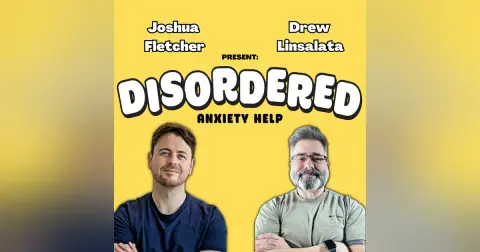
This week on Disordered Drew and Josh deconstruct the idea of a panic attack. It sure feels like you're being attacked, but are you? Is there a more useful and accurate way to frame what's happening? Do we find power when we stop looking at panic as a force that swoops in to attack us?
The guys chat about how a panic "attack" is really an adrenaline surge based on natural, expected, bodily functions. It's not dangerous and not indicative of an actual problem, just a misguided threat detection system in your brain. The conversation goes through why panic attacks are all the same from a physiology perspective and how its the context and the interpretation that makes them feel different or sometimes "worse".
This can be a really useful reframe for anyone struggling to overcome recurring panic attacks or panic disorder so grab a beverage and a comfortable chair and have a listen.
Want to ask us questions, share your wins, or get more information about Josh, Drew, and the Disordered podcast?
Visit us on the web at https://disordered.fm
----
Disclaimer: Disordered is not therapy or a replacement for therapy. Listening to Disordered does not create a therapeutic relationship between you and the hosts of the podcast. Information here is provided for psychoeducational purposes. As always, when you have questions about your own well-being, please consult your mental health and/or medical care providers. If you are having a mental health crisis, always reach out immediately for in-person help.
---
Disordered Roundtable is coming! Think of it as "Disordered Live", a way for members of our audience to spend time with us in an intimate virtual setting (attendance is limited) to engage in real time sharing and discussion on specific anxiety disorder and recovery topics. To be notified when new Disordered Roundtable sessions are scheduled, sign up for our email list using the form on this page.
We want to reassure you straight away that nothing's actually attacking you. Panic attacks are not dangerous, they are just extremely uncomfortable.
SPEAKER_00We use the word panic attack, that's a generally accepted term. Everybody knows what it is. From a phenomenological perspective, it sure feels like an attack. So I I get that. I understand why we say that. But is it really? Is it really an attack?
SPEAKER_01We never ever intend to undermine or devalue your feelings. I like to reframe the word panic attack to adrenaline flood or an adrenaline rush. Because one, that's more accurate, and two, it sounds less scary.
SPEAKER_00The difference from one panic attack to the other was whatever thought I latched onto in that particular panic attack or that particular episode. Welcome to Disordered. We are up to episode six today. Today's episode is entitled Panic Attack. Anyway, welcome everybody. I am Drew Linsolata. I am a graduate student in clinical mental health counseling and a future therapist in training here in the U.S. in the state of New York.
SPEAKER_01And I'm Joshua Fletcher, uh psychotherapist based in the UK, specializing in anxiety.
SPEAKER_00Here we are.
SPEAKER_01Welcome, Josh. How are you doing? I like how you uh said the title there panic attack. Attack. Is there a reason why we've uh named it as a question?
SPEAKER_00Yeah, I think there is. First of all, I appreciate you pointing out my Master Thespian skills. That's as good as it gets for me. But uh yeah, I think it's important that we question that because people we use the word panic attack. That's a generally accepted term. Everybody knows what it is. But is it really? Is it really an attack? And I think you and I are in somewhat of an agreement, and calling it that might be doing ourselves a disservice.
SPEAKER_01Yeah, I mean, uh, we're we're two people that know what it's like to have severe anxiety. And when you're anxious, you know, imagine the connotations with the word attack, you know, when actually we want to reassure you, you know, straight away that nothing's actually attacking you, you know. Panic attacks are not dangerous, um, they are just extremely uncomfortable, you know. And I don't know who came up with the word attack, but it uh we'd like to challenge that, and I often challenge that. Um, do you find it helpful, Drew? Do you find the word attack to be helpful?
SPEAKER_00Well, I mean, I guess from a you know phenomenological perspective, it sure feels like an attack. So I I get that, I understand why we say that, but to me, the word attack also implies a connotation of some sort of outside force that comes to get you over which you have no influence, it just shows up on your front door, and I know it feels that way, but I find it to be more empowering if we say, Well, it's not an external thing, it's coming from inside you, and it's not attacking you, it's just an inappropriate response, and we'll get into that. But sometimes I find it's a hard sell. People really like panic attack.
SPEAKER_01Yeah, yeah, yeah, they do, and and and you always remember that on this podcast, we'll never ever intend to uh undermine or devalue your feelings. Uh, and it does come from a place where I mean I must have had thousands of panic attacks. I don't know about you, Drew. Um, but what helped me, and we're we're only gonna share with you what we feel helps and when I work with people in my practice, is that I like to reframe the word panic attack to adrenaline flood or an adrenaline rush, because one, that's more accurate, and two, it sounds less scary. And if something's less scary and more accurate, then I tend to kind of use that. Now, before we go on a bit more, let's let's actually clarify what we mean by a panic attack, what's actually happening during it, because not everyone's panic attacks presents the same, do they?
SPEAKER_00No, I think, well, that's always interesting because I think physiologically, if we hooked all of us up to monitoring and everybody had a panic attack, we'd all probably look about the same. But I think experientially we they are different because people wind up wind up being a little bit more afraid or a little bit more focused on certain aspects, certain symptoms of the panic attack. So for some people, it's a gastrointestinal problem. For some people, it's just that fear of doom or dread. For some people, it's a heart thing or a breathing thing or a dizzy thing or a depersonalization thing. So, yeah, you if you put a hundred people in the room, you get a hundred different descriptions of what a panic attack is based on what is most scary for each individual person, I think. But the probably about the same for all of us. We're not that common.
SPEAKER_01And some of the most common symptoms of a of a panic attack are I mean, for me, it was um suddenly overwhelmed by a sense of doom and dread. Sometimes my heart would palpitate, sometimes it didn't. Sometimes I feel that derealization and that and that detachment that we spoke about in the last few episodes. Sometimes I wouldn't. Um, sometimes I'd feel very hot and sweaty, sometimes I wouldn't, sometimes I'd freeze, and sometimes I'd want to pace around as much as I as I could because I felt this surge, this adrenal surge. Yeah. Um, and they always came up racing thoughts as well. I just can't stop my thoughts if try if I tried. But it always came with thoughts like, what if I have a heart attack? What if I go crazy? What if I never feel the same again? That's how mine presented. Yeah, how did yours present, Drew?
SPEAKER_00I I would say that um I had some common themes that ran through almost all of them, but it's hard to say because they were somewhat different. And for me, uh, the common themes for me were the depersonalized feeling, the feeling like I was not real or I was outside of myself. That was the most disturbing thing. My heart was always pounding. Sometimes it would be skipping beats. Felt like I couldn't breathe. Um, I'd get that like just jitter. I would literally, people would know because I would start to shake my leg, right? Like involuntarily and even though I was doing it until they cut it down. But for me, I discovered over time as I got more experienced with it, that like, oh, the difference from one panic attack to the other was whatever thought I latched onto in that particular panic attack or that particular episode.
SPEAKER_01If it was a heart attack, that's so important. That's so important, isn't it?
SPEAKER_00Whatever I caught on to in that moment made it that kind of panic attack, if you will.
SPEAKER_01Yeah. This is super, super important as well for people. If you struggle with panic attacks and you're afraid of them, um, this is why I mean by panic attack, that they that they're different each time because the whole point of the anxious response, the threat response is to make you doubt. So if you constantly had panic attacks over the same trigger, the same non-dangerous trigger. If it was a dangerous trigger, you know, an actual threat, then yeah, it's doing its job. But if you're having the same panic attack over the a trigger that isn't dangerous, then actually your threat response is letting you down because the threat response, the amygdala rewires itself when you ex when you're exposed to it and nothing bad happens. The brain remembers that. I remember I'd have panic attacks over going crazy. Well, I didn't go crazy, so it kind of shifted onto my heart. Well, I didn't have a heart attack, you know. Uh, and then it shifted onto not being able to go to the toilet in time and embarrassing myself, and then it then it shifted to um going crazy because I'm too claustrophobic, uh, and then it shifted to many things. However, physiologically, like Drew said, they were very similar, although sometimes the even f the physical symptoms present differently. But what's universal that matches every panic attack is the fear of impending doom and loss of control.
SPEAKER_00Yeah. Yeah. Like something bad is about to happen.
SPEAKER_01Yeah, utterly convinced.
SPEAKER_00Yeah, yeah, 100%. And I one of the things I found interesting about in my own experience with panic attacks is I got as I got better and better at dealing with them, I I started to experience just that where I wasn't really having that same massive physiological response. And I remember very clearly one night um I I had become friends with a couple of different people on YouTube back in the day, and we would share our stories on YouTube. And I remember looking into my crappy digital camera from 2008, or whatever it was, and asking, Hey, is it a thing to have a panic attack without the panic? But what I was feeling was not a lot in my body, but I still felt terrified. It was such a strange experience.
SPEAKER_01I get that question a lot from followers. Do you get that?
SPEAKER_00I I get that, and I had that experience. It was interesting. It was like my my body was was getting the picture, but my my brain, you know. Amy just would not, it was not following along yet. It was the trailing edge of recovery, and and I would still get that fear of it. You leaned over to press it as well. If you're watching on YouTube, you saw that.
SPEAKER_01There's nothing subtle about that whatsoever. Um so you're saying you can have it just a purely physical panic attack.
SPEAKER_00Yeah, for me, it actually was opposite. There was it wasn't purely physical, it was it was mental. It was it was the just the feeling of fear, being afraid, being convinced that something utterly disastrous was about to happen to me, but without having that super elevated level of racing heart, it was just as strange as experience. I'd say that that's the majority of my panic attacks. Well, now they are. If I'm going to panic now, which happened very rarely, but it can happen, it will look more like that. Yeah.
SPEAKER_01Yeah. Oh, yeah. I think I and to be honest, in my experience and working with people, that's the vast majority of panic attacks. How many times have you had a panic attack or spoken to people where they've people have had panic attacks in work meetings or at family gatherings in restaurants or out with their friends? No one can notice it, other than maybe a jittery leg, or maybe you've had to ask someone to repeat themselves, or you might be a bit pale, but the the intense maelstrom of emotions inside are not really visible to those around you. Maybe you get a bit blotchy, maybe you get a bit red, or whatever. To you, that having the panic that's probably feels magnified. But actually, most people don't notice panic attacks. Um because yeah, they're not actually that obvious. Whereas on, you know, if you see a panic attack on Netflix or Apple TV or something, you know, that someone's rolling around on the floor, you know, flashbacks because dad didn't come to your baseball game and all that, and you know, gasping for breath as you're crawling across, really, you know, as someone who in this practice works primarily with panic attacks, I very rarely see stuff like that.
SPEAKER_00Yeah. I think two of the more interesting along those lines, more interesting um visual depictions of panic that you'll ever see is I don't remember, he was a news anchor here in the US. Harris, Dan Harris, I'm not sure. He actually wrote the book uh 10% happier, which I only found out about after I wrote 7% slower.
SPEAKER_01Like, oh come nobody told me this. Oh, he's the mindfulness dude, isn't he?
SPEAKER_00Yeah, and he was uh on national television, ABC News, and he had a panic attack while doing the six o'clock news on national TV in the US. And when you see that video, it's on YouTube. He just goes blank. He's not, it does not look like you would think. I know internally we feel like it's just a volcano erupting, but he just sort of goes blank, and it's a very accurate because he was literally having a panic attack on national TV. And Ted Lasso, which is a show that I really love, he started having having panic attacks. And I think that was a pretty accurate depiction. He just me, he just got really disturbed and just sort of left and went outside and sat on the curb, and he it was not rolling around and screaming, and no, it was really good. They did a good job with it.
SPEAKER_01Yeah, and I could relate to that, you know. Remember when we're talking about the threat response, the fight, flight, freeze, and form. Most of my panic, well, it mixes between freeze, like I just I just have to freeze, and or or sometimes it's get out, and you know it's a panic attack because you know you have this urge to just get out. But remember that is a deeply intrinsic, uh inherited part of your brain, the final flight that's that's literally like flight, run, there's danger. Yeah, but what you've got on your side is that you've still got choice. Now, the easy choice is to leave if you have panic attacks, which I did for a very long time and realized actually that that doesn't help. Um, or you can start to you know willfully tolerate it, which again we'll we'll talk about more of that further on in the podcast. But we just want to let you know that we know how how it feels, you know. Do you have a worst one or do you have a top three of panic attacks?
SPEAKER_00You know, uh I discovered and again in my own experience that I I kind of had to call myself out a little bit because for a while there every panic attack was the worst one. This was the worst one.
SPEAKER_01This was you hear that like I had the mother of all panic attacks, the monster, the the big biggest of all panic attacks. When when I actually no, they're all the same. You're either 10 out of 10 anxious or you're not.
SPEAKER_00So I go, yeah. I only I have a top one panic attack, and that top one is the first one I ever had because it was such a memorable experience and so frightening, and it really kicked off all of the nonsense. But uh, so I really only have a top one, but that it was the mother of all panic attacks. This is where social media-based support is always interesting because when someone say in my Facebook group says it was this was the most severe one I ever had, like, oh be careful because social media has a memory, and then you can go back and show them here was the most severe one two months ago, here was another most severe one eight weeks ago, here was the most severe one six months ago that you talk about. Yeah, and it's always an interesting proposition because people, oh, oh, I guess you're right. You know, that's always an interesting moment, and I had to do that to myself.
SPEAKER_01It's interesting as well what they mean by severe, because physiologically it was probably the same, but maybe they're talking about social consequences or yeah, or interpreted maybe the stakes were higher, maybe it was the same anxiety attack, but they it stopped them from going on holiday, or it was the same anxiety attack, but they had to leave the wedding early, or whatever. And but what you gotta remember is that this anxiety attack, panic attack, adrenaline flood um it's it is the same physiologically, but we often measure it by the impact it's had on us socially. Yeah, emotionally, yeah, yeah. Actually, oh no, I had an anxiety attack at home, and actually it was probably exactly the same physiologically as the one I had at work, but the one I had at work, I had to tell my boss I had to go home, and so therefore, that is the mother of all panic attacks. That was the worst one yet, the severe. Well, actually, no, kindly remind yourself that this is something that you're enduring all the time. Try not to rank them in order. It doesn't help, does it, Drew?
SPEAKER_00No, I don't think it helps at all because the propensity will be, and I get this, it's not a crime, by the way. It's not wrong to do this. It is a crime, and we will personally come and arrest you. You will be thrown in some sort of 1500s British jail. All right, Gavna. That's exactly right. But I think to me, it was the realization that, like, well, these are are all kind of the same, and it's just, and I get this because I would say, yeah, but this one felt so so much scarier. And I like the idea for you, like it's the external sort of uh consequence that it has that can influence that. But people will often say to me, Yeah, but it just felt scarier.
SPEAKER_01But but the but that but there's method to that, there's a reason why your latest panic attack is always the scariest one, yeah, and that is because that's the brain doing its job. Yeah, it has to fill you with doubt. So people who struggle with anxiety and panic attacks, including me, including Drew, um, is this next one is scarier than the last one because when you're experiencing it, you are experiencing the maximum amount amount of doubt possible because fear is doubt, that's all it is. The whole point of fear is to make you doubt. So you can't experience a panic attack rationally because it shuts down that part of your brain, opens up the threat response, the amygdala, which triggers that physiological response, which which gets you going because it is doing its your body and brain is doing its absolute best to persuade you that you are in danger. So you will hear stuff like, what if this is the panic attack that makes it worse? What if you're finally going crazy? What if this is the time where your heartbeat, you know, heart explodes, you know, in front of everyone, you know, and whatever. What if you collapse and faint? What if this is the time you've really got to worry? But actually listen to listen to that. That's actually the mechanics of your brain going, it's trying to help you. It's going, well, what if it's this? What if it's that? Because it doesn't understand why your body is full of adrenaline. Yeah, it doesn't understand why your peripheral vision is opened up, scanning for dangers. It has no idea, and so it's just giving you suggestions. It's going, well, maybe it's that, maybe it's that. So when Drew said before, like, well, it latches on to something, that's exactly right. Because it's like, well, today maybe it's this, maybe it's maybe it's that, maybe it's because I'm not getting enough sleep, maybe it's because of this. It's trying to help you by understanding the mechanics of when you have a panic attack in inverted commas. Yeah, you know, actually, this is really normal, and it's called metacognitive awareness. And that was massive for my recovery. I don't know about you, Drew.
SPEAKER_00Yeah, understanding what it was. Like this is there's I understand it's trying to tell me and fill me with doubt, really good. I have a little anecdote I could share about that too, but you know, it's never actually proven itself out to be true. So I I understand that it really wants me to listen to it and obey it. I get that, and I and I appreciate what it's trying to do. But if I keep obeying it, it's gonna keep doing that, and nothing ever gets better when I do that on the long term. You know, if I run out, I feel better in that moment.
SPEAKER_01But uh, what if this is the time, Drew?
SPEAKER_00Yeah. So interestingly, I I think uh, and you know, the the idea of like what the consequence could be is always such a big one, but what if? And so when you ask a large number of people, which I certainly have the privilege of doing, and you do too, we have relatively large audiences that we are addressing, we have the privilege of that. What is one thing that keeps you from moving forward in your recovery? There were themes when I asked that question, and many, many people asked it, answered it. And one of the top themes was doubt. But what if this time was the number one thing? What if this time? And I think you have to remember that that that system that Josh is is talking about, that fear, that threat response system, it also has nothing to do with social systems, relationships, work, school. It's not interested. It has no knowledge of those things, it doesn't care that it's ruining your grandma's birthday party. It doesn't even know it's grandma's birthday party. It has one job, and that's all it's doing. And it's really good at getting really loud and seeming really important and very urgent, but it's just doing the thing it's designed to do. That's it. That's all it's doing. So is that an attack? Or is that just a misguided? Is it a bug? We we could call it anything we want, but that's I think why we talk about like, well, maybe we should rephrase the idea of attack. It's just it's a it's doing it at the wrong time. Yeah.
SPEAKER_01And just remember as well, like, yeah, it's a mechanism that's uncomfortable, but you're not being attacked. You are safe. Um no one's ever died from a panic attack, you know. But of course, what's really interesting is when people have panic attacks, it's whole the whole purpose of the threat response is to make you doubt, a bit like the cave analogy and the and the lion analogy and stuff like that. And so be prepared for your brain to do exactly what it's supposed to do. You're not broken, but it will say, But what if I'm the first?
SPEAKER_00That's exactly right.
SPEAKER_01What if I'm the first? Oh, my great-grandma died from uh her heart condition. What if I've inherited that and this panic attack pushes me over the edge? Uh, and then yeah, uh that's it, I'm dead now. You know, what if I'm the exception to the rule? There we go.
SPEAKER_00So interesting about that too, is we be we reason purely based on that emotional response. And and I understand fear is powerful and it motivates us. So when you tell somebody, well, you're safe during a panic attack, uh by show of hands, people listening, clearly we can't see your hands, but nonetheless, you know, how many people have heard that, but yet in the aftermath of a panic attack or when worried about your panic attacks, still go to Google to try to connect panic attacks and strokes, and panic attacks and heart attacks, and panic attacks and schizophrenia and psychotic breaks. I know you're doing it because we did it. So it will continue to feed.
SPEAKER_01That like that you you'll be the exception, you gotta find proof that this is true, and it engages an executive function in your brain, which is just basically do something. Yeah, because that's what it wants you to do something, you know. And how how many times did you have that true where it's like uh do something? This is why people this is why I don't really like the phrase sit with it. I can't stand, you know, when you have a panic attack, sit with it. Well, no, I don't want to do that. I personally don't sit with it. What they mean is accept it and do with it. Uh but I actually know when you sit with something, you give it attention. So I if I was to rephrase it, like I'd sit with my back to it, maybe I'd sit and ignore it, but I'm not gonna sit with it because I'm gonna acknowledge it, okay, it's there. But my brain is this whole part of me, this threat response, and part of it is the do it. Do it. Actually, I'm just gonna be like, well, I'm just gonna do what non-anxious me was doing because anything that diverges from what I was originally doing is telling the brain that yeah, you're right to make me feel anxious right now. Yeah. So if I'm sat there and I'm reading a book or whatever, and I'm having this threat response, bang, panic attack, adrenaline rush, adrenaline flood, whatever you want to call it, and I'm reading and suddenly it hits me. Am I gonna put that book down? You know, and start. No, I'm not. I'm gonna try to continue reading the book. Is that book gonna be easy to read? No. Or am I gonna probably have to reread a few pages? Yes. But or even if I find it too hard to difficult to do that, I'll probably put the book down and slowly and calmly, compassionately, you know, go and maybe tidy the kitchen, or just do something that doesn't conform to the immediacy that that threat response wants me to act in.
SPEAKER_00Yeah, yeah. Because I I think the threat response is the don't just sit there, do something. But in reality, it's the best response is the other way. Don't just do something, sit there. But it's not literally sitting there. It's yeah, I suppose that could work.
SPEAKER_01If sitting with it, where what do you think about sitting with everything? Do you like it?
SPEAKER_00No, I I agree with you 100%. I don't like sit with it. I don't like I've I've used it, and then I it causes confusion, and people will ask, I don't know, but do but I I'm sitting with it. Well, what were you doing when it happened?
SPEAKER_01Focusing on it, obsessing about it. That's what I used to do.
SPEAKER_00Yeah, people will sometimes think, take that literally, and and I get it, I understand why, and this is why we have psychoeducation, but they'll hear people say sit with it. And if they are in the middle of whatever dinner with fam with the family and they begin to experience panic or the the the adrenaline flood, they will get up from the dinner and go quietly and sit somewhere. Like, no, no, no, you didn't you didn't have to do that. Yeah, to me, it's stay in the context you are in. If I am sitting, like you said, I'm sitting quietly, whatever, and I begin to feel that, then I'm gonna keep sitting quietly because that's what I was already doing for some reason. The the best I can, but it's not you you're not optimal. And it was really important when you said it's gonna be easy to read that book. Hell no. But you can do the best you can.
SPEAKER_01I love that sentence. You're not optimal. It's okay not to be optimal as well. It's okay. Yeah, you're probably gonna be functioning at 40%. You know, that's normal. Literally, and you've got to remember this psychoeducation is so important. Half you think your brain kind of shuts down, so your memory is gonna suck, your decision making is gonna suck. It's okay. You've got to be kind to yourself when you're doing that. Because if you start getting angry at yourself, oh I forgot what Josh and Drew said, or forgot what I was doing in my CBT, or forgot that's okay. Yeah, like just get through it. You're not gonna do it perfectly. This doesn't you can't, you can't do it. But the the perfect way to do it is to acknowledge I'm not gonna do this perfectly and do it anyway. Yeah, do the best. Do the best you can, knowing that actually, yeah, this is normal. Actually, this is normal for this context that this isn't this isn't supposed to happen. It's really interesting. Uh, I just want to add as well, like when people say sit with it, I found particularly for the ruminators out there, including me, sit with it can often be misconstrued as an invitation to just ruminate. So sit there and play out the catastrophic, listen to everything the anxiety is telling you, engage with it, imagine all the worst case scenarios. No, that's not sitting with anxiety, that's sitting and giving all your attention to anxiety. Um, sit with it, you know, and playing your PlayStation or your Xbox is a bit different.
SPEAKER_00Yeah, but it's gonna take a while to figure that out. You'll get it wrong, you'll stumble. That's okay. You you get for me, I got way better at understanding what to do, inverted quotes, I guess, when I the more I practiced. Sometimes I did a better job and sometimes I didn't, but each time it taught me a little something about what sitting means, what being active, what engaging means. You're learning as you're going. So, not people don't rarely ever just get this right. Oh, Josh said to do this, and then boom, I did it, and wow, everything changed. No, it's a process.
SPEAKER_01No, no, no. And you gotta again look out for the perfectionism in you there. You can't do it, it's impossible. The paradox is there. You cannot to do it perfectly is to accept that you're not gonna do it perfectly. Um, and for some people, like, what on earth is that man talking about? I don't like that. Um, but yeah, you can't do it. Like you're gonna um we'll give some of our own examples. So for me, when I was struggling um with panic attacks and agrophobia, you know, uh one of the ones was just to walk through a park, you know, walk through a park, try and keep my attention external whilst uh tolerating the adrenaline flood, the urge to run home, to have my safe person on speed dial, you know, or just or just to ruminate, even if I wasn't panicking, you know, just to ruminate, walking through, no, keep my attention external. How many squirrels can I see? How many people are ripping a bong on a park bench? How many smells can I can I see? Well, how many different trees, how many different colored flowers? Yeah, um, and yeah, could I do that perfectly? No, because my attention was flitting from outwards to inwards to outwards to inwards, but I was gently going, no, come on, bring it back outwards again. You can do this, yeah, and stop turning around, stop trying to map your route, go and get lost in the park if you want. It's okay. You know you don't need to run to safety. Um, yeah, I didn't do that perfectly to begin with, but then you know, I think I was on my second visit to the park, I went really far in, didn't have my magic bottle of water and all that, and just stood there and I was like, it's pretty intense now. I was like, no, this is what I'm trying to do. This is the adrenaline flood, this is the panic attack that I'm trying to challenge. Yeah. And it lasted about six, seven minutes of that time. Everyone's different, so and sometimes it can last, but I remember that time six, seven minutes, and I was like, I can feel it passing, and I've not really done anything, and that is a wonderful feeling.
SPEAKER_00Yeah, it leaves you with there's no other conclusion you can draw then that you're stuck, your your brain is in a corner now. Oh, I can only conclude that I didn't ever have to do anything before this.
SPEAKER_01Yeah, and a week later, I was reading a book in that very same park. I would never ever imagine to do that because the threat response was like, okay, I get it. This park isn't dangerous.
SPEAKER_00Yeah, fair enough. I think to bring it sort of back to the original thing before we get to our questions and our and our did it anyways. When we question the use of the word attack, like the last couple of minutes where we talked about recognizing and being kind to yourself, you're not going to get it perfectly, you're practicing, you're learning new ways. The word attack often implies that there is a defensive strategy. When I am attacked, I have to do this, and that's why there's so many different acronyms and steps and methods, and everybody tries to do a different, but in the moment when you are being air quotes attacked, you will forget the letters, you will forget the steps, you will forget all of the things, you won't know what to do. People say it all the time, it goes out the window. So you just do the best you can, and that's okay.
SPEAKER_01Yeah, your recall sucks and you're anxious. So yeah, you're gonna forget the steps. And you can actually, if you want, if you're starting out with if you're someone who really struggles with panic attacks, yeah, you can just write it down on a bit of a piece of paper. Yeah. Not as a like uh as a magic paragraph to make your anxiety go away, but just that I'm remembering what I need to do now.
SPEAKER_00Yeah, and that's okay. And I think the word attack leads to that idea that, like, well, when attacked, I must respond. And no, you're not being attacked, so you don't really have to respond the way you thought. Yeah, so there you go. Should we do it? Should we do questions? Like we usually do questions in anywhere, anyways.
SPEAKER_01Yeah, okay. Yeah, let's do that. Um oh, we had what we we we uh we had a good one, didn't we, before the before we pressed record? Um, who is it from?
SPEAKER_00Uh, the question, the question that we want to go through. Yeah first, yeah, and it's right germane to the topic. So this is Barb and Sheffield, you know, our fair our friend Barb.
SPEAKER_01Hi, Barb.
SPEAKER_00Hey Barb.
SPEAKER_01Fellow Northerner.
SPEAKER_00Yeah, exactly. And this is a question that uh she asked, but zillions of people have asked both of us. Yeah, what's the difference between a panic attack and an anxiety attack? What do you think?
SPEAKER_01Um officially there's actually no such thing as an anxiety attack. Um often people interchange it with panic attack. I had an anxiety attack, I had a panic attack. Um, there's not really a difference. I don't find them difference. You hear lots of mistruths and weird descriptions on social media, like a panic attack is something that creeps up on you, whereas a panic attack strikes from nowhere. No, um, that's just nonsense. I don't think that's helpful rhetoric. Uh, and I say that as a therapist as well. It's I don't think it's helpful. Um, yeah, and and actually both include the word attack, so nothing's actually attacking you. Uh, and physiologically they're the same. You're having an adrenaline rush, cortisol rush, whatever, you're having that threat response. Um, another one I hear on social media is uh one has a trigger and one doesn't. It's like, no, it's just nonsense. There's no official definition of that. Um, if you're gonna keep one, you know, just call it, well, you can choose whatever one you want, and then I just reframe that. Like, I'm just having an adrenaline rush, whether it's an anxiety attack or a panic attack. Um, unfortunately, I hear stuff like, uh, I'm doing well with my anxiety attacks, but I'm afraid that a panic attack might get me. And I was like, that doesn't mean any that that means nothing. There's actually what I'm hearing is you've been doing really well tolerating your anxiety attacks. You know, that there's nothing different. There's not a mega one hiding around the corner for you, which is quite relevant to what we've been talking about today.
SPEAKER_00Yeah. I think that because the difference, I I to me, I would question the question itself, like, well, why do you need that information? What's what does it inform? What does it tell us? I mean, listen, psychoeducation is important and having understanding is certainly important, but there comes a time when that question smacks of there's a line across which I still believe I cannot cross. So please tell me when to know it's an anxiety attack because that'll deal with. And when it's a panic attack, is that uh no? Like what 100%. Yeah, what are you gonna do with this information? If if we had a definition that all the clinicians in the world agreed on, which we do not, because there is, like you said, there is no definition of an anxiety attack. What would you do with it anyway? Oh, okay, I'm all right if I have an anxiety attack, but uh, not if I have a panic attack, I gotta go home.
SPEAKER_01That's yeah, that's also you've you've missed out on the fact that you've probably been absolutely nailing it this whole time because you've poured all your energy into all, but then there's that one that I can't handle when actually you've just been nailing it this whole time, you know, you've but you've been doing brilliantly.
SPEAKER_00I gotta make a topic uh entry here in our log because this is a thing we'll have to talk about. But it leads you to if you're doing really well with your anxiety attacks, but you're afraid of your panic attacks, I would posit to say that you might not have a panic attack the way you define it, because you helped to make that. And if you're doing really well with the anxiety attack, you're not pouring the gas on the fire, the petrol on the fire anymore.
SPEAKER_01So absolutely, yeah, no, absolutely. Um, yeah. Anyway, good question. Thanks, Barb. That's a great question, Bob. Thank you. Uh as always, I've got a good did it anyway. Apologies. I don't have I screenshot this did it anyway from a while ago, but I didn't have their name. Uh they didn't give me permission to give their name either, so I'm just gonna read it out anyway. Um I'm not sure where people are putting these hashtag did it anyways, but want to include my own. On the weekend, I went to Brighton Pride. Always wanted to go there. Uh it was my first trip away since pre-pandemic. I sat on the curb as the parade went by. No one around me would have noticed a nuclear bomb detonating in my head. I wanted nothing more than to reach out to my partner and demand we go home. Not the hotel, home 50 miles away. I didn't. I stayed with it, the peak passed. Sure, I had an anxiety hangover with wobbles after, but I stayed the whole weekend. Now my amygdala knows that going away is safe. Oh, look, that's a banger, that one in it. Hashtag did it anyway.
SPEAKER_00That is really good. That that deserves a round of applause right there. Very good. That is the most British, most British did it anyway I've ever heard. Oh, yeah. Brian's a lovely place. Wobbles. Yeah, like I can't do any better than that. Um, mine comes from my Facebook group. Again, I won't use the person's name, but this person said just a couple of days ago, um, she said, I I am on day 17 of not checking my blood pressure. To be honest, it's huge, right? I'm a bit scared to check it now since I felt it's been so long since the last time I checked it. And you know, I know we talk all the time about doing things like sort of in agoraphobic context, but this is a health anxiety context. 17 days without checking her blood pressure is a huge did it anyway.
SPEAKER_01Outstanding, absolutely outstanding. Well, where's that applause button? Where's that applause? I mean, not applause. We've got a crowd in here now. We're applauding this.
SPEAKER_00Video audience, please, everybody, calm down. We have a ton of time limit.
SPEAKER_01Super well done. And I know out how difficult it is just to just one more check. One more check. Now you don't need to.
SPEAKER_00Yeah.
SPEAKER_01Well done. I think we're good. That's episode. Thank you. Thank you, Drew. I think we should probably spend an episode talking about how to talk to yourself or a loved one during a panic attack. And that'll be a nice follow-up one. Uh, what do you think? How about we do that the next episode? All right, then see you in 10 minutes. I'll go get a cup of tea.
SPEAKER_00How about we're wearing the same things in that episode? Sure. Well, we will record that one next. So stay tuned next week. We'll talk about that one, and I'll be back in a minute to wrap this one up and give you guys all kinds of cool links and stuff. So thanks, everybody.
SPEAKER_01Thanks for tuning in. Yep.
SPEAKER_00Hey, it's Drew. Thanks for joining us for this episode of Disordered. Josh and I both hope that you're finding it helpful in some way. For more information about Josh or me or the Disordered Podcast, find us on the web at disordered.fm. That's disordered.fm. Hop on over and find links to our social media platforms, join our mailing list so we can let you know when new podcast episodes are available, and we'll send you easy ways to ask us questions and share your wins so we can answer questions on the air and share your successes with the community. And if you're listening to the podcast on Apple Podcasts or Spotify or any platform that lets you rate a review, do us a favor and leave us a five-star rating and maybe write a review if you're digging disordered. It really helps us out and we appreciate that. Thanks again for coming by, and we'll see you in the next episode.