
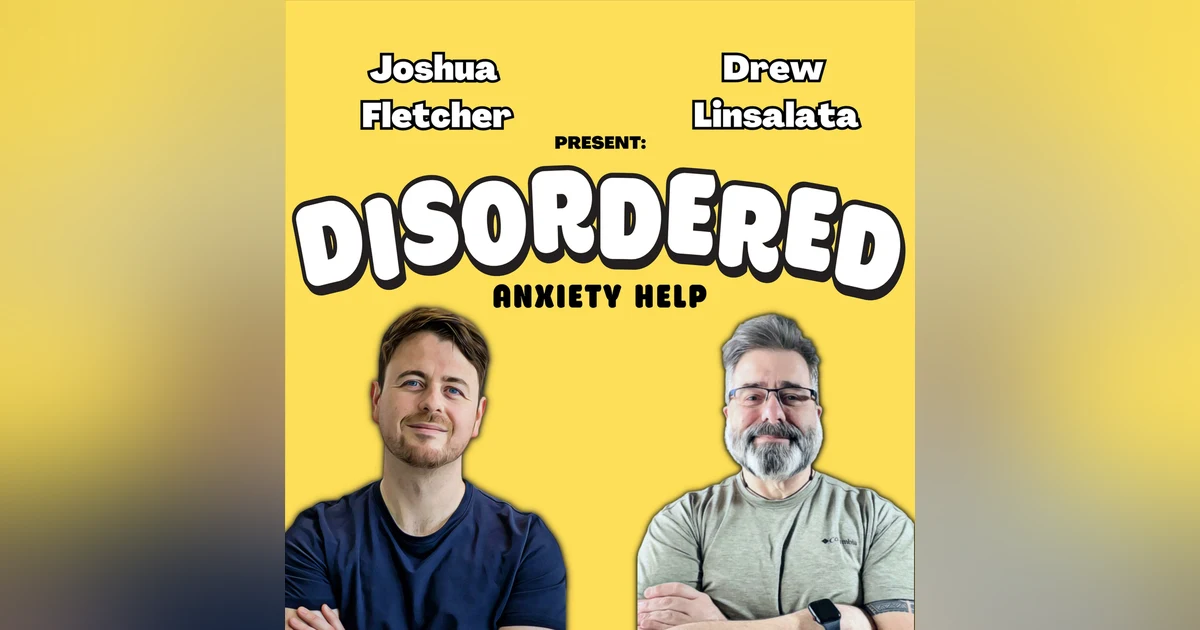
Maintaining Momentum in Anxiety Recovery (Episode 032)

 Apple Podcasts
 Spotify
 YouTube
 Amazon Music
 iHeartRadio
 RSS Feed
 "How can I maintain momentum in recovery when I have a setback or I don't feel motivated?"
This is a very common question asked in our community so this week on Disordered we're addressing the topic of momentum in the anxiety recovery process. We relay some of our own experiences with recovery momentum and what it looked like for us, and we touch on some common issues related to momentum and motivation in recovery:
- There is no linear "perfect" recovery. It's OK to make mistakes. We need to make those mistakes in order to learn!
- Momentum is often about fully embracing a commitment to challenging anxiety and the thoughts, doubts, sensations, and inner criticism that come with it.
- REST is part of maintaining momentum! You're not going to break your recovery if you take time to rest and recharge when needed.
- Motivation is not required before acting. It's OK to feel unmotivated. Sometimes we have to act even when we feel that way. A feeling of motivation sometimes comes after the action.
- Being afraid to "lose progress" is a common reason why some people stop or stall in recovery.
- Thoughts about never getting better are still just thoughts. When we have those thoughts we must be mindful to not glue ourselves to them and let them dictate our actions.
As always we have a couple of "did it anyways" and we answer a question about anxiety that comes in "waves".
----
If you love Disordered and think you might benefit from spending 30 full days in an everyday intensive small group recovery support group led by Josh and Drew, check out Disordered Boost at https://disordered.fm/boost
-----
Want to ask us questions, share your wins, or get more information about Josh, Drew, and the Disordered podcast?
Visit us on the web at https://disordered.fm
Disclaimer: Disordered is not therapy or a replacement for therapy. Listening to Disordered does not create a therapeutic relationship between you and the hosts of the podcast. Information here is provided for psychoeducational purposes. As always, when you have questions about your own well-being, please consult your mental health and/or medical care providers. If you are having a mental health crisis, always reach out immediately for in-person help.
---
Disordered Roundtable is coming! Think of it as "Disordered Live", a way for members of our audience to spend time with us in an intimate virtual setting (attendance is limited) to engage in real time sharing and discussion on specific anxiety disorder and recovery topics. To be notified when new Disordered Roundtable sessions are scheduled, sign up for our email list using the form on this page.
It can be really easy for an anxious person to just, you know, wave the surrender flag and retreat and then take three weeks off in the recovery.
SPEAKER_02Momentum doesn't mean doing everything correctly. It means how much am I going to commit to this new attitude shift towards challenging my anxiety?
SPEAKER_04You can keep up momentum and continue recovery even when you make air quotes mistakes. There's no perfect recovery. Keeping the positive stuff going, allowing space for the negative, because you can't not have it, but not allowing it to become the new primary narrative again.
SPEAKER_02It isn't going to be linear, and some exposures and some efforts to step into uncertainty are gonna suck. It's not gonna go how you want. Please remember this, and this is super important. Rest and stopping is part of momentum. Welcome to Disordered. My name is Joshua Fletcher, also known as Anxiety Josh, and I'm a psychotherapist based in Manchester in the UK and a previous sufferer, also author of several books, and the co-host of this podcast.
SPEAKER_04And I am Drew Lintelata. I am a graduate student in clinical mental health counseling and route to be a licensed therapist here in New York, in the US of A. Also a former sufferer and an author of multiple books on anxiety and anxiety disorders. And the other co-host of this podcast. What are we talking about today, Josh?
SPEAKER_02It's like it's like you bought me off Wish.
SPEAKER_04Wish.com. Need a podcast partner. I got him for like $15.
SPEAKER_02It was amazing. Straight in shots fired. Today's topic is on keeping up momentum in recovery, which was requested from our disordered boost group. Yep. Uh, and we're going to answer it because um during this experiment, we get would love the feedback, want to know what's going what's going on, and um some really good stuff. So yeah, thank you to the person who recommended um that we do it do this. Keeping up momentum when you're trying to recover from an anxiety disorder. Um, how important is that, Drew?
SPEAKER_04I think it's pretty damn important because when when we're trying to face scary things and do challenging things, we're gonna run into frustration, we're gonna have days that feel harder, all of those things, and it can be really easy for an anxious person to just uh you know wave the surrender flag, and I mean in a bad way, and retreat and like this isn't working, and then take three weeks off and then recovery. So finding strategies that you can use to not do that, I think is really helpful.
SPEAKER_02Yeah. I was thinking about from my own recovery, momentum doesn't mean doing everything correctly, but it means kind of how much am I going to commit to this new attitude shift towards challenging my anxiety. And it was rocky, it wasn't linear. I mean, don't ever expect it to be linear for anyone. Anxiety is really tricky, and if you're listening now and you're struggling with a lot of anxiety, you know it's tricky. You know, well done. Well done for putting up with it. Um I think it's important that we kind of do define what momentum means because for perfectionists out there, they must mean, oh no, I I took a day off and therefore I'm failing. That isn't necessarily true.
SPEAKER_04Yeah. Yeah, I think that's a big one. We should probably say that right up front because I'm glad I'm glad you brought it up. It has nothing to do with like doing it right or perfectly or buy the textbook. Because I think a lot of people feel like, oh, I'm not sure if that was that avoidance or not. I'm not sure. So therefore, I did I just ruin everything. Don't worry about that. Like you can keep up momentum and continue your recovery even when you make air quotes mistakes. So it's doesn't matter, there's no perfect recovery. Get that right out.
SPEAKER_02Absolutely, absolutely. Now, before we crack on with this, we love to share community wins. Uh, I'm gonna read one out because I really enjoyed this one. It may made me smile. Um, and it's it's always nice to yeah, to kind of look at people's bravery and celebrate their courage. Um, I think in the last episode or the episode before, I requested some piano back music because it made it sound more epic, like I was on the Hallmark channel. Um can we do that again?
SPEAKER_04We could totally do the piano music. Hang on, let me queue that up for you right now and we will get some music going. So whenever you're ready, you just let me know.
SPEAKER_02I'm ready.
SPEAKER_04All right, let's do it.
SPEAKER_02Hi guys, I have a did it anyway to share. And you can use my name. It's Cheryl. Hi, Cheryl. This morning I woke up feeling really anxious about my appointment to get my eyebrows waxed. One of non-anxious me's favorite self-care activity. Love that. On my way to my appointment, the anxiety escalated into a full-blown panic attack. AnxiousMe wanted to turn around and go home, but I knew that was gonna get me absolutely nowhere, and I'd end up feeling bad about it later. So I carried on. I got in the door, I was shaking and crying, but I did it anyway. I've now left the salon feeling super proud of myself and with nice eyebrows. If I'd listened to Anxious Me, I'd feel awful and still have crazy eyebrows. Feeling super happy, and I've seen it as a good opportunity to show the amygdala that 15 minutes of getting my eyebrows waxed was not a threat. Yay! Well done. I love that was applause from the studio audience. Superb. I loved it. What I love how you framed it. You've obviously been listening to what we've been talking about and stuff. What would non-anxious meeting do right now? Well, I get my eyebrows waxed, and I'm gonna do that despite the amygdala having a tantrum, telling me to avoid, giving me the adrenal flood and all the symptoms. I'm gonna do it anyway. And you did it, and you could do it, and well done. And I hope that you're really happy with your eyebrows.
SPEAKER_04Me too. And I I love how she connected it to like a regular life thing. Like I'm it's just a normal like thing to do, I guess.
SPEAKER_02Yes, and it ties in beautifully with today's topic. Yeah, because hopefully, Cheryl, you've built up on the momentum of that, and you realize, okay, well, if I can do that and I didn't withdraw, maybe I can build some momentum and not withdrawing from other things too.
SPEAKER_04Yeah, what else can I do? Is a really good question if you're worried about like keeping up your progress or your momentum or whatever word you want to use. What else can I do now?
SPEAKER_02What what when people when we say momentum, what do you think? You know, what does that mean, Drew? What momentum took for what?
SPEAKER_04That's a really good question. You're making me think a little bit. What did momentum mean to me? I think it meant that I was able to continue to ride the wave of the winds and the positive lessons that I was learning about myself. Uh, so when you take a big break in that, you tend to start to forget that because we have that negative bias, especially in anxious mind, goes right back to the negative stuff. So if you give it too much time sometimes, or you like kind of allow that stuff to creep in too much or you engage with it, all those that positivity, the wins, the victories, the oh my goodness, I did it anyway. I didn't know that I could do that. Look what I learned, can begin to fade a little bit. And then the loud part of the amygdala-driven Craig the Critic, like I can't do this stuff, comes charging back in. So to me, momentum was keeping the positive stuff going, allowing space for the negative, because you can't not have it, but not allowing it to become the new, the new primary narrative again, as it had been for years.
SPEAKER_02How much of a role does Craig the Critic play in momentum?
SPEAKER_04I think it, you know, in the community we serve, a huge role. Like that guy is just it's Craig the Critic. He's everywhere, and it's it's a such a douche as well, isn't he? Oh, yeah. I think Craig the Critic might be the number one enemy of momentum for many, many people listening right now. It's that whole like, oh, that was nothing. That was a silly, that was such a small thing to do. That didn't mean anything. I still can't still can't go to my grandma's birthday party. I'm I'm this isn't working.
SPEAKER_02I'm weak. What's the point? You can't do this, stuff like that. Yeah, that's correct the craig, and he'll always come up and suggest to you um your vulnerabilities and what you think of yourself when you're at your when you feel at your lowest. But they're all lies. You're uh more capable than you think, and part of momentum in recovery is realizing and learning slowly that you're more capable of what you think, just like getting your eyebrows done when you don't take the time. I don't I don't think I can do that. Wait, now I've got the best eyebrows in town, you know.
SPEAKER_04Yeah, I think it's important, and you're challenging that narrative. That that I the what's the point, I think is a big one. I love how you say what's the point. A lot of people do struggle with what's the point? You know, I I walked to the post box or big deal, I drove around the block, or I stayed home alone for five minutes. What's the point? You know, that's not anything. Oh, those are stepping stones. That's just part of building momentum, is building on top of those things.
SPEAKER_02Yes, yeah, and letting it and having like letting things positively snowball. Yeah, I love that. Yeah, not negatively snowball. Like I'm gonna build this, and the more I do it, the bigger the snowball gets. Yep. Um, but not in a negative way, like it's it's it's a snowball you can't manage, or it's something that kind of takes over. No, it's it's something that you can can build upon and you can start to realize wow, I'm I'm achieving more than what I thought was possible. Yeah, I I think that's that's brilliant. Um, yeah, momentum for me. It was yeah, start I had to do the basics. Leaving my bedroom to go to the bathroom. I'm challenging the amygdala. And then okay, the bathroom, I realized, well, maybe well, there's there's a belief that I've just challenged, a misbelief. Maybe now to the end of my garden. Now to the end of the street. Now in a social conversation, now public transport, the bus, yeah, you know, doing these things. Um, and then for my OCD, the intrusive thoughts like how good can I leave this alone and not compulse? Sure. How long can I take this? Actually, I've been gone 10 minutes without compulsing. That's I didn't think I could do that.
SPEAKER_03Yeah.
SPEAKER_02You know, uh, and yeah, building that momentum. But what's really important is it isn't going to be linear, and some exposures and some efforts to step into uncertainty are gonna suck. Yeah, it's not gonna go how you want.
SPEAKER_04Yeah, I I think there's a couple of like mechanical things that play into momentum or losing momentum, if you will. One of them is that the declaration of failure or destruction of your recovery when you encounter it's that Mike Tyson quote. Everybody has a plan until you get punched in the face. I love that plan, I love that quote. And it applies a lot in our community. Like, I'm oh man, I'm doing great, I'm doing great. And then one day, maybe it's not so great for whatever reason. You're tired, you're sick, you had a fight with your partner, whatever, it doesn't matter, you're stagging a little bit, and you feel it. And it's really challenging. The thing you did easily two weeks ago was a challenge today. That's the punch in the face that Mike Tyson was talking about, and then oh, this isn't working, square one, I'm I'm done. And that's that's a huge enemy in momentum. That's one of the mechanical issues. Yeah, like yeah, and then you latch onto that and start to advance that narrative.
SPEAKER_02Yeah, absolutely. Yeah, uh another important myth to dispel of momentum as well. It's not get up every day at uh 6 a.m. and and and run, you know, run to the hills and challenge everything. No, no, no, no, no.
SPEAKER_04David Goggin's.
SPEAKER_02Please remember, please remember this, and this is super important. Rest and stopping is part of momentum. Correct. You know, um it's a bit like I'm gonna use a football analogy here. Went to recently watched Newcastle beat one of the biggest teams in the world, um, and it was a really nice night at St. James's Park. And they can after the interviews, they say this because we're in a good run of form at the moment. It's you've got to keep the momentum going. Gotta keep the momentum going. What those players are gonna do after 90 minutes of running around endlessly is rest.
SPEAKER_03Yeah.
SPEAKER_02Because when it's when it's game time again, yeah. But a lot of people with correct the crick and perfectionist tendencies are like, oh no, I'm resting, I'm stopping, I'm failing, I'm regressing. No, no, no, no. You're allowed to rest because stepping into uncertainty is exhausting and tricky.
SPEAKER_04Physically, mentally, emotionally, all of those things. So I think defining that is really important in the momentum conversation, too, because you will get worn down on all of those dimensions. And the difference is when you're tired, you rest. When you need to recharge, you rest. Sometimes I think in the beginning, and it's okay to get this wrong, you're feeling it out, you're in new unfamiliar waters. An anxious person that defaults to avoiding will kind of say, Well, I have to rest when really they're afraid. And you might not know which one you're doing at first. So maybe you'll get it wrong. And only afterwards will you look back and say, I probably could have maybe taken a small walk yesterday. Okay, cool. So then take that lesson with you. You didn't just destroy your recovery, you still have momentum. Go ahead and take your small walk today. You rested yesterday, fine. Yeah, good point.
SPEAKER_02No problem there. So and you expanded your metacognitive awareness. Correct. I'm noticing patterns now. And yeah, okay, I uh maybe I could have done an exposed yesterday, but now I know more than I did yesterday. Right. I think I think that's so essential. It's one of the most essential things in recovery is spotting your own thoughts and habits.
SPEAKER_04Which I because I think it's a big discussion and it's it's related to the momentum thing. I can't tell the difference between resting and avoiding, or resting and retreating. Okay, in the beginning, you might not be able to tell a difference. Make a mistake and see what you learn from it. That's okay. Yeah.
SPEAKER_02A word on tiredness as well. Um, because if you're tired and exhausted, rest. But also for some people, they might be afraid to do things when tired, uh-huh. So it becomes avoidance. Yep. So part of that is well, and again, what we've done episodes on sleep anxiety and things like that. That's gotta be a call you've got to make. You'll know deep down, like I know I'm tired, but I'm still capable. Yeah, because part of recovery is realizing you can still function when tired.
SPEAKER_03Yep.
SPEAKER_02But but it's up to you to make the call of no, I'm actually just quite mentally and physically exhausted. I'm gonna be kind to myself now, yeah. And uh and and you know, and put some rest time in because that is part of momentum. Or that that in contrast to I had an you know, I had an event today that I'm supposed to go to. I know I can do it. It doesn't matter if I'm tired because non-anxious me can also be tired and still do it and get through it. I've noticed I'm using or my brain is trying to suggest to me, oh, maybe you should avoid this because you're tired.
SPEAKER_04Yeah, I'm too tired.
SPEAKER_02Yeah, and and it's it's it's it's a subtle, and and it's got to be you that kind of decides it's a gray area, it really is, and it's gonna change from day to day.
SPEAKER_04And it's okay to not be totally sure. It's really okay, and like maybe one day you'll get it wrong. But there is no wrong as long as you take something out of the experience, so it's okay. When I wrote it's what it's really the second book I wrote, but the first book I released, which is the whole story of my anxiety journey. I said I no days off. I did that. I said I did no days off, and I even used silly words like no self-compassion because I didn't understand, I didn't conceptualize it the way everybody does. I wish I hadn't written those words. So if you've read that book, sergeant book and what you got got out of it is, well, that guy just never rested. He was just a recovery machine. Not really. It's just what I probably should have said is I tended to not let myself be fake tired, if you will, you know, or anxious tired. And I pushed that a little bit. You need the screaming American eagle when I say shit like that. Super, super American. No rest in that moment. I'll rest when I'm dead. Right. I'll rest when I'm dead. Um, so I do I did want to throw that in there. If you've read that book and you just thought, but the who's this guy telling me to rest, he never rested. I did rest. I promise I rested.
SPEAKER_02I love how since he's trying to train training to be a therapist and and meeting other people in the field, it's like actually there's a lot to this self-compassion stuff.
SPEAKER_04Yeah, and I think well, I get to learn from our audience too. I mean, a different conceptualization of what that meant. For me, it meant like I wasn't gonna let myself hide anymore. I was doing something nice for myself. Yeah, absolutely.
SPEAKER_02And also we're in the social media space, and that kind of gets lumped in with things like sit in, check in with yourself constantly, make you know, tell the world uh this and and give yourself an excuse to do what you want and kind of almost simmer in a neurotic cycle. Um and for anxiety disorders, no, we don't do that. We want to get you to a good place. Um I can see how people get sucked into that. Um again, I saw it was only yesterday, someone with quite a large following who's a has a PhD and is a therapist in anxiety. I'm not gonna name them, but you know, it was like five ways you can use ice cubes to calm you down your nervous system uh and heal. I'm like yeah, you know, like that isn't helpful for a variety of reasons. Yeah, um, and I think you know, don't get me wrong, if you want an ice bath, you've got some tense muscles, go for it, it's great. Uh, but but in general, you know, or if you like open water swimming, because that's just like what you what you want to do, that's cool. Yeah, if you're using ice cubes compulsively, no, and that's kind of I think that's what the self-c you kind of saw the word self-compassion banded in with all this kind of inwards connected candles and lavender oil in it.
SPEAKER_04That didn't look that way for me. And I anyway, if I could recall all of those books and change the words, I would. But so don't get don't get confused by that. I have two other things that I think come into the momentum thing. The first one is what if I overdo it? I think that can interrupt momentum sometimes. I just had a couple of really big wins, and I'm worried that I if I keep going, it'll be too much. I will overdo it. Can you overdo it?
SPEAKER_02I mean, theoretically you can overdo it, but you might you know hit burnout. But when people say overdo it, what they're actually saying is, what if I push this and go back to square one? Right, which will not happen. Or what if I give my mind and body so much stress that I start harming myself? Well, what you've got to remember is that when you're challenging your anxious response, it's actually a beautiful, healthy response. Your body is doing everything that what it's capable of, it's doing a very healthy response. It doesn't feel comfortable, but it's healthy. And part of recovery is realizing that you can tolerate that very healthy response. Um, again, disclaimer if you're if you're working with chronic conditions and things like that, if you're um you know, if you're steroid dependent, if you have um certain conditions that require you to stop and rest and stuff like that, of course, do that. Um, you know, um definitely, you know, you don't want to keep giving that, or if maybe you have a heart condition or something, you know, talk to your doctor and your medical team about this. Is it okay? Do I have the green light to do this? And if the light, yeah, go for it. But it falls back to that kind of how can I compassionately decide and analyze do I need rest now? Am I pushing it more in terms of exhaustion and burnout, as opposed to am I pushing my brain and it's gonna explode?
SPEAKER_04Yeah, that is two different things. And I think that question often gets asked, not so much in the I'm not sure if I need to rest as well, I I don't think I need to rest right now. I can do more, but I'm really afraid that I might, you know, I'm I'm having a lot of wins in a row, but if I push it, I might break that. You know, is what is the point where I should stop? Well, why would if you don't feel like you need to stop and you're not tired and you're not feeling those effects, why why would you need to stop?
SPEAKER_02It's almost like a fear of losing their wins.
SPEAKER_04Yeah, or that's they may have a negative experience or they may fatigue themselves or something magical will break in them, or they'll push themselves over some imaginary line and then all of my wins will go away. Like you said, I'll be back to square one, and that's not a thing.
SPEAKER_02Yeah. And yeah, and uh, yeah, in my experience as well, when people are proud of how far they've come, they don't they feel like I want to cash my chips in while I'm up. Yeah. And if I do an exposure that's too much, I'll lose my chips. Yeah. And it's like, no, you can't. Those chips are yours. You cash them in.
SPEAKER_04That is a totally understandable concern because if you've suffered for a long time and now you're starting to see some progress, of course you don't want to lose that. Yeah, that would feel so precious to you. Like, no, no, I can't, I don't want to lose this because it's I'm finally seeing something. But oddly, if you keep pushing it, you're more likely to continue to see the progress, more so than I broke myself and somehow I lost everything.
unknownYeah.
SPEAKER_02Yeah. And if you feel like you're at your limit, or sorry, the anxious brain, the amygdala is saying, what if you're at your limit? Right. And then you do more exposures and you find that you're not at your limit. You're nowhere near your limit. Yeah. Think about that. Because again, it's another what if, isn't it? Is this a what if I'm at my limit, or I can actually feel that I'm exhausted now and maybe I need a bit of rest. But no, there's no like pressure. Like when you're doing exposures, it's not like, oh, there's pressure. Oh my god, everything's gonna explode and snap. Yeah, no, no, no, that's not how it works. If anything, it's weighed up by the fact of when you do exposures and you're often and you should be proud of yourself. Uh it adds into uh confidence. You suddenly find that you've got more serotonin and dopamine floating around your brain because you're like, oh wow, there's there's hope. There's hope here. I can access more of my life, and that's actually super way better for your brain than the constant cycle of avoidance or the constant cycle of compulsions that we've been doing.
SPEAKER_04Yeah, and I think it's not so much about like making sure that you don't you don't hit the overdo it point, it's that you literally move your definition of overdo it back to where it actually belongs in your life, which is 100%. Yeah, yeah. Like, oh wow, overdue is so far out there, I'm so far away from that. I hope I never get to that because that might be a really extreme situation as a natural disaster, or some really seriously ill. Fair. That's a huge amount of stress. But this you think is overdue. It's like, no, no, what I'm doing is pushing that definition back to where it belongs now.
SPEAKER_02Yeah, like like my cup's overflowing, and if it overflows, everything's broken. But actually, you don't your your coping mechanisms are not in a cup, they're in a giant vat, swimming pool.
SPEAKER_03Yep.
SPEAKER_02Olympic. I have I have a s I have an Olympic swimming pool of of um tolerance and ability and strength, and my brain and body can deal with this. Yep. When you're anxious, when you're anxious and you have anxiety, you feel like I only have a cup worth. But doing lots of exposures, uh and not responding to kind of triggers and doing your exposure response prevention, leaning into uncertainty, doing the scary things, you start to discover, like, oh hold on. This isn't this is just one bit of what I have.
SPEAKER_03Yeah.
SPEAKER_02You know, I've got a whole I've got a whole larder of cups that I could fill up. And I'm teaching that to myself.
SPEAKER_04Yeah. Or you learn that the cup is actually inside of a much bigger cup. And when it overflows, it doesn't wind up on the floor or on your feet, it just flows into the bigger cup.
SPEAKER_02And like you have more Which is inside a bigger cup. Cupception. Cupception.
SPEAKER_04Cupception. Love it. You may have just invented something in that show. Um the other one that I want to touch on too, and the momentum conversation. This one is so self-referencing in meta, and I'm sure you hear this too. And this one really surprised me. I I'm losing my momentum because I keep thinking that I'm I'm getting better. I'm I'm actually getting better. I'm I'm having wins on a regular basis. I'm doing things that I used to refuse to do. I have this new view of it. I'm seeing myself as more capable, but I keep having the repetitive thought that I'm never going to get better. And now I'm losing my momentum. So it's literally like you're doing it, and then, but thinking that you might not be able to do it, and then people will act on that thought. Have you seen that? Like I keep thinking that I won't get better, and it now I'm back, I feel like I'm back to square one because I keep having that thought.
SPEAKER_02Yeah, but but that's habit. You know, that's habit, and again, it's a what if. You have to treat it like a what if and be, oh, there's that thought again. What if and I'm gonna get better. These are usually um you apportion this to people that see anxiety recovery as like a singularity. You know, I am not in the singularity here. My test for overcoming anxiety recovery is I wake up and I feel perfect all day and I'm happy and all and I've beaten anxiety. No, that's not how it works. You need to define what your um definition is of getting better. What's getting better? For me, my definition of getting better is I don't mind if I'm anxious. And as a result of that, it passes almost sometimes instantaneously, sometimes a while. It doesn't matter, it doesn't matter. You know you're better when you're not thinking about it. You know you're better when it's been a week and you're like, I've not even thought about my anxiety, you know, or maybe there's a few reminders now and then that's okay. But if you have that singularity and you've made recovery a thing, a perfectionistic trait, then the first sign of anxiety that comes up, or the first sign of doubt that's triggered by stress or old habit, you'll go down that ruminative hole of oh, I should, or I'm never gonna get better. And no, that's not what it is. It's always measured on the willful tolerance of uncertainty. And I know you're gonna be sick of me saying that after so many episodes, but it's so true.
SPEAKER_04Yeah, and I think it's an I I mean, I I'm not surprised by it. I guess I mean we've both been, you know, highly anxious people at times in our lives, but you know, I keep having that thought. What are you what am I supposed to do when I keep having a thought that I'm never gonna get better? Keep going. Like it's a cheeky answer, but the it probably is the best of well. My brain keeps saying, Well, what if you never get better? The answer is I don't know. I don't know, brain, but I'm gonna keep going. Like I'm gonna have to test your theory, brain. Like, uh, you know, so I think the way to overcome that thought or to keep your momentum going when your brain is screaming you're never gonna get better is to keep getting better. So, you know, I look at the logic or or look at the emotional reasoning that comes in. Well, I have a thought that I'm never gonna get better, and then I glue myself to that and I act on it and I stop. But but you are getting better. So the answer to that is I don't know. Maybe I will never get better, brain, but I'm gonna keep going. So yeah, come with.
SPEAKER_02If you've got if you if if non-anxious you, and again I'm back to the uh uh Cheryl and the eyebrow accent, if non-anxious you is like, yeah, I want to go do this, and your anxious brain's like, Oh, what if this happens? And you go, No, I'm gonna do it anyway. Yep, I'd argue that pretty much is a huge fragment of being better.
SPEAKER_04Yes, just the fact that you are willing to stand up, hear that thought, and keep going. Like, I hear that thought, I hear you, but I'm gonna go.
SPEAKER_02And that thought gets quieter the more you do it. It gets quieter and quieter and quieter. It's and then sometimes it doesn't even it doesn't even speak up at the table. So there's no point. This person's ignoring me.
SPEAKER_04That's true. I mean, we can acknowledge it is a distressing thought. Again, if you've earned if you've got some hard-earned progress here and you earned that and you suffered for a long time, the thought you might never get better is certainly distressing from an emotional standpoint. It's okay, you can have that thought. It's just you don't have to agree with it or act on it, keep going. That's the answer.
SPEAKER_02So yeah, in my I did I did a very scary keynote presentation. I don't know if I mentioned it in the last episode, but yeah, uh a few weeks ago. And I could feel the freeze panic when I lost my slide and lost my train of thought, and there was a bit of a gap there. And I knew that was in a good place because that's me. That's me having the start of a panic attack, adrenaline rush on stage. But I wasn't thinking about it afterwards, I wasn't thinking about it two minutes later. It's like sometimes this happens, sure, but I'm like, I'm just gonna tolerate it, it's okay. There's a dump of adrenaline, that's all right. But if I'm like, oh my god, I'm not better now, what's that gonna do? You know, and actually I ended up having a really good day, one of the best days in my career. Um, and that wasn't even an important slice of it. It was just something that happened, felt intense. I only just remembered it now because we're talking about it.
SPEAKER_04Yeah, yeah. And that came from, you know, back to the beginning of the episode when you're talking about, well, I have to I have to get out of my bed and go into the bathroom, even though my amygdala says don't do that. What directly led a little bit at a time, momentum, little bit at a time, led to I'm giving a keynote address here at BACP in London in front of all my colleagues here. And I and wow, I panicked a little and it turned out great. Yeah. So yeah, that was the result of momentum over a long amount of time. One step at a time, one step at a time, one step at a time.
SPEAKER_02You know what? Super cool as well. I told the whole audience, like, I'm anxious now, like seven out of ten, eight out of ten. Yeah, wavered up and down, and I just didn't. That was not so nice as well. Just like the shame of it. I was like, no one thought I was judged me for that. They just saw a very confident speech. I'm like, this is what I'm talking about. Like, it's not you're gonna get anxious. Like we all do, it's normal, it's very every human has anxiety, yep. But with people with anxiety disorders, it becomes such a thing because of that secondary fear, yeah, that we lump all anxiety under one umbrella and we want to erase it forever, and that's no, we we we uh challenge the secondary fear, and that's where recovery lies.
SPEAKER_04We'll do one more, uh, which is I I should have thought about this motivation. I've done entire episodes of my old podcast on motivation. People like, well, I'm having a hard time with with momentum because I just, you know, I it's like a hamster wheel, I keep just doing the little exposures, it doesn't feel like it's going anywhere. How do you feel? How do you get motivated? People ask me this all the time. How did you stay motivated? And I think motivation is tricky, and that people have it backwards sometimes. What do you I you had thought came to mind right away, I could say.
SPEAKER_02Motivation, yeah. Well, I know you say values, things like that. Uh uh yeah, uh, I want I want my old life back or I want a new life because this one feels very restricted. Use that as motivation. You can use other people as motivation, you can use your family as motivation, that's part of your values too. Uh, I actually used anger as motivation. I was angry. Yeah, me too. I was just really angry at it, and that helped. You know, but also being being your own friend in this, you know, like how you've gone through some sticky stuff and you gotta, you know, you're gonna get to a good place. Uh motivating yourself to allow and give your permission to experience joy again. You're allowed that. You know, and I think a lot of people with loud crave critics and and people with low self-esteem and struggle with depression, and now what's the point? And now I'm a burden, and all this nonsense. Yep. You deserve joy just as much as anyone else. Is that yeah, picture yourself having joy again, picture yourself feeling powerful, independent, autonomous, yep, and the endless possibilities that come from that. You're not gonna feel the same level of motivation every day. There'll be some mornings where you wake up and go, I feel like garbage.
SPEAKER_03Yeah, I don't want to.
SPEAKER_02But it will come back. Feelings are transient.
SPEAKER_04There you go. This is the uh where we turn it into like stereotypical two guys with microphones podcast. Can I blow your mind? Um this is the part like motivation, and I find that so fascinating. It gets studied a lot, like in other contexts, like in big in business schools and whatnot. We study that people study motivation. And some of that research is fascinating. You know, motivation is a feeling that peaks after the act, not before. And sometimes people get confused, like, well, I have to I have to make a feeling before I can do a thing. And sometimes it's fascinating to me. I'm a brain nerd, but like it's fascinating to me. And like really that that peaks after the feeling of motivation is more like a feeling of accomplishment that then you want to repeat. So a lot of people would say, Well, I don't how did you get it? How did you get motivated? Well, sometimes I didn't. I literally just dragged my sorry rear end at the door on freezing cold mornings. I didn't want to do this stuff, but then afterwards I sure did feel motivated. So sometimes we just have to act even though we don't want to. Yeah. That's a dread.
SPEAKER_02But to add to that as well, is that it was really nice to when you're journaling your exposures or doing that or stepping into uncertainty or whatever is that I took motivation from each time my anxious brain suggested something and I proved it wrong. And that started to build. I was like, wow, this is an illusion. Take motivation from every time that you're you go with your rational brain and shatter the illusion. Because anxiety will only present to you a suggestion, it only feels real because of that threat response, because of the adrenaline, because of the cortisol, because of the sensitized nervous system, because of the racing thoughts. But shattering that illusion can add to your momentum, and that's what I personally did. I was like, wow, like there was a point where I okay, I can notice my anxious brain, it wants me to avoid, it doesn't want me to go into that restaurant, it thinks I'm gonna, you know, um, I'm gonna throw up or freak out or embarrass myself because I can't eat in front of people or whatever. And I come out and go, yeah, okay, I got anxious in there, but I shattered a lot of that illusion today. Well done, me. Yeah.
SPEAKER_04Yeah, and then you try and take that with you, you know, for down the road. But if you don't, you know, sometimes the the motivation thing in the context of momentum is like, well, I I need to create a state of feeling before I am okay, before I can act, before I can do things, which is really like I'm only okay if I'm calm, I'm only okay if I'm happy, I'm only okay if I'm in a good mood. I'm all I can only act if I'm motivated. Uh challenge that narrative. Maybe I can act even when I'm not motivated. Not fun, but let's see how I feel afterwards. Try that experiment.
SPEAKER_02What would you say to someone who is you know anxious at the moment and they've been pouring a lot of effort into challenging the threat response and things. Uh but then maybe they are struggling a bit with momentum and motivation. What would you say to them?
SPEAKER_04I think it's really it's a complicated thing, and I would probably say, look at what what is different today than from a week ago, maybe not a week ago, maybe two months ago, maybe a month ago, maybe six months ago. Look at that, grasp onto that. And also, you wrote a thing in our boost group the other day, which was really actually got me all pumped up. Like, why am I this is what we are choosing to do. Why am I choosing to do this? I always found that it helped me to connect back to it's not this is that cliche thing also of my why. The why was like, I don't want to be like this anymore. So I'm choosing to struggle, I'm choosing to challenge myself. And yet sometimes it wears me down and I'm tired and I'm frustrated and impatient, but I can remember why I'm doing it. And then maybe I gotta take a little rest, give myself a little break, but then get back to it. So just expect the ups and downs, I think, and express whatever you got to express too. You don't have to stuff your emotions, but if you're frustrated, tell a friend or tell your support group or pitch about it on social media. It's you're allowed, that's okay. Just you know, express what you gotta express, but remember why. Why am I frustrated? Because I'm choosing to do hard things for future me. I think that's a wonderful note to kind of leave that on.
SPEAKER_02We can do more episodes on motivation, sure, momentum as soon. Um, I would like a question or a did it anyway.
SPEAKER_04Do we have an audio did it anyway? I love this one. Well, let's play it first and then uh we'll talk about it afterwards. Here we go.
SPEAKER_01Hi, um, my name is Erin. I don't mind you sharing my name on on air. Um, I'm not sure if this is the proper did it anyways or not, but um I had a strange moment today where I had a clogged pipe and I didn't know how to fix it because I've never done any of that before. Um and I've recently separated a year with a husband and he was still coming over to fix things for me. Um I have generalized anxiety, I have driving anxiety, I have social anxiety, I have to work. Um, but I never thought I had monophobia anxiety listening to your podcast tonight, and I had nobody to fix the strain. So I ended up remembering how I had seen my husband do it in the past, and I think it's amazing, and it didn't feel just good that I did it. Somehow it connected to just my sense of well-being and my dealing with the separation, and I just felt a hundred times better about myself and being being a capable person, um, being able to move forward alone on my own. It was just crazy.
SPEAKER_04How great was that? It's a totally different kind of did it anyway.
SPEAKER_02I love that. It was really good. Um and it's self-empowering as well. You're more again, you're more capable than what you think. Yes. Um, you can live as an autonomous human being. Uh also it's okay to ask for help and as well, you know, or if some people need help if they've got um disabilities and stuff. But in that in that scenario, I think that was really, really powerful. And thanks for sharing that with us. Uh if you'd like to share something with us, you can log on to disordered.fm, share a voice note, or drop us uh a message uh with a question or a did it anyway. Uh we love listening to them, reading them out, and um, yeah, and maybe we'll play them on the show.
SPEAKER_04Absolutely. That's the cool thing about a clogged pipe, which we're like, well, how does that recovery? It touches on all the things self, like my self-esteem, my ability to feel capable. Very well, it's not always walking around the block.
SPEAKER_03You ever had a clogged pipe, Drew? I have had my share of clogged pipes. We all need to eat, you need to eat more fiber.
SPEAKER_04That's the issue right there for sure.
SPEAKER_03Uh, did we got a question to wrap up the question?
SPEAKER_04Yeah, it's a nice short one, and we can answer pretty quickly, I think. And we appreciate you guys sending it in. Um, this person did not say it was okay to use their name, so I'll just ask the question. Hi, is it possible for anxiety to come and go in waves? Like wave of relief, then a wave of anxiety? And this repeats for hours every few seconds. Thank you for your answer. What do you think, Josh? What does that sound like?
SPEAKER_02Anxiety. Yeah, well, I can answer it in the context of panic disorder. Um, in my first ever book, I labeled it the loop of peaking anxiety. It's where you know when we have the threat response, we get that dump of adrenaline and cortisol, and it goes up. And if you picture it on a graph, it goes up and there's a parabola, and then it comes down and then it lingers around for a little bit. When we fear that parabola, when we fear that anxiety peaking, we monitor for it, we keep an eye on it, we change our lives, our attention goes inwards, we compulsively scan, monitor, etc. Um, and yeah, that kind of behavior signals to the brain, oh, the the threat itself is the threat response. Yep. And then we start to fear that graph going up again. Uh, yeah, I call it the loop peaking anxiety. Very familiar with it, so is Drew. Um, what I recommend to you, it's very common, very normal. I'd recommend to you is work on extending those gaps in between uh the anxiety by almost leaving it alone, leaning into uncertainty, giving yourself things that aren't monitoring for it, and try not to fear it because you're okay. It's not hurting you, it's uncomfortable, it's debilitating, but you're all right. Uh, and I'd say to myself, listen, I've got a phobia of this response here, and my and I keep I'm in the cycle.
SPEAKER_03Yep.
SPEAKER_02It's okay, the cycle's not hurting you. Um, and I'm gonna work on kind of getting some momentum here of challenging my fear of this fear, and it will pass. You're okay.
SPEAKER_04Yeah, I would add two things to that, a little bit of psychoeducation, which is yeah, even after the peak of it and it starts to come down. And if you're good at this, that might take 10 minutes. If you're not so good at it, it might take a longer time. That's all right. But when it starts to come down, you're still gonna feel it for a while. And then what's happening is, well, I still feel shaky. I still I don't feel a hundred percent. So now I'm going to treat myself like I'm fragile and I have to do something special to keep it from peaking again. That's that's the challenge. No, I don't. Like, yes, I'm gonna feel shaky for another half hour. That's just chemistry. There's nothing I can do about that. What else can I do besides sitting and carefully trying to keep myself from going back up the other the mountain again?
SPEAKER_02Yeah, because that's what will cause it. 100%. You're almost guaranteed it's gonna peak. Yeah, also as well. This is where I don't even recommend distraction because distraction will show you metacognitively, look, where my attention is here is super important. You know, distraction, we've talked about, did an episode on distraction, really enjoyed it. Um, if you're that person who's like in that loop, I I often recommend like saying, like, you know, you can just distract and then look and analyze. Oh, look, when I wasn't obsessively scanning uh and monitoring and I was distracted with something external, I was less anxious. So what does that tell you?
SPEAKER_04Yeah. And in that is we always have to acknowledge, in that is taking what you perceive as the risk of allowing it to happen again, correct? Because what you have to learn is even if I even if for whatever reason it went back up again, it'll come back down again. That's allowed.
SPEAKER_02So yeah, and if you get on a roller coaster once, a big dipper, you know, you'll be really scared the first time, and then you'll go on again and again. I challenge you, how how boring can I make this big dipper roller coaster? Yeah because if I'm willing to get on it over and over again, it's gonna get boring at some point.
SPEAKER_04That's not a challenge anymore. So yeah, you gotta write it a little bit. Good question, though. Thanks for sending it in.
unknownYeah, I guess.
SPEAKER_02Thank you very much, Drew. Yeah, it's always a pleasure. I can't wait to record our um next episode. Thank you to all those that have pre-ordered my latest book. Um if I've ever helped you, um, and I'll even rope Drew in on this if we've ever helped you. Um uh the pre-order is of this book is means it means a lot to me and actually helps me when it comes to release time in March. It's called And How Does That Make You Feel by Joshua Fletcher, and it's the best thing I've ever written. Um and yeah, thank you. Uh, there'll be a couple more plugs, sorry, Drew. No, bring it.
SPEAKER_04It's a great book. I've had the pleasure of seeing it in advance. Uh, not all of it, but a lot of it, and it's great. So see you later, Drew. In the next one. Hey, it's Drew. Thanks for joining us for this episode of Disordered. Josh and I both hope that you're finding it helpful in some way. For more information about Josh or me or the Disordered Podcast, find us on the web at disordered.fm. That's disordered.fm. Hop on over and find links to our social media platforms, join our mailing list so we can let you know when new podcast episodes are available, and we'll send you easy ways to ask us questions and share your wins so we can answer questions on the air and share your successes with the community. And if you're listening to the podcast on Apple Podcasts or Spotify or any platform that lets you rate a review, do us a favor and leave us a five-star rating and maybe write a review if you're digging disordered. It really helps us out and we appreciate that. Thanks again for coming by, and we'll see you in the next episode.