
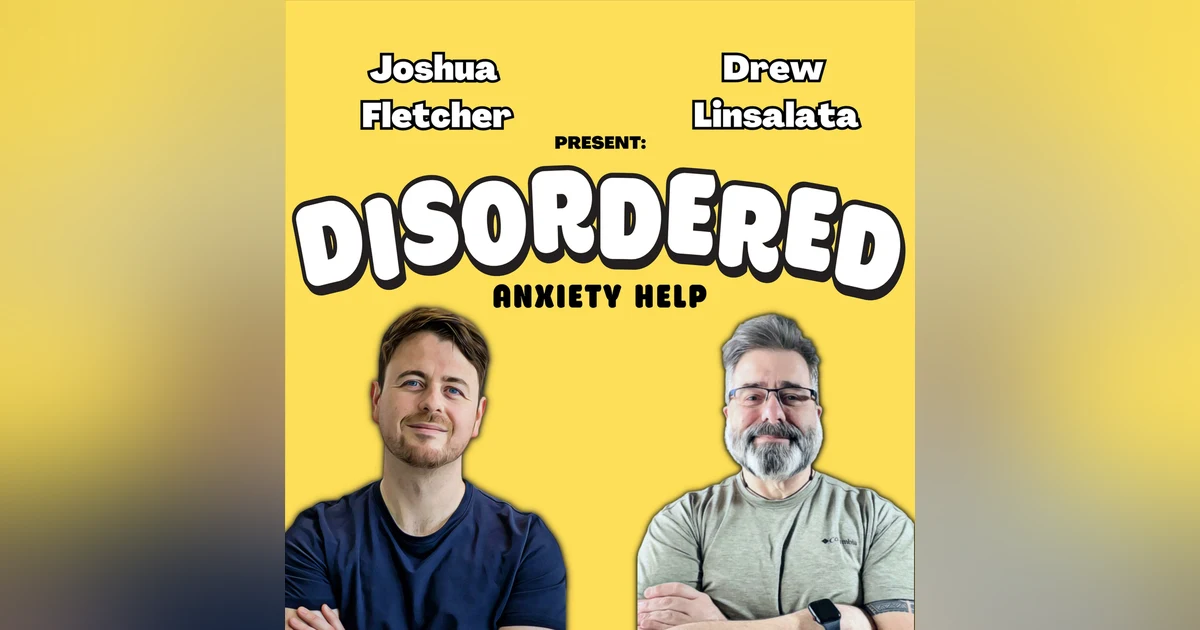
Driving Anxiety - Anxiety Experienced While Driving (Episode 018)

 Apple Podcasts
 Spotify
 YouTube
 Amazon Music
 iHeartRadio
 RSS Feed
 DRIVING ANXIETY!
This week on Disordered, Josh and Drew take a look at a very common concern in the anxiety disorder community - driving anxiety. Many many people that suffer from panic disorder, agoraphobia, OCD, and other anxiety disorders often experience intense anxiety or even full-scale panic attacks when driving or when driving under certain circumstances or conditions.
We'll talk about what driving anxiety is, a slightly more productive and less overwhelming way to frame it as not a special form of anxiety, some of the most common fears associated with driving anxiety, and how to best address this issue. As usual, the episode combines professional experience, clinical knowledge, our own lived experiences, a bit of humor, and plenty of understanding and compassion.
-----
Want to ask us questions, share your wins, or get more information about Josh, Drew, and the Disordered podcast? Visit us on the web at https://disordered.fm
----
Disclaimer: Disordered is not therapy or a replacement for therapy. Listening to Disordered does not create a therapeutic relationship between you and the hosts of the podcast. Information here is provided for psychoeducational purposes. As always, when you have questions about your own well-being, please consult your mental health and/or medical care providers. If you are having a mental health crisis, always reach out immediately for in-person help.
---
Disordered Roundtable is coming! Think of it as "Disordered Live", a way for members of our audience to spend time with us in an intimate virtual setting (attendance is limited) to engage in real time sharing and discussion on specific anxiety disorder and recovery topics. To be notified when new Disordered Roundtable sessions are scheduled, sign up for our email list using the form on this page.
Driving anxiety became the the most pronounced presentation of my panic disorder and then my agoraphobia.
SPEAKER_03I used to just get panic everywhere. I didn't like being away from my safe zone or being somewhere where I felt um that if I lost control the stakes would be really high. And one of those places is the car.
SPEAKER_01It's just one of the places where I would experience anxiety.
SPEAKER_03Oh no, because we use cars a lot, and therefore don't be surprised if you experience anxiety in a car. And then I avoided motorways and harmonies altogether. Then I started to avoid dual carriageways and main roads and A roads.
SPEAKER_01If the road was too congested, I couldn't get on it. If the road was too isolated and empty, I couldn't get on it. Textbook like avoidance cycle that builds agoraphobia in relation to driving because I have exactly the same thing.
SPEAKER_03Welcome to Disordered. Today's episode is on driving anxiety. My name is Joshua Fletcher, also known as Anxiety Josh, and I'm a psychotherapist, an author specializing in anxiety disorders.
SPEAKER_01And I'm based in the UK. And I am Drew Linsolata. I am a graduate student in clinical mental health counseling, a therapist in training, an author on anxiety disorders, and I am based in New York in the U.S.
SPEAKER_03A much requested topic today is on the topic of driving anxiety. Drew. Yeah. We often get these questions. Uh something that we could personally relate to, isn't it? Did you ever struggle with driving anxiety?
SPEAKER_01Oh, driving anxiety was my jam. It was probably the most the thing that restricted my life the most all started with driving anxiety. Really? Yeah. Oh, yeah. It probably. Because it's really hard. I mean, you know, I live in New York, but I'm not in the city. I'm on Long Island in the suburbs. And so you have to have a car. There's no mass transit. I can't walk to places here. So it's all about driving.
SPEAKER_03Wow. So it's essentially it was needed. Quite lucky in the UK where you can, I would say driving isn't essential because we're quite a condensed country and there's public transport links, unless you're right in the middle of nowhere in the countryside. Transport links are pretty good. But that said, you know, people like to drive, they need to get to work, need to go away on holiday, need to see friends and family and stuff. Driving anxiety is something I did struggle with many years ago. Uh, as part of the whole agrophobia, panic disorder thing. And I'm gonna guess it was part that was the kind of the same umbrella it went under for you too.
SPEAKER_01Oh, yeah, 100%. I think what for me, that's where the panic attacks started to become most prevalent was in the car. And so driving anxiety became the the most pronounced presentation of my panic disorder and then my agoraphobia. So it wasn't, it's probably important for me to say, in retrospect, I could say that wasn't special anxiety. It's just one of the places where I would experience anxiety. So I I know everybody likes to call it driving anxiety, but in retrospect, I probably wouldn't call it that. I would just was anxious while I was driving. It was a trigger for me, and that was it.
SPEAKER_03Yeah, same. And I I was lucky actually I saw it for that. So someone who used to avoid driving, um, and we'll talk about the presentation, what driving anxiety looks like in detail shortly. But in general, yeah, it was I used to just get panic everywhere. I didn't like being away from my safe zone or being somewhere where I felt um that if I lost control, the stakes would be really high. And one of those places is the car. You know, it's the car. What if I lose control? I've got my family in the car, my friends, you know, what if I hit someone else? What if I panic and veer into the central embankment, etc.? The reason why it kind of gets this special mention, because it does, doesn't it, Drew? There's always always there, but what about driving anxiety? Yeah, it's well no, because we use cars a lot, and therefore don't be surprised if you experience anxiety in a car where you're needed to concentrate but ultimately sit still, it can be quite stressful in itself. But saying I have driving anxiety is most of the time equivalent of saying I have house anxiety, I'm afraid to be in the house or I'm afraid to be, it doesn't really matter where it is. The exception, and as a disclaimer, is if you've been in an accident and you do have kind of PTSD around that accident, the flashbacks, um, acute anxiety and kind of trauma responses. Um, but again, it's the the vast majority of people listening to this will not experience that. But I have worked with people that have PTSD from having accidents stuff. That's a bit different. Um, but the general rule is that driving anxiety is just anxiety, it just happens to happen in the car.
SPEAKER_01Yeah, and I one of the things I find interesting is you hit on a bunch of the really common themes. I'm afraid I'm going to crash, and people are afraid they're gonna hurt themselves with the car or other people. You know, it's not just me. That's another common thing that I hear that that anxiety will throw that argument at me in these in these conversations. But it's not just me. You don't understand it's not just me. I can hurt someone else with my car. Oddly, and either this makes me a psychopath or something else. I don't know. I never had that fear. I never had the I'm gonna crash and hurt myself or someone else. I was just, I'm afraid to panic. And if I'm in the car, how am I gonna get help and how am I gonna get saved? So mine never took the next step to like you'll crash the car. I never thought I was gonna crash the car.
SPEAKER_03But actually, there are several variations of uh thinking about it now, of how your anxiety presents, and your threat response will use ammunition to get your attention. So if you've got a panic disorder, pure panic disorder, you'll be like, Well, I'm afraid of how this will make me feel, and I'm afraid that I'll lose control, and etc. If you've got um anxiety around loved ones, and maybe you're having intrusive thoughts about grief or whatever, you'll be like, Oh, but what if I'd hurt my kids and my partner? The stakes are too high here. What if me losing control has an impact on them or maybe someone else in another car? And then you've got those with OCD. I'll never forget those people with OCD who struggle with intrusive thoughts, quite a common one. These people are afraid of driving because they're afraid that they've actually hit someone, or they've they hit someone and missed it, or they've run over someone and they've missed it, or they've hit something on the way and remarkably forgot about it, so they have to go back and compulsively check. We remember you guys too, don't worry about it. Yep. Um, but yeah, in general, it's a it's a doubt behind the wheel.
SPEAKER_01Yeah. And that doubt can manifest in a bunch of different ways. For me, it was the doubt that I would be able to be okay. You know, it's like, well, I can't if I panic, especially if I was on what you would call it the motorway. We call it the highway here. Actually, on Long Island, it's Long Island Expressway, but and driving on congested highways or motorways where you are trapped between exits, or I guess you guys call them interchanges. How can I possibly what happens if I panic while I'm stopped dead in rush hour traffic on the Long Island Expressway between exits 47 and 48? I'm screwed. Like how can no one can get to me? I can't get help. I can't get off. I can't. So that's for me, it really came down to that. But I do understand for other people, it comes down to well, then then I lose control of the car. But I I will say that I was a better driver. Don't and people were like, Are you kidding me? I would maneuver that car. I was Mario Andretti. My skill set would go way up because I had to get off the expressway in a hurry. Oh, I was really good at maneuvering that car. Which most people, I think, would say, when I confront them with that, they'll always say, Oh, yeah, you're probably right. Like, how many times have you frantically driven back home very quickly to get home as quick as you can? You were really good at controlling the car, weren't you? Oh, yeah, I was. So there we can go through all of that stuff.
SPEAKER_03It's really interesting. Um, same here. I used to get mine started as part of the agrophobia, so it was the driving first. So it was I drive. Oh, by the way, it's not called exits, they're called junctions in the UK. Excuse me, junctions. Junctions on our carriageways. I'll have you. I don't like all the, you know, all the way. Yeah, I actually since you've pointed that out, it does sound quite posh, doesn't it? It does. And they're and they're not, they're they're they're quite abhorrent. Uh yeah, so mine started the agrophobia started with the driving. So bear in mind my agrophobia got to the point where I didn't couldn't leave my room for six months. But it did start driving on the motorway, the highway, in the fast lane, and suddenly I felt a bit hot. I was stressed at the time, my stress jug had filled up. I was unaware of this. Um and yeah, I just felt this hot sensation, like like I was dizzy, lightheaded. I was like, oh, well, you know, I hope I hope I don't, you know, pass out. That would be horrible. And then flooded with these intrusive thoughts of my car, you know, fast and furious 15 smashing over and stuff. So just in case I pulled over into the slow lane and actually came off the motorway. And then I did calm down a bit and then went back on the highway, the motorway. But this time, just in case, I stayed in the middle lane and slow lane. Then the next time I went on the highway, I went on, and I was getting this feeling again. I was like, well, I'm sure it's nothing, but just in case I'll stick in the slow lane and the middle lane, then I started to panic and my hands started to sweat. I started to feel derealization, my peripheral vision changed a bit. The car suddenly feel felt very fast. Even though I was only doing 60 miles an hour, whatever, they suddenly felt like they were doing a hundred around me, the noises were amplified. Sure. I could feel the road noise amplified. I was had to put um the air con on my face, things like that. And then I realized, oh, maybe I should come off here because you know what if something bad happened?
unknownYeah.
SPEAKER_03And then I avoided motorways and highways altogether. Then I started to avoid dual carriageways and main roads and A roads. And then one day when I was driving, I stopped at the traffic lights, and I felt so bad, and my palms were sweating, and my and I felt horrible, I couldn't catch my breath, and I woke down my window, and then then I avoided that traffic light. I used to be sensed with anticipatory anxiety. I hope the lights green so I don't stop. And I just started to equate, looking back, these stupid rules that felt so real at the time. Um, so kind of, and I know a lot of people get that junctions, roundabouts, intersections, yeah, certain certain roads. Yeah, absolutely. Driving at night, driving in the day, yeah, driving at rush hour, driving too far away from your home. Uh any more, am I missing? Sorry, I'm going off on around here.
SPEAKER_01No, it's okay. Driving through, I mean, you know, I you don't live in a rural area, I don't live in a rural area, but I actually have a friend of mine who, you know, was agoraphobic. She also lives in Long Island. Um, and she remembered telling me, I live a little further east than she does. And she would say things like, I can never come and see you, because you know, when you get out there, now out there, for probably 70% of our listeners, would still be very congested. I mean, this is not an a rural area at all. But to her, it was less dense. So she would feel like I might go a half a mile without having a shopping center or some sorts of rescue. Yeah. And I'm thinking, yeah, like thank there's a little some trees. Like, thank God there's a half a mile break there. But to her, it would be no, no, no. So it was also driving on isolated roads. Now, for me, if I went all the way out into the North Fork or the South Fork or Long Island, I might encounter that. But what if the road was too congested, I couldn't get on it. If the road was too isolated and empty, I couldn't get on it. And you described a textbook like avoidance cycle that builds agoraphobia in relation to driving because I have exactly the same thing. Your highway, motorway stories, I have the exact same story.
SPEAKER_03It's insidious, isn't it? It's it starts a little bit at a time. It doesn't, you don't just wake up with it, it starts a little bit at a time. And the next thing you know, I'm I'm in my room and I can't leave because of these safety behaviors and compulsions and stuff. Um, to be fair, I didn't really know what was happening.
SPEAKER_01Well, you so often don't know you're really doing it until suddenly you realize like, wait a minute, something's wrong here. I know in terms of the driving anxiety thing, I would go to great lengths to try to still go places, you know, when I could, and I would try to push through it, but I wouldn't take the highways, I wouldn't take the big roads. So I would turn a 12-minute drive into a 40-minute drive because I was snaking my way through residential neighborhoods and taking back roads and roads that I don't know seemed safer for some reason. My anxiety told me were safer.
SPEAKER_03You're avoiding that traffic light that hill. Oh, another one here from a client. I didn't have this one personally, but that hill driving up that particular hill I find frightening.
SPEAKER_02Yeah.
SPEAKER_03You know, why? You know, well, are you gonna slide down the hill? No, I just it's just doesn't matter the association I have with that hill. And even though I never had the hill thing specifically, I get it. I completely get the feeling it's not rational, it's just what the brain, the amygdala, go and press it. Amygdala. I was ready, yes. You're sorry, I should have had some more faith in you. Um it's uh yeah, it it associates that is suddenly just doing its job and it's trying to protect you, and suddenly traffic lights and hills and routes and highways and all these things, car parks are all kind of sources of danger. Underground car parks are another one as well for those who struggle with um claustrophobia. I really liked it when you said sources of rescue. What do you mean by that?
SPEAKER_01Sources of rescues yeah, there that was a big one for me, and I think it is for you know a large portion of our community. Sources of rescue. Now, this was really my friend who was saying that, but I can relate to it because I felt the same way. If you are in a rural area, like I I would I could induce panic in those days by just thinking about the drives I used to take when I used to go from New York City to Buffalo, New York, where I was going to university. And I was driving through rural New York. Now, for those of you who are not familiar with New York geography, yeah, it's New York City and we're packed here and there's millions of people. When you get north and west of New York City, it's nothing. It's a dairy state. There's mountains, there's farms, there's nothing until you get to certain cities up there, small cities. And I would think about the drives through on Route 17 in New York, those of you who know it, like there's nothing on it. These tiny little towns would pop up. You couldn't even see a town, it was just a sign on the roadway. Who would rescue me? Like if I had a panic attack on Route 17 between Roscoe and Fish's Eddy, New York, who was gonna, what was gonna happen? There's no hospital, there's no nobody would save me. Yes, and I could trigger panic in those days just remembering my drive through rural upstate New York. It's a lovely drive, it's beautiful scenery, but evoked that it's like helplessness, isn't it? I and there's nothing I can do about it. I am 60 miles away or 100 miles away from the nearest medical center or whatever I thought I needed in those days, and there's nothing I can do about it. So I will just be at the height of panic, the height of danger, the height of I'm gonna die, and there's nothing I can do because I I'm now too far away. I've gone too far away from help. And that for my friend, it went down to like literally like a half a mile stretch where maybe there's a you know some pine barrens instead of a shopping center. Anybody who knows Long Island, we have nothing but shopping centers here, and any break in that sort of suburban sprawl would trigger her. There's nobody I can't pull over into a supermarket somewhere, run and ask for help.
SPEAKER_03That's really I mean I can relate to that, and I'm sure a lot of people can. Um, I first of all, the most pressing issue is there's a Buffalo University. Like, is is the Dean of Buffalo? The dean? All the all the lecturers of Buffalo, and you go and they all talk in Buffalo.
SPEAKER_01It is the second biggest city in New York State. Most people don't know that. It's all the way in western New York, close to the Canadian border on Lake Erie, and it's the second biggest city of New York in New York State.
SPEAKER_03Run by sentient buffaloes with academic degrees.
SPEAKER_01Most people don't know that part. That's a that's a very heavily guarded. And uh yeah, I spent four years there. That's where I did my undergrad work. Oh wow, didn't I didn't know that? Yeah, didn't know Drew could read. Never mind. Amazing, right? Yeah, so that's incredible. That's why I have a degree in architecture.
SPEAKER_03We didn't have to read we only uh anyway, back to the pressing issue. I I knew people who I know people live with this, uh, that literally have rigid rules in their head where they will drive 30, 40, 50 miles from home, but then they almost memorize the radius from their house or bang on the 50 mile mark at a at a specific site, and if they go past there in their car, they will not cope. Yep, all bets are off. I had that. All bets are off, even though like you sit in there with these people and it's like you you you're 50 miles from your home, you know, what is it? And they're like, I just you know, deep down, it's like I just don't think I can cope past this point. I believe that the anxiety will get to a point where I can't cope and much, but in general, it's like, yeah, I just I just have this like almost protractor put on my on a map. And if I go past that radius, you know, and again, we're going into agrophobia territory here, but driving anxiety and agrophobia have a lot in common.
SPEAKER_01Yeah, very, very well connected. For me, it was my brain would create like in retrospect, they were arbitrary. Like, well, this is an acceptable distance, I would still not like it and avoid it at all costs. But I I this is I could do this. If I know I can get home in 11 minutes, I'll I'll roll those dice. But if it's gonna take me 14 minutes, nope, not doing it, can't do it. Oh wow, yeah, yeah. Yeah, so it got to that point.
SPEAKER_03Check checking the traffic, traffic updates.
SPEAKER_01Oh, if I'm in rush hour, it's gonna stop me from being rescued. I would do things like driving to a friend's house, which I would, you know, we're again, we're getting into agoraphobia, but there's such a big overlap. You know, come and watch American football with me on a Sunday afternoon. Okay, cool. I'll come because I know I really need to do something like this, even though I'm terrified to do it, only 10 minutes from me, 12 minutes at the most. And I would early days of Google Maps and the early iPhones in those days, I would have on it, it's a straight line. There's no turns to make. It's one road. I know how to go there, but I would have the traffic up on my screen, like the GPS to know. Is that is that light going to be red? Do I see a yellow part on the map where I might have to wait for 45 seconds for a light? I I would obsess over that in that little 12-minute drive.
SPEAKER_03So most of it is well, and again, most again, the exception of um people with particular subtype of harm O CD, where you know they they're convinced and the brain convinces them that they've done something horrible in the in the car. In fact, no, I'm gonna spend a minute talking about that. Yeah, because we are called disordered and OCD. Like, um, yeah, there are people out there who they're driving and they go over a bump and they're not really bothered, but then with the nature of the threat response and OCD and overflowing drugs and whatnot, um, they'll be sat there at home and suddenly they may have the thought, what if that bump was a person? Or if that bump was a child or even an animal, an animal, yeah, small. And they're suddenly they're thwacked by not only anxiety but guilt too, because this is where OCD usually doubles up, it doubles up with uh with anxiety and guilt, and therefore the stakes are so high, and Craig the critic is screaming really loud.
SPEAKER_02It's Craig the critic.
SPEAKER_03There he is, he's always there. Um, but and it's what you've got to realize is that oh god, I can't rest because this threat response is going. And so these people may go back with a torch at three o'clock at night trying to find stuff, trying to look in the bushes to see if the person crawled away and died, trying to do all these things, and it feels real. And I hear you, you know, someone who's struggled with OCD for a lot of my life. I hear I hear you, it feels real. But again, this is kind of where we always go on about the willful tolerance of uncertainty of surrendering, surrendering to uncertainty. Yeah, um, you know, you've got this, you're all right. Also, where people with OCD and and panic disorder relate and they overlap is that at the core of it is a fear of losing control and not being able to cope. And I think, and it's very rare, you know that. Also, use facts.
SPEAKER_01How are most car accidents caused, Drew? Yeah, not paying attention, not distraction, and and believe it or not, being terrified that you're gonna crash your car is not a distraction, it's a focus, like it laser focuses you on driving the car.
SPEAKER_03Yeah, you're a you turn into a mere cat. Yeah. So you know and again, it's it's what I get people when I work with people with OCD or whatever. It's like you're in mere cat mode, so you're like hyper-vigilant, you're not off daydreaming about, I don't know, um, the new Barbie movie. You're just actually you're so hyper-vigilant and and now looking for th imminent threat that you don't miss a trick. Whereas most accidents are caused by reckless, care, uh careless driving, right? Reckless, not concentrating at all, falling asleep at the wheel, etc.
SPEAKER_01Yeah. The the other thing that I'll mention, just sort of at the sister sort of subtype to what you're talking about, are the people who are afraid, not that they have accidentally hit someone or harmed someone, but that they will decide to do that. Losing control. I'm gonna lose control. Like, what would have what would stop me from just turning my wheel a little bit and driving into that? At storefront or at sidewalk. I've heard that one too. Like I'm afraid that I might panic so much or I might lose control that that thought will come true and I'll run those people over, even though I don't want to. I might what if I do that? But that is a thought that everyone has. 100%. The comedian if you're listening to yeah, if you're listening to this now. Sorry, carry on. No, it's okay. If you ever heard if you ever listen to Bill Burr, he's a really popular comic. He did a bit like that a while ago. It's a you're driving and you got your hand at 12 o'clock on the reel, and everything's fine. And that thought pops in your head. All I gotta do is like five degrees, one o'clock, and I'm on the news. We don't know why he did it. He plowed through the pedestrians, like and he was a happy person.
SPEAKER_03No reason to do it.
SPEAKER_01He was caring. And just decided it's a joke, you know, because he's making a joke of the thought we all have, but for somebody with Leto C D subtype, that's not a joke. That's like a connection.
unknownYeah.
SPEAKER_03Yeah. Or even if you're just feeling really anxious that day, and your cognitive brain is trying to pin a reason as to why you're feeling threat. Yeah, that could even be it too. Maybe you are just about to lose control.
SPEAKER_01Or I could drive off this bridge. What would stop me from just I might panic and just drive off the bridge as I go?
SPEAKER_03Very common one. Or what if I get rapid onset depression and have a breakdown which causes me to lose control and drive my car into oncoming traffic or a school bus? Right. Uh, I hear that quite a lot again. Come on, rapid onset depression as you as you're driving back from KFC. What you no, no, maybe if they've run out of of chicken legs, maybe or barbecue sauce. Yeah, maybe I could see my rapid onset depression kicking in then, you know, the world hates me. No, and I you know, just drive drive into a church or something. But no, no, that's not what I'm gonna do because that doesn't happen.
SPEAKER_01Right, it's an illustration of how creative that's why anxious thoughts we should never engage with them because they can just make up anything they want. We live in the real world where there's reality. Anxious thoughts live in whatever world they feel like making. So, like, drag them out into your world, into reality, and deal with them there. If you deal with them in their world, they'll just make shit up and then you will lose the argument every single time because that they can make that up. Yeah, just make some nonsense.
SPEAKER_03But well, actually, it's being clever, but it's exhausting itself of possibilities. And this is really important. This is what I say to my clients and stuff is that your cognitive brain and your threat response are working together to try and find out and identify where the threat is. I call it the three stages of fight or flight. And the first place it scans for danger is in your environment. Now, say if you're someone with disordered anxiety, your threat response, your amygdala's firing off because you're stressed, or it feels like there's no real reason it's triggering, it will then scan your environment for dangers. It'll go, yep, there's no saber tooth, tigers, lions, whatever, uh, out to kill me, or no roaming tribes of cannibals or whatever. But but I am on a bridge, so maybe the bridge is dangerous. No, the bridge is fine. Phase two of the fireflight response, it goes internally, and these are people that struggle with health anxiety. So, actually, no, you know, I felt a neglect in my chest, or I felt that, or a pain in my stomach, or my bowels aren't great. And then sometimes it decides to fixate on that. Oh, well, maybe that's where the danger is. So there's the people that get there with health anxiety uh with health anxiety. Yeah, if it skips the first stage and the second stage, it ends up at the third stage, the third stage of the fight or flight response. And this is well, if it's not in my environment and it's not in me, maybe it's something that's just gonna happen out of the bazaar, right? Because this is this is this is all I've got left now. So maybe, I don't know, but you watched a true crime uh program the other day, and the guy just you know he woke up and he went mental and killed everyone. Maybe that's it. Maybe that was it. Yep. That's maybe that's what's about to happen. This is why people who suddenly develop kind of obsessions, health anxiety, anxiety disorders will pin it on things that have happened around them because this is what the fight or flight response wants to do. So people I've had um clients, nurses working on oncology wards for 10 years, not bothered, and suddenly they develop an anxiety disorder. What if I've got cancer? I mean after 10 years, you know, um my my my sister has developed uh uh a neurological condition. What if I get it? You know, suddenly we come become convinced. The reason why this relates to driving anxiety is that it wants to attach and and and blame something for why the threat response is disordered. And driving anxiety is not special, it's just it's just pinning it to that. So, what's the most thing, what's the most plausible thing I can persuade you that this dump of adrenaline could be? Maybe I'm about to lose control, lose my mind, and veer into that oncoming vehicle. And because the stakes are so high, it feels real. Yeah, and I'm sorry I was ranting on a bit there.
SPEAKER_01No, it's okay, it was really good stuff. I mean, what you're describing, what you guys listened to Josh describing there is like really applicable to any kind air quotes of anxiety, not just driving anxiety. But then let's apply it to why we're talking about a driving anxiety episode because you are in two tons, two and a half tons of steel and plastic and metal and hot stuff and flammable liquids, unless you have an electric car, like some people we know. But, you know, I'm talking about Josh and his Tesla. I shouldn't pick one of those. I want one of those. But in the end, like it feels like it's much more of a real danger because if I panic in the supermarket, okay, it might just be that I need help in the supermarket, but there's no, I can't find a threat in the frozen food section. But if I panic in the car, I am going at a high rate of speed. I'm in a very heavy, complicated piece of machinery. So are the people around me. We're all vulnerable. So it makes the anxiety feel special because of what you're doing at the moment. But if let's segue a little bit into people, because I know we're 28 minutes in and people are going to say, Well, you didn't tell me what to do about this. I know that I know they're well calm down. So let's talk about for a second, not so much the anxiety in the car and what it might make you do with the car. Let's talk about how you actually choose sometimes to engage, and that's not blame. There's power in this. For me, I had to realize that I was much safer just letting myself be anxious and driving the car than trying to stop myself from being anxious. Because all of the ways that I was trying to stop myself from being anxious, looking at the map, turning up the radio, singing with the song, putting my head out the window to try and blast cold air on my face, those are distractions from the driving. So I hear that all the time. One person recently said, I reject your premise that driving is safe because I've been yelled at by policemen, I've gotten tickets because I hug the road, I hug the side. I go to the shoulder of the road and I and I slow down to a crawl and I've sideswiped things. Yeah, because that's what you did to try to feel safer. And it literally made you less safe. So let's maybe we can start to get into that. Like, well, what do you do then? Yeah, you have driving anxiety. What would you do? What did you do?
SPEAKER_03Well, what I did, and this goes back to our episode about getting the credit, is that well, first of all, you look at avoidances of both a macro level and a micro level. I couldn't even leave my house, never mind get in the car. So my first step was to get in the car. Avoid uh uh um kind of tackle the macro avoidance, complete avoidance. So getting in the car for me was scary. I'd sit behind the wheel, wouldn't even go anywhere. I'd have you know, I'd have a Craig the Crit going, look at this, you used to be able to drive somewhere, now you can't, you know, and all that. And I'd just sit there and just allow the brain to wire itself to be used to be behind the wheel. Then I started up and down the street, but I did it whilst being anxious. Here's the thing I wasn't doing it with again the windows down, my rescue remedy suites, my my Xanaxes, my van blasting me in the face, my you know, deep breathing to make the anxiety go away. No, I was like, I'm just gonna see what I can do whilst being anxious. And actually, I could drive up and down the street. Yeah, and then my I think my mum asked me one day, can you give me a lift to work? I was like, I'll try, I'll go slowly, but we'll go. And I did that, and yeah, there was a few micro avoidances in there, like I'd avoid a certain road or whatever, but still that was a big jump for me, and I just kept going and getting the credit until the point where I was actually my biggest fear wasn't even the highway, it was the slip road to the highway. It was the oh my god, what if I panic when I'm on the slip road merging on? Yeah, uh, and so I just practice that over and over again. Um, I start at night, so using graded exposure here, so I you know, no one's on the highway, so I just practice going on the on the on the slip road, and then I start in the day, and I used to think, oh, there's loads of cars. Uh, it's gonna make merging really hard. Actually, it's easier when there's loads of cars and there's traffic because everyone's not really going very fast, so you can just be like, and people just will let you in, and that's fine. But that's how I got it. Until one day I was just driving in the oh, yeah, I'd started on the highway, I wouldn't go in the fast lane, but practicing the middle lane and wasn't always linear. I'd be like, Oh, I need to go to the slow lane again and the fast lane and slow lane. And I'm being kind and compassionate to myself, you know, it's a little bit of a journey, you know. I wasn't going, oh, that's a micro avoidance. Oh, you're doing this wrong. No, I'm like, keep going, keep going. And and then I practiced in the fast lane, uh, and then one day I I was driving along, wasn't even thinking about my anxiety until I did start thinking about the anxiety, and then it was like, and then I got hot, and I was like, and I was like, no, I'm definitely not pulling over here, not a chance. And um, I'll admit I probably put the temperature down a bit in my in my car just to stop my hands from sweating. But in general, no, I didn't leave the fast lane and and five minutes later I'm back listening to a podcast again. I didn't really care.
SPEAKER_01Yeah, and that's that, you know, uh, you know, talked about this thing, like the measure of recovery. It's not that Josh never panicked or never got anxious in the car. He didn't learn to drive without being anxious, he learned to drive while anxious, which is you mirror my story completely. I spent months driving up and down my block around my neighborhood a little further, a little further. Then it's like, okay, today's uh I'm gonna do the Long Island Express for you today. One exit, you know, one exchange, one whatever you guys call them. Like, okay, then that was okay. But I practiced it again and again and again and again and again. And then it was like, all right, let me do a little more and a little more. And that's what happened. And and I panicked while I was practicing, but that was the practice.
SPEAKER_03That's the homework. That's what it's quite like oh, I drove to the mall and didn't panic. I'm not interested. Oh, where did you drive where you panicked? Right, you know, uh uh just be careful um of where the credit goes. And again, if you're not listening to the episode about you know doing the credits, like uh it's okay to use things and crutches to get you on the journey to keep going, but like if you can only drive with a certain person in the car, or you can only do certain things at this, you know, this then learn to kind of practice without that because the brain and the threat response needs to learn and wire itself to associate you on your own and your ability to tolerate and cope with anxiety as enough to be able to do it, yeah. And um, yeah, and you'll get there, it's it's quite free. You start off a little bit of time, honestly. Just sit behind the wheel. That's it, that's a good way.
SPEAKER_01I actually started at my front door. I learned that I had to panic getting ready to drive so that I could get in the car. And so my first drive, I thought, oh, I'm gonna start doing driving exposures. What it really turned into is practicing getting ready to get in the car, and I would panic while I was putting my shoes on and my coat and I was in the wintertime. And I'm like, oh, I learned how to panic getting ready before I could learn how to panic in the car.
SPEAKER_03Yeah, because you're you're dealing with the anticipatory anxiety.
SPEAKER_01I would go to a fever pitch and I would panic as soon as I knew I my eyes are coming to drive first thing in the morning and do my driving exposures. But I think those micro avoidances are normal. In fact, you don't recognize them until you tear down the macro avoidances. I would, I would say. You don't even know you're doing them until you start doing more things and you realize, oh, look at me, like with my water in the car. I'm afraid I will fulfill forget my water. And then you start to let go of those things little by little. It's totally okay to do it little by little. It's fine. Everybody does it that way.
SPEAKER_03Yeah, and that and that's a good point. Just listing a few there. Um, it's your little Mac, your little magic objects. And we do what episode was that? I think we talk about magic object objects. That's the same one. Who gets the credit? Who gets the cred? Really good episode to check it out. I would say that I was the one who recorded it. Uh but um but in general, yeah. If you're there and you're like, well, I'm still getting nervous about driving, and and and you've got your person with the magic water and all these things, and the emergency Xanax around just in case, and all these things, it's a bit like try removing those, see what happens.
SPEAKER_01I did one of the time. I did one of the time. The other thing that I did, um, you know, we finally now get to the practical stuff, but I think it's important to recognize why we did not go right to this is how you fix driving anxiety. All of that stuff we talked about for 30 minutes is really important when it comes to conceptualizing driving anxiety. But one of the things that I did also was I remember I recorded myself on a few drives. It might have been one of the very first YouTube episodes I ever recorded on my YouTube channel, was me. And I saw body language that I had no idea I was engaged with. And those were body language? Always. That's not even a question. But in terms of anxiety recovery, they were not productive. So I saw myself doing things behind the wheel that I did not recognize I was doing, and then I just worked on them little by little.
SPEAKER_03They would get you arrested in 30 states.
SPEAKER_01People would wonder this guy's clearly driving under the influence. I was hugging in my ears, I was scratching my nose obsessively, I was touching my face and my neck, and I'm like, oh my goodness, I didn't even know I was doing all these things. And then neck touching and just constant neck touching. Yeah, I everywhere but the wheel, and I realized, like, oh, okay. And I worked on just one of those things at a time. No, no ear pulling, no ear pulling. Sounds crazy, right?
SPEAKER_03But no, you because you're undoing behaviors and you're getting more and more often. Each time, yeah. Yeah, um, uh I'd like to, yeah, if you any experiences, drop us a message on that. We usually um answer a question there, but we're aware of time. But we are gonna always make some time for some did it anyways. Yeah, uh, at the end of this show.
SPEAKER_01Uh let's do one let's throw one more thing, and I know we're running long, but I just want to address this. If you've made it this far into the episode, I know what people are gonna. If you've made it this far, if you've gone this far in the episode, I know where the objection is still gonna be. So let me just address it preemptively here. Many people listening are gonna say that was all great information, great psychoeducation. I love the practical tips, but how but I don't understand. You're telling me to practice driving, but I can't. That's that's dangerous. You are going to have to at least consider as you listen to this episode that your assertion that is dangerous is wrong. At least consider that. So there's one or two things could be going on here. These two dudes on on the with the microphones could be intentionally giving you a bump steer and making you do dangerous things, or we know that they're not dangerous, and that's why we're telling you it's okay to do them, which one seems more likely.
SPEAKER_03I've been met with that resistance a lot. No, but they my case is different, right? My legs and arms literally turn to jelly. Well, they figuratively turn to jelly. Um, I can't see. Well, you can. We've we've actually tested that here and in the car park and stuff, right? And suddenly, yeah, and don't get me wrong, it it comes from a considerate place, you know, like it's too risky to drive, yeah, when I'm doing that. But actually, I challenge those notions, you know, unless you've got like again a chronic condition or some kind of um kind of existing condition that actually stops you, prevents you from driving. In general, no, and that's the anxiety succeeding in getting you to avoid. Oh, but I can't even press the pedals, I can't even get the really really. I want to see that. All of you go downstairs into the car park, into your car. I want to see you. Yeah. This uncontrollable mess you're convincing, trying to convince me that you are. And every time with a client, we drive across the car park. Yeah, they're anxious to shake you know, whatever, but they're fully in control of the car.
SPEAKER_01Yeah. And so Josh will get in the car with this client that insists on the cannot control, which tells you, you know, we understand that the fear is feels very real, but there's a distortion and a rationality there. And I always would tell people, Well, how do you know that that it's unsafe because you can't control the car? Well, it happened to me on the on the motorway and I barely made it home. No, no, no, don't tell me you barely made it home. How did you get home? I drove home. You just told me that you're incapable, but you did, but you actually made you drove home. Oh, yeah, I guess I did. So I understand that you're going, you might want to say, Thanks for the practical tips about practicing driving, but but but but usually anything that's the word but is largely irrelevant, which sounds unkind, but it it's true.
SPEAKER_03Yeah, but we're happy to hear your feedback on the please drop us on disordered fm. Um, again, these episodes here we always celebrate with some did it anyways. I love this one. This was sent in on on the website, disordered.fm. Um hello. I'm having a rough time of it lately. In addition to my other anxiety disorders, it's become apparent that I also have complex BTSD and I've started trauma treatment. Uh, I'm motivated and know that it'll get worse or it gets better, but it is so hard. I'm having anxiety and emotional flashbacks regularly. And just now I had the beginnings of a panic attack whilst doing a week's worth of grocery shopping. But you know what? I just let my body do what it does and focused on picking out bread. My threat response was screaming that I needed to get home, especially as I felt the need for the toilet, which always happens when I get panic attacks. I hear you, I get that too. Adrenaline flooded my system. I started hyperventilating, but I hashtag did it anyway. Eventually it passed, and I finished my shopping. I absolutely love that. Yeah, I can relate to that as well. It's probably why I love it, because I'm like, wow, I know that's so tricky. Uh and well done. And and and you weren't using the the PTSD and everything as uh uh you weren't listening to anxiety try to use PTSD, sorry, as an excuse as to why your anxiety is different. You just, I mean, that's incredibly brave. Well done. Uh I don't know if we've got any studio audience in today.
SPEAKER_01We do, they've been very quiet and patient.
SPEAKER_03Thank you. They all have driving anxiety, they're just worried about the drive home.
SPEAKER_01That was me. I'm gonna go home. Um, very good, excellent. That's a huge step to take, especially the first time you ever do that. So huge props to that person. I love that. Thanks for sharing that. Should we do our question? Question of the week? If you'd like, yeah. Yeah, let's do it. So this is an audio question. We will play the question and then we will do our best to answer it in a couple of minutes so we can wrap this one up. Here we go.
SPEAKER_00Hey Josh and Drew. My question is really about something that I like to call an anxiety hangover. Um after I have uh an adrenaline rush, I find that I drop into like a kind of hangover state where I feel really tired and I got and this is when my self-doubt thoughts start creeping in. Um if you've got any kind of tips on how to deal with it, please to know. Loving the podcast. Um it's really, really helpful. Thanks. Bye.
SPEAKER_03That was a great question. Great question. Um, did you also hear the is that just me or the robot techno glitch thing? Yeah, I enjoyed that. Keep it in, don't edit it out. The robot tech, it was a techno question. You got this, Drew. You you nailed the answer to this before when we did the question out of course.
SPEAKER_01So in, you know, Josh and I have both had independent podcasts. My podcast is called The Anxious Truth, if you don't know it. I did an episode on this called The Panic Attack Hangover. And the best answer to this question is the one no one wants to hear. The panic attack will make you feel fragile, especially if you haven't had one in a while. It will make you feel vulnerable, it will make you feel weak. And the standard response, understandably, this is not a crime, you're not doing anything wrong, is I better take it easy. I feel fragile. I if I push it a little too much, it might happen again. I'm I'm on the edge. I'm not very resilient right now. I don't feel strong anymore. But the best thing to do is go right back out. The worst thing to do is to say, I'm gonna listen to the hangover and and try to retreat and rest, and I must have a protracted recovery from this panic attack before I can get out into the world again. It's that is the worst way to approach this. It's okay to be, you know, really exhausted by it. You might need to rest the rest of the day. That's okay if you're exhausted. It's gonna do that to you sometimes, but do not turn it into a week's worth of sitting on the sofa because you feel a little bit too vulnerable now. And what if it happens again? Behaving damaged. Yes, behaving like you've been damaged or that somehow this has exposed some sort of crack in your armor or weakness or or that you're incapable. So you better better hang back and take it easy. I know that the pan the hangover feels like you should do that. You'd need to just do exactly the opposite. Whatever I was doing yesterday, when this happened, I need to go back and do that again. Which is scary. It's really hard. It requires courage. Be nice to yourself while you do it. Be careful over that critical voice that's gonna pop up that tells you you're not capable. But that's the only way to do it is act the opposite to what that hangover, I love the term hangover, will make you think you should do. Do you have anything you want to add to that?
SPEAKER_03No, I think you nailed that spot on. There you go. Um, thank you very much for tuning in. We'll catch you next time, guys. And um, thank you very much, Drew, as always.
SPEAKER_01Yeah, yeah. See you in the next one. Hey, it's Drew. Thanks for joining us for this episode of Disordered. Josh and I both hope that you're finding it helpful in some way. For more information about Josh or me or the Disordered Podcast, find us on the web at disordered.fm. That's disordered.fm. Hop on over and find links to our social media platforms, join our mailing list so we can let you know when new podcast episodes are available, and we'll send you easy ways to ask us questions and share your wins so we can answer questions on the air and share your successes with the community. And if you're listening to the podcast on Apple Podcasts or Spotify or any platform that lets you rate a review, do us a favor and leave us a five-star rating and maybe write a review if you're digging disordered. It really helps us out and we appreciate that. Thanks again for coming by, and we'll see you in the next episode.