
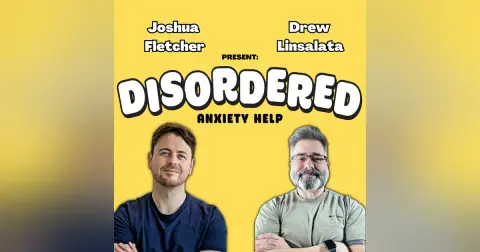
Anxiety Recovery and the Fawn / People Pleasing Response (Episode 72)

 Apple Podcasts
 Spotify
 YouTube
 Amazon Music
 iHeartRadio
 RSS Feed
 Fight ... flight ... or freeze. But what about the fawn response?
This week on Disordered, Drew and Josh explore the fawn response and people pleasing. While this may not be a response we see directly like we do with fight, flight, or freeze, the fawn response that leads to habitual and almost automatic people pleasing can get in the way of the recovery process. It's not exactly easy to choose to do difficult scary things to get better when you may have been conditioned by past experiences to keep yourself under wraps and not rock the boat or risk rejection or harm.
We're examining some common experiences that can deal to developing and fawn or people pleasing response and looking at how the fawn response can impact family relationships friendships, intimate and romantic relationships, and even career or social group performance.
One item of note. It's perfectly OK to be shy. Being considerate of others and trying to be a good person is not a problem. We're not trying to erase these parts of our personalities. Overcoming the fawn response and excessive people pleasing is not about becoming hyper-independent or insensitive. This is always about bringing behaviors and beliefs back into a healthy, beneficial place in one's life.
---
Struggling with worry and rumination that you feel you can't stop or control? Check out Worry and Rumination Explained, a two hour pre-recorded workshop produced by Josh and Drew. The workshop takes a deep dive into the mechanics of worrying and ruminating, offering some helpful ways to approach the seemingly unsolvable problem of trying to solve seemingly unsolveable problems.
https://bit.ly/worryrumination
-----
Want to ask us questions, share your wins, or get more information about Josh, Drew, and the Disordered podcast?
Visit us on the web at https://disordered.fm
---
Disordered Roundtable is coming! Think of it as "Disordered Live", a way for members of our audience to spend time with us in an intimate virtual setting (attendance is limited) to engage in real time sharing and discussion on specific anxiety disorder and recovery topics. To be notified when new Disordered Roundtable sessions are scheduled, sign up for our email list using the form on this page.
You might be going to work dealing with your OCD, your panic attacks, your agrophobia, etc., your intrusive thoughts. And then on top of that, you might be someone who finds it difficult to say no. And you're constantly people pleasing and you, at the expense of your own opinions and your own feelings. You worry about people's judgment of you. You're afraid to say no because you're afraid of that person that may reject you or push you away.
SPEAKER_01Or here we are a million years later, still really, really driven to work collaboratively and belong, to not be left alone, not be isolated. It's really hard to intentionally choose to be uncomfortable and trigger yourself and do scary, difficult things if you have been conditioned to keep yourself under wraps all the time or risk disapproval.
SPEAKER_02Welcome to Disordered. This is episode 72 entitled People Pleasing and Fawning. I'm Joshua Fletcher, also known as Anxiety Josh, and I'm a psychotherapist specializing in anxiety and anxiety disorders. I'm based in Manchester in the UK. It's a privilege to co-host the Disordered Podcast, Alam, and I'm the author of the book, and how does that make you feel?
SPEAKER_01And a good book it is. I am Drew Linsolata, the other co-host of this fine podcast. I am a therapist practicing under supervision in New York, specializing in the treatment of anxiety and anxiety disorders, an author, a podcaster, a psychoeducator, and a former sufferer of anxiety disorders and depression for many years of my life on and off, but doing better now. And happy to be here for episode 72. We're going to talk about people pleasing and the fawn response. What do you got on that, dude? It's a good one.
SPEAKER_02Oh, yeah. Well, shall we kick off with a did it anyway? We've got loads of written did it anyways, um, uh, and a scarcity of audio ones. So if you've got a did it anyway and you want to um send it in via audio, feel free to send it in. We've got loads of written ones, which we're really happy to have. But um, I was gonna ask you, Drew, can I have the piano music?
SPEAKER_01You can have the piano music. I will play that for you. I just had to find it because I wasn't expecting that. You caught me up. Sorry, I've I put that on you, didn't I? It's all right. I'm not even gonna edit this. People are just gonna listen to me fumble around my computer for you. All right, ready? Here we go.
SPEAKER_02Hi, Drew and Josh. One thing I'm very proud of is that I went to Wimbledon and I enjoyed it. I've been going through a stressful period which has triggered my OCD symptoms. I used the mentality, what would the me who doesn't care about anxiety do? And I'd rather be anxious at Wimbledon than be anxious at home. I had a great time on the whole, and it showed me that I can look forward to things. Thanks for all your work on the pod. Oh, I love that. That's really great. Wimbledon, so British. I wonder how Tim Enman did this year.
SPEAKER_01I don't know. I do because I don't know who that is, I will admit.
SPEAKER_02He was a famous um British tennis player who retired about 20 years ago.
SPEAKER_01You don't strike me as a people pleaser. I am I am not a people pleaser. I don't I don't try to not like people sometimes hear me and they think, oh, this guy's just abrasive and like confrontative. I'm really not, but I'm I'm not a well, maybe a little, but I'm not a people pleaser. That's true. So I have not really I have no personal experience with this people pleasing and font thing.
SPEAKER_02It's huge in our community because obviously anxiety disorders are one thing, but you know, under the whole umbrella of anxiety, a big one is people pleasing. This can apply to anyone, and it could be particularly tricky when it overlaps with an with an anxiety disorder. It's another worry that we can add onto the pile of worries. So if you imagine if you're someone who, I don't know, has to go to work, works in an office, works with people, maybe you've got, you know, quite an authoritarian boss. You might be going to work dealing with your OCD, your panic attacks, your agriphobia, etc., your intrusive thoughts. And then on top of that, you might be someone who finds it difficult to say no. And you're constantly people pleasing and you at the expense of your own opinions and your own feelings, which adds to our stress jug because we're just adding more pressure on ourselves.
SPEAKER_01And that's the does that I'm guessing that would play into the whole like when when I'm anxious, what if I ruin everybody else's time or I ruin it at work, or I ruin I screw up this project and everybody is angry at me. I'm guessing that would play right in there if you're a people pleaser.
SPEAKER_02Absolutely, and the pressure that you put on yourself to not be anxious because you want to perform or placate and make sure everyone around you is okay, is pressure we don't need when we're trying to overcome anxiety because what we need is is compassion and encouragement. When we try to hide anxiety, push it away, and go through our life day to day, trying to find that balance. What causes an imbalance is always putting your needs and other people's opinions of you first.
SPEAKER_01Yeah, that does make sense. And you know, I I wonder, it just popped in my head now, so I'll throw it out there. You would think that like this sort of I'm a people pleaser would lead to, well, I do everything out of fear of not, you know, of repercussions. I'm afraid people won't like me or whatever. But what about the flip side? The people who their identity is so based on being the good person that they get driven into people pleasing because they're worried about what they think of themselves. No, I'm I'm the loving person, the kind person, so I I take care of everybody.
SPEAKER_02I bet you that's kind of people, yeah, trying to people people please yourself and others. Um, we spoke about this briefly a few episodes back, um, about the fawn response. Because you know the fight or flight freeze fawn response. And we spoke about are you know you're a fighter, are you a flighter, yeah, are you a freezer, are you a fauna? And for the the fauna is uh is a really common one, particularly in our community. You know, you know you're a fauna when you are very sensitive to people's moods. You worry if people someone's in a mood with you, you worry about people's judgment of you, you're afraid to say no because you're afraid of that person that may reject you or push you away, and that doesn't necessarily mean intimately either. Yes, it can apply to relationships, but it can apply to friendships, family, uh, work stuff, and you're always that person who really cares and ruminates a lot about what people think because that fawn part of the amygdala, you know, the what the amygdala's decided no, you need to fawn now to feel safe. Now, what what what's the ad evolutionary advantage of that, Drew?
SPEAKER_01Oh, that's the evolutionary imperative to belong. You know, we just did better in groups for sure. Your chances of survival and passing your DNA along and perpetuating the species for sure was given to people who adapted naturally to have that tendency to to cooperate and work collaboratively. You know, if you look at it that way, like, yeah, the collaborative people just you know randomly popped up and they had a better chance of surviving. So here we are, you know, a million years later, still really, really driven to work collaboratively and belong, not be ostracized, not be left alone, not be isolated.
SPEAKER_02It can be scary. Yeah. Yeah, and particularly when you look at it from our ancestors and a tribe perspective. You know, if the big, strong alpha dude is a bit of a knob, but he's responsible for keeping the tribe together, yeah, you're gonna have to fawn. You're gonna have to just say, you know what, my opinion doesn't matter here. I need to keep pleasing this person so I can belong. Because I'm gonna survive in a tribe, I ain't gonna survive on my own in the wilderness.
SPEAKER_01You know, it's funny because I've heard people talk about that sort of stuff, and it's like, no, no, it's actually better from a survival and safety standpoint to go along with the wolves that are bullying you than to be against them. Like, I that's always an interesting interpretation. I've heard people say that. Like, well, I I know it doesn't make sense what I'm doing, but it just feels safer to let them kind of push me around and to oppose them because then they're gonna push me out of the pack. That's not cool.
SPEAKER_02Yeah, and don't get wrong, there's an advantage to it, it's not weakness as such, and like we said, that part of our brain has never evolved, but it's frustrating and can get in the way of your life when you're doing it every day, every week, um, at the expense of who you are, at the expense of your own authenticity, being in touch with yourself, your own personality. And it's sad when they're often hid it's often hidden who you really are, because all that matters, all the all the anxious response wants is you to feel safe not to be you, and that's why I love therapy as well, like exploring that. Like, come on, who are you? Let's get you out of the shell. But we talk about that because the fawn response is just as convincing as when the amygdala shouts, leave the room, yeah, run away, find a safe space. It's just as powerful to make sure this person's happy.
SPEAKER_01Is that the fawn response? It's interesting because sometimes when people would talk about that, and again, I have no personal experience with it, but you know, oh, is it showing up in like agoraphobia and and panic? So, or you know, are we really seeing that more in social interaction? Somebody has a panic attack and has the fawn response. Does that really sound right? Or are we talking about more in like interpersonal relationships and and social interactions?
SPEAKER_02All of it, really. I think if you're struggling with agrophobia or thing and things like that, it's even more difficult because people equal threat, equals threat. People are looking at me. So not only am I scared because I might have a panic attack, lose my mind, whatever. The extra layer is actually people uh looking at me, um, people are observing me. We get lots of memor messages at disorder.fm about there's pressure from my partner, you know, to do this. And yeah, I just thought it was a really good topic to talk about today because it applies not only to you, but many people, and is often associated with social anxiety. In fact, the form response is social anxiety in a nutshell, and there will be lots of people with social anxiety listening to this podcast and in your personal life.
SPEAKER_01Yeah, I would bet you'd see it a lot with people who have GAD too, that constant thinking and worry and rumination might be focused on social interaction, or did I piss this person off? You know, am I gonna get kicked out? Do they still like me? You know, very fine line there. They all start to, you know, kind of merge together, I guess.
SPEAKER_02Yeah, definitely. Now there's a bit, there's there's a distinction between being shy and socially anxious. Shy is okay, you know. If there's a room full of people gobbing off, that's the worst room to be in in the world. Uh being shy is okay, it could be a personality trait. That's not what we address, but social anxiety is I'm just afraid to speak because I'm afraid of the consequences of that, and that is often conditioned. Now, as a therapist, and you'll see this a lot, Drew, and look out for it kind of in in your work, is that lots of people are afraid to be authentic or to or say what they really mean because they're afraid of the consequences socially. Um, and it's conditioned often, you know. Um, where do you think it starts with conditioning?
SPEAKER_01Oh, you know, I mean, well, clearly, you know, as a child, it's gonna if you had the way your parents interact with you naturally, have you experienced acceptance, or do you have to prove your worth all the time? Or are you looking for, you know, cues? Did they like that? Did they not like displease with me? And you know, parents maybe who are a little bit, I don't want to use the word strict, but you know, don't do that like, hey, you're cool no matter what you do here. And it's okay to make mistakes, it's okay to say things wrong. You're a kid, you're learning, we still love you, we support you. If you don't have that, you might be conditioned to like look for disapproval. Uh-oh. Problem.
SPEAKER_02Yeah, yeah, definitely. And particularly when you're raised conditionally, like, I will show you my love as a as a as a parent. It's not just parents, but we'll start with parents. Sure. I will show you my love when you meet the conditions that I make. Now, if those conditions are not healthy or conducive, you're gonna struggle because you're you know you're genetically wired to adore your parents, particularly as a kid. You're gonna be searching for that love and affection. And if your mom and dad are dicks, that's gonna really mess you up. Your phone response is gonna be like I I want everything, this is everything to me for this person's love. Um, and I'm gonna fawn and I'm gonna actually see that I'll do anything. Not this doesn't apply to anyone, everyone, but some people are like, I'll do anything to make sure mom and dad are happy. And it's even worse because if you've got parents who can't be pleased because they've got their own stuff that they've never addressed, yeah, you often you often grow up as a fauner. Look at and then it and it and it'll seep into your relationships too, and you'll find you know, you often see that like, oh my god, I've married my dad, I've married my my my mom, you know, that kind of thing. This can be a facet of that.
SPEAKER_01So interesting. Sometimes I think this shows up too, because this gets into that gray area where it's like, oh, are you saying that like my childhood was the cause of my anxiety disorder? Well, it certainly could be a contributor. We've talked about this before, like in our trauma episodes. But where I do see this sort of stuff is it's really hard to intentionally choose to be uncomfortable and trigger yourself and do scary, difficult things if you have been conditioned to keep yourself under wraps all the time or risk disapproval. And I definitely see that even in my client work now, where like expressing my emotions, including I'm afraid, is not okay. I can only express happy emotions because I was given conditional acceptance. As long as I was happy, it was cool. But if I was sad or if I was scared, not so much. So now I always try to be happy all the time. And how the hell am I supposed to do exposure? Because then my partner and my family will see me unhappy and triggered. And I can't have that.
SPEAKER_02Yeah, sometimes maybe think like it's even it's woven, particularly in British culture as well. It's like someone gets upset, everyone does the mini phone response, which is oh, I'm sorry, I'm sorry for burdening you with my emotions. That's a mini phone response. You're probably having an authentic reaction to something upsetting, but immediately the priority is the other person. How is me being upset going to affect this person's satin? I get it as a therapist. People pay me money, I was gonna bring that up to be emotional, and then they apologize to me. Yes. I'm like, well, that's you. I'm a therapist, you're supposed to do all that. Cry all you want, you know, it's all good. You could you can express anything in here, but yeah, it's that phone response. Now, for some people, it's okay, it's it's manageable, you it doesn't get in the way of life, but for other people it's horrible. It keeps them in jobs they don't want to be in, it keeps them in relationships that they don't like. Um, it stops them from it makes them avoid social interactions. It's it can be quite crippling, and and it's sad because you don't the phone response stops you from bringing who you really are to the surface.
SPEAKER_01Which I think is difficult because if you want to tie this, you know, so maybe the fawn response, yes, maybe you'd see it more directly in GAD and social anxiety, but even if you're dealing with OCD and things of that nature, it might express directly as part of the disorder, but it could get in the way of the work you had to do in recovery. You know, that that fawn response where you're going to just be a little bit more timid and a little bit worried about what the world thinks about what you're doing makes it harder, I think, to do difficult things sometimes. Because you're not only, yeah, you're always looking around you to see what you're doing is is upsetting the world. And that's really if you're super afraid doing an exposure, it's very difficult if you have a the fawn response or you're a people pleaser to discount how that is impacting the people around you, even though they might not be noticing at all, you're really worried if they're noticing or not. So, yeah.
SPEAKER_02Absolutely, and also I fully believe that if you want to go over an anxiety disorder, you've got to have some level of self-esteem. If you are uh, you know, fawning constantly and really socially anxious, you're that's gonna be an indicator of low self-esteem. And so sometimes in therapy, and this is why I love therapy, like yes, we we do the hard things, and but therapy is all encompassing because then I would work on self-esteem before even starting the exposures. Be like, okay, let's let's look at what does this mean to you? What's this what are these beliefs about yourself? You know, because if if you're asking yourself and challenging yourself to do difficult things and you already don't think you've you're very strong or worth much, that can backfire. Um, and particularly if you're a fauner, um, I think it's also important to look at more conditioning. So we we spoke about parents, but a big one for me was at school. Sure, friends, social groups. But just getting bullied for years, every day for years, your brain, your you know, your threat response. I don't know if we've got the the the um you know the amygdala button. Yeah, he's always here. Amygdala is remembering and coding all of these memories, you know, and I've noticed it as well, like even as an adult, I'm fine now, it's okay, I'm you know, confident and things like that, but and content. But I remember when I when I get stressed, or if I'm anxious about something and I go out to like a music gig or something, I notice that form response in my head just a little bit, but I'm looking around me, I'm looking over my shoulder just in case someone's gonna get me. Because my brain remembers that when I'm in that state, I have to be careful because at school, you know, people come after you and beat you up and you know, take you behind a sports hall and kick seven bells at you. That doesn't happen now, but the amygdala remembers, and that's only me. I live a content life, but for some people, it's so alarming, yeah. That they have, and particularly people with PTSD who's been on the end of abuse. It's this it's a similar thing, and and yeah, I just want to bring people's attention to the form response, yeah.
SPEAKER_01And social situation, not just parents, then.
SPEAKER_02Yeah, social situation, bullying, yeah. A big one, a big one with relationships.
SPEAKER_01Oh, that's what I was gonna say, too. It's intimate partner relationships for sure, you know, even family siblings, you know, that those things matter. When you were said, you know, well, I'm I'm better now, I'm confident. Clearly, that's how I know you. I don't I don't know you as somebody who seems easily bullied, but okay, in your in your past you were. And one of the most interesting things I ever heard was when Stephen Hayes was on, and he said, uh your nervous system has no delete button. You can only make new things, you can't delete the old ones. So I think sometimes people, especially if you're gonna have that low self-esteem, or this guy the critic, is always chiming in. It's gonna be the whole like, but I don't understand why I still react that way. That's not a crime that you still Josh is just telling you, like he still has that little bit of a thing. You're not failing. It's okay. You know, so you have to write new routines to go with the old ones, but you're not trying to delete your phone response. You can't delete it. You can always can only add more to your repertoire. I think it's really important.
SPEAKER_02That's really important. Uh yeah. And so, yeah, so and particularly people that are like, I've gone back to square one. No, you just go back to an old habit. Go back to the new habit.
SPEAKER_01Yeah, you're feeling things that you might feel sometimes. Okay. Um, that that intimate partner relationship thing, it's interesting because now as doing client work, which is I don't know how quickly hundreds of just ridiculous. The training is ridiculous over here. But, you know, when you hear that, which I hear all the time, like, oh, well, you know, my my partner, or sometimes it's a sibling, you know, a very close sibling. My sister gets really upset when I get anxious. You know, she she thinks she doesn't like me when I'm like that. And you almost, as a therapist, in my opinion, the follow-up question to that has to be, well, forget what she thinks about you, or he or her. What do you think about you when you're in that state? Like you gotta go right there. Like you were saying, it's that self-belief that comes from that conditioned background. Because, you know, contrary to popular belief, a therapist is not gonna be like, oh, well, that's because your sister is a narcissistic gaslighting abuser. No, we're not gonna go right there right away. But like, what do you think of you? And let's see where that comes from. Because if that's standing in the way of your recovery activities, then we we care about that. Or you might care about that as the as the client. I don't like it like this, I want to fix it or change it.
SPEAKER_02I also as well, it's important to realize that it was probably part of a safety behavior that did help you. So if you grew up around abuse, conflict, violence, if your if your household always had things smashing and you witnessed violence, stuff like that, or when someone got angry, that meant that you're unsafe. This could be an ex-partner, your current partner, this could be people growing up, your siblings. A literal safety behavior would be to feel safe, I must keep this person calm. You know, I don't necessarily mean safe violence as well, but also someone could just be vicious with their words, hurt you emotionally, you know, and this that as well. And so if that's happened to you, and unfortunately, listeners of this podcast will this will have might have happened to some of you, yeah, um, is that you might take that into other relationships too. And sometimes you end up in a cycle. Um, interestingly, I had a client many years ago, and I set them a homework because they were so I noticed the placation. So it would be like I'd be like, when you're free next week, and they're like anytime. I'm like, no, you're not. You have a you have a personal life, you're not free anytime. I'll work around you. I was like, no, let's work together. Uh and because I noticed they were placating me. And so we worked a bit on that. And then I remember one of the homeworks I set them, which was one of your homeworks is to cancel on me 10 minutes before the the appointment. You won't be charged. That's really good. I want you to cancel, I want you to ring me and cancel 10 minutes before. Don't tell me when. Yep. Just cancel, and you know, we won't, I won't charge you. It's so hard for people to use. Oh yeah, oh yeah, yeah, yeah, yeah. They did it, though, they did it. I was like, I smiled, I was like, No, you go.
SPEAKER_01I love that. That's really that's actually very creative. It's funny because one of the first uh yeah, I can't, you know, nobody knows, but like there was uh the first sort of intake thing, and like this person leaves, and there were stairs in that particular office that I was in at the time when I first started in the winter, got to the bottom of the stairs, turned around, came back up because you know, had to apologize in case some of what she had said was misinterpreted. And that was that's a fawn. Yes, I said next time you want to apologize to me, don't just sit with it for a minute and then tell me what you were thinking about saying. We can maybe work through that. But so interesting how that came out immediately, you know.
SPEAKER_02So, yeah, yeah. And you know, uh some subtle fawn responses are like constantly asking you okay. Don't tell me there's nothing wrong with asking someone, are they okay? Are you okay? Are you sure you're okay?
SPEAKER_01Because it's all become about your feelings. Yeah, yeah, because your feelings will trigger bad feelings in me, and I don't so I'm gonna try and manage your emotions so I don't feel bad, too.
SPEAKER_02Which is you know, part of that very similar similar. It's like the fight response. So the with the with the sisters, like stop being anxious, you're making me upset. Yeah, it upsets me when I see you upset. That's almost like the fight part, isn't it? It's like I'm gonna be forward and direct about my feelings because they're fight or flight. It makes it making them anxious, but in a different way. But with the fauna, it's are you okay? Is there anything I can do? Is you okay, you know, in a way that isn't healthy. Don't get me wrong, be helpful, be nice, be selfless. That's lovely. Yeah, but notice you're doing it to appease yourself because that anxiety is so strong.
SPEAKER_01It's interesting because I think well, there's the we I think we've been talking a little bit or leaning more toward people pleasing fawning that relies on not failing or not disappointing. But what about the flip side where your can your approval was you weren't a bad kid? It wasn't like you got praised when you stopped being bad. But what about when there was no response except when you excelled and then you knew you were worthy? So, like the people pleasing comes out as like, I always have to do it perfectly right. I cannot get it wrong because that was my worth. My worth was the person who did it fast directly and damn near textbook, or it doesn't work. Oh, I think we have a sound coming up. I can't be sure.
SPEAKER_02No, I was just gonna say just gonna just redo this guy.
SPEAKER_03It's Craig, the critic.
SPEAKER_02Yeah. Um, because these are the perfectionists. How many uh we did an episode, applying perfectionism to recovery. I wonder if we can do like a little hypothetical kind of tally of perfectionists, you know, and faunas.
SPEAKER_01I because I suspect that they might be related to a certain extent. You'd have to tie it back to oh, my worth was shown to me when I was when I high achieved, whatever that was in the moment.
SPEAKER_02Yeah, yeah. So therefore, mom and dad, I got a I got a B in my essay. Why didn't you get an A?
SPEAKER_01Right. Or nothing except when I got an A, and then you got excellent, great job, so proud of you. Which is surprisingly a large number of people who are exposed to that too. So who knew all this, you know?
SPEAKER_02Yeah, I was lucky. My mom was like, Did you try your artist? I was like, Yeah, just like, well, that's all that matters.
SPEAKER_01Yep, do the best you can. Which is proud. Just do the best. You know what I have definitely found, whether it's in our our community, a large shared community here or the client work that you do, it's amazing how many people never really still as adults have to get their brain around like it's okay to just do your best. Like you won't be rejected for doing your best. It's a foreign concept to them. They can't, it's really hard for them to take that on and start to incorporate that.
SPEAKER_02Yeah, well, you've got people out there with really harsh, strict parents with a have a binary view of success. Yeah, don't get me wrong, it can sometimes come from love or their own anxieties because they don't want you to fail, maybe in a way that they did, or it's become egocentric where they want you to continue their legacy, or they could just be whatever, it can come from something. Um, but it does just just because you've had those interactions in the past doesn't mean that that's the rule book for how you can live your life, you know, and and it's really important. And this applies to people with anxiety disorders too. Like it might compound the feeling that you're a failure and start encouraging comparison comparative behaviors and comparing yourself to other people. But don't it doesn't matter, you're just on your own little journey, and you'll get there and make learn your own lessons on the way.
SPEAKER_01We all learn new things as we go along the way until our last day. Just, you know, maybe you have to learn this now, and that's okay. Yeah, I think the other part of that for sure is the whole like it feels like, well, I'm why am I like this? You know, it feels like failure that I'm I'm 42 years old and I still have and I'm still trying to people please. What's wrong with me? Well, I I'm also starting to form this general conceptualization of anything that becomes like an operationally impactful problem, like you and I might treat with a client, because only you get to decide. If it's not a problem for you, then it's not a thing that a therapist treats. But if it does become a problem, I'm starting to see that in the case of anxiety disorders, most of the time you can trace that back to something that was at one time adaptive and useful and just somehow got caught on fire and now was burning out of control and got twisted. So, like, you know, uh being sensitive or being concerned about other people is a nice trait. And then somehow or other, based on things you've learned and your environment, that got something set that on fire. And now you have this overwhelming people-pleasing or fond response that now you now is negatively impacting your life. So it's it's interesting. It's not failure, it's just probably something that at one time was useful to you, or is a nice part of your personality that's just morphed and taken over the building.
SPEAKER_02I like that, that reframe. Yeah, it's not a weakness in itself or anything like that, it's just overamplified. You're over-amplifying that consideration. You never lose being considerate, but the consideration bit is so overamplified now it's not helping anyone. Yeah. Because you forget your if you fawners forget their own boundaries. That's true. They'll keep saying yes to tasks when they've got no time left. Yeah. And then that adds to their stress drug, and then they wonder why they're having panic attacks and insomnia.
SPEAKER_01How about a little mini rant to follow up on that? Go on. You know, you you mentioned the word boundaries, so let's go on a little mini social media rant. Because I think part of it is, and you also said don't lose being considerate. That's a good part of your personality. You're not trying to erase that. But sometimes I think people who are listening who like, yeah, my people pleaser, I've the fawn response in a big way. It's from my parents, whatever. And some of the mainstream advice we hear used all the time is you immediately go to you got to learn to set boundaries, true, but they are like the walls around Guantanamo bay boundaries. Automatically, nuclear, cut everybody out, nuclear option, leave the toxicity behind, cut out the abusers. That is so extreme and ironic. Yeah, right. It's crazy when you think about it. So sometimes you could be led into this thing where the response that the social media, whoever's posters, I'll say I'll be kind, are almost teaching you or trying to get you is now you have to go from being a people pleaser and a fauner to you all can't handle me. I'm too much for y'all when I show my true self. What's up with that? They're all they're all tits.
SPEAKER_02They're all tits. I think it's weird.
SPEAKER_01It's a difficult position for somebody to be in. Like, oh now I have to be that, I have to become like a raging, like uh you all just dial down what you already have, just dial down what you already have uh and make subtle changes.
SPEAKER_02So some of those powerful boundaries you can have is just like one the first one is saying no. Yeah, fawners find it difficult to say no. Someone says, you know, can you come do this for me? Fawn response activated. Rational brain says, I don't want to. Yeah, fawn anxious brain says, but I don't want this person to feel ill of me. Yeah, say no and see what happens. And if that person probably isn't gonna feel ill of you, um saying no, um saying your opinion in a group of people just to someone else, disagreeing. Yeah, yeah, I disagree with that, you know, not laughing at a joke that isn't funny, you know, like you don't have to feel polite to do that. These are all common little fawn behaviors, true, you know.
SPEAKER_01Um and then the trick there is not going into analysis mode after you do those little experiments.
SPEAKER_02Uh oh oh oh yes, yeah, having the shower, the post the post-interaction shower analysis, or lying in bed going, do they hate me? No, don't hold on that rumination hole.
SPEAKER_01Now I have this really bad feeling inside of me because I said no, I couldn't pick up my friend at the airport when they asked. And now I feel bad about me, and now I have to try and fix that feeling. No, that the moving forward or the changing or the incorporating of new concepts is no, no, you can handle that feeling. Like that feeling will come and go like any other, and you'll be able to like more accurately gauge what that impact really is on your friendship. So that's tough for people. If we don't give that's the RP part. If it's if it's exposure and response prevention, that's the RP part, which is the most important part.
SPEAKER_02Yeah, or you can go hardcore. So I I with my exposure, I went into the gym, went up to the biggest, muscliest guy, toughest guy in there, and I said, move. These are this is my weights bench. Respect my boundaries, douchebag. And then he was like, and then he started fawning. It was like, Oh, yeah, yeah, your anxiety, Josh, you're a big tough guy. I'm not gonna uh mess with you. Um, obviously, I didn't do that. Can you imagine?
SPEAKER_01Oh but just by saying Josh still has one eye swollen shut, but it's fine, we're here to record, you know.
SPEAKER_02So yeah, just say it just say no. Is it it's weird and sitting with the discomfort after it, you're so right, Drew. It's it's it's not the saying it, it's the challenge is after you do it.
SPEAKER_01That's right. Because you when you do that and you're gonna say, well, hey, you know what, this the my people pleasing, my phone response, it's out of control and it's negatively impacting my life. So to change that, I'm gonna have to work through some bad feelings. I don't just, you know, oh I'm gonna I'm setting boundaries now. And I think sometimes, and I don't want to continue the mini rant, but I do think it's connected. Sometimes the alleviation of the discomfort is I'm going to say no when you ask me to pick you up at the airport. Okay, that's a pretty big deal. And to get wiggle out of this discomfort, now I'm going to accuse you of being a taker and an abuser and toxic. Oh. Well, that's there are, listen, there are toxic people in the world. I'm not trying to deny that, but at the same time, sometimes they set your boundaries and then attack the person because you had to set a boundary with them is it is a way to try to alleviate the bad feeling.
SPEAKER_02Well, well, that will happen if you're in some form of abusive relationship. Well, yeah. Um, it's just it's interesting as well. Like fauna, I often hear this, particularly from all my friends, but particularly my women friends. Uh the ones that always say, Oh, I always end up with the wrong guy, you know, and I always end up attracting the same kind of person. And I think sometimes it's not I don't think it's the same person, but it's it's a similar dynamic that occurs where they're so desperate to want to please and be in a happy relationship that they forget from the start, from date one, to lay down what they're about and what's acceptable, what's not, and and being authentic. Instead, it's a lot a lot of it's like smiling and people pleasing, and I want this to be good, yeah. And then they finally realize actually the dynamic doesn't work there. I'm not giving dating advice, I'm the last person to be able to give that. But like uh, but in general, like the from an anxiety perspective, you know, uh the healthy view of boundaries are you know, and respecting that as well, but done not in a reactive, explosive social media way. In a I'm gonna sit down, preferably even therapy. And if you are a social anxiety fauna, people I love therapy for that, and not just like CBT anxiety disorder stuff. Yeah, good therapist, maybe on um attachment and stuff like that, is really good to understand. So when you are coming to the anxiety disorder stuff, you know a bit more about your brain and what it's about.
SPEAKER_01Yeah, and you could be a little bit more, I think, kind to yourself. I mean, hell, ain't nobody more specialized than me in anxiety disorders, but in the work that I'm doing with clients, it cannot always be CBT MCT Act. It cannot always be that at all. Sometimes you just gotta explore some stuff because it helps you be a little less critical and more accepting of who you are now and maybe why. And now I can work on it a little bit better.
SPEAKER_02Yeah, you gotta do it. And it's also an insight into how you're talking to yourself during difficult things. I said from the from the outset, and when we did this, like we talk about compassion. If you ain't being compassionate and kind to yourself, you ain't gonna do the exposures properly.
SPEAKER_01It's really hard, yeah. Yeah, you cannot be beating yourself up all the time. So yeah, that was a lot of fawning and people pleasing.
SPEAKER_03Yeah, yeah, yeah.
SPEAKER_02I actually disagreed with everything you said during that. I was just nodding and smiling. Josh is fawning. Yeah, just uh absolutely. Um did it anyways, right? I did it anyways. We got a question, did it anyway?
SPEAKER_01Should we have read a did it anyway again? Yeah, well, we'll do I have a did it anyway, all the way from Sweden. I'm not gonna say the person's name because he did not tell me we could do that. Um, hello, thank you both for a very helpful podcast. I would like to share a success story that I'm happy and proud over, which is always good. Uh, about a year ago, I was off at a job at a court in Sweden where I live. I was very excited about this opportunity. Apart from one detail, I had to once in a while work on cases involving people who I committed crimes while suffering from a mental disorder. Oh, I know where this is going. I suffered many years of panic anxiety and appear and experiencing DPDR made me fear for a long time that I was losing control or going crazy. About three years ago, I finally decided to do something, stumbled across across your podcast and books, and I've been doing so much better since. However, once in a while I still have anxiety in parentheses, as one should, very good, and can experience short moments of DPDR. And usually a quick thought pops up what if this is not anxiety and you're actually having a psychotic break? Because my fear of going crazy, I have never Googled symptoms of psychosis, schizophrenia, or similar, terrified to recognize any of the hallmarks. However, with this new job, I would have to read through medical journals and sit down in courtrooms listening to people actually suffering from these disorders. Ooh, this is difficult, right? This became a very long email. That's okay, dude. But long story short, a year has gone by and I am so glad I did it anyway. He accepted the job offer despite being anxious about it. And with time, he's actually come to enjoy the psychiatry cases and finds them very interesting. My would ifs have also become less convincing there this year. Many thanks for all the work you do and educating and helping people around the world. Very good. I love that. That's amazing.
SPEAKER_02That was so good. Um well done. I mean, great, and it's use of ERP doing it there. I'm gonna do what narcissists me would do. Yeah, and you don't regret it. Uh we get a lot of those, don't we? Fear of psychotic breaks and things like that.
SPEAKER_01It's right, it's in the top three or five for me, for sure, in terms of the number one here.
SPEAKER_02I'm wary of the time, so I'm gonna save the question. Let's save the question for the next podcast. But I do want to read an uh another did it anyway. All right, let's do it. Um that we've got here. You ready? Yeah, let's do it.
SPEAKER_01Oh, do you want music? I want piano music again. We'll give Josh music.
unknownHang on here.
SPEAKER_01Here we go. Ready? Hi, Josh and Drew. I'm playing the wrong thing. What the hell are you doing? I'm not even gonna add it. Too bad. I have to listen to it. Here we go. Have attitude.
SPEAKER_02Hi, Josh and Drew. You can use my name. Hi, Helen. Anxiety hit me over the head in February this year, although I'd always had tendencies towards rumination and overthinking. Your podcast has been immensely helpful to me, the single most helpful thing in my recovery, in fact. It has changed the way I think about my own thoughts and feelings. Well, thank you, Phil. I wanted to share a did it anyway. Work offered me an opportunity to speak at a conference in my second language in a country I've always dreamed of visiting, and one that is quite off-the-beaten track for visitors from the UK. This was during the peak of my anxiety, but I managed to think about what non-anxious me would do and agreed. A few months and two long flights later, I was there and my inner critic was screaming at me that I couldn't do it and it was all going to go wrong. I willfully tolerated and also white-knuckled a bit, to be honest, and got through my presentation in front of a hundred people. I didn't feel an immediate sense of relief afterwards. Anxiety wasn't going to let me off that easy. I was beating myself up about my performance for a while, and it took some days for me to give up give myself the credit and feel grateful for what I managed to do. I then had an amazing, memorable week of holiday traveling around that country with loved ones who came to join me on the trip. I started feeling better and better about what I had achieved, and I and feel I have learned a lot to take forward into scary experiences in the future.
SPEAKER_01Oh, that was so great. I love that one.
SPEAKER_02Lovely that. And again, that balance of compassion. I am all about the compassion. Your values, guy. I'm compassion guy.
SPEAKER_01I love it. Good job, Helen. You know what I love about Helen? She re she did it imperfectly and still was happy. And when she says, uh, you know, well, hey, I was a little bit white knuckling too. Yeah, that's okay. No crime, no beating yourself up. Good job, Helen. Love it. Well done, Helen.
SPEAKER_02Well done. Um, and well done to the guy from um was it from Sweden, Denmark. Um thank you for sending that in too. If you would like to send in an audio did it anyway, or written did it anyway, you can go to disordered.fm. Um if you want to follow us on social media. I'm at anxietyjosh, and Drew is at the dot anxious.truth. Um, we'll be back again next Friday, every Friday. Um, we really appreciate you um tuning in. Thanks for listening, peeps. We'll see you next week.