
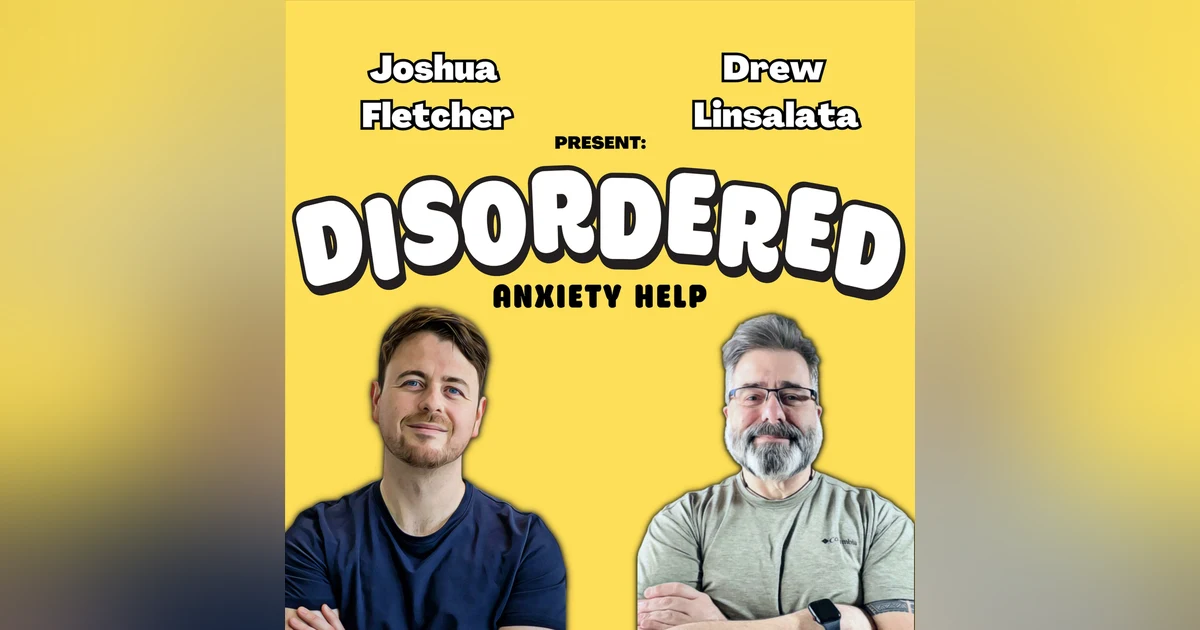
Anxiety Recovery - Am I Doing Too Much (Episode 115)

 Apple Podcasts
 Spotify
 YouTube
 Amazon Music
 iHeartRadio
 RSS Feed
 Am I Doing Too Much Recovery/Exposure?
This week Drew and Josh tackle a common question in anxiety recovery: "Am I pushing myself too hard with exposures?" The guys explore the nuanced balance between challenging yourself and recognizing when you might genuinely need rest.
In this episode:
- How to distinguish between being genuinely depleted versus being scared
- Why feeling anxious after successful exposures doesn't mean you've done "too much"
- The difference between active, reasoned decisions to rest and anxiety-driven avoidance
- Special considerations for people with OCD and chronic health conditions
- How to balance recovery work with other life priorities like family time
Featured listener stories:
- Nicole shares her experience flying to Munich for a Champions League game and wondering if she's overdoing exposures
- Tyler's victory over health anxiety by choosing the gym over Google searches
- Matt's success working an 8-hour shift without his "safety person"
- Chris's inspiring story of dating while tapering off medication
While you can't actually "break" your recovery by doing too much, it's important to allocate your resources wisely and remember that feeling scared doesn't mean you've made a mistake - it means you're doing exactly what recovery requires.
---
Disordered Roundtables are here! Think of it as "Disordered Live", a way for members of our audience to spend time with us in an intimate virtual setting (attendance is limited) to engage in real time sharing and discussion on specific anxiety disorder and recovery topics. To be notified when new Disordered Roundtable sessions are scheduled, visit our homepage and get on our mailing list.
---
Struggling with worry and rumination that you feel you can't stop or control? Check out Worry and Rumination Explained, a two hour pre-recorded workshop produced by Josh and Drew. The workshop takes a deep dive into the mechanics of worrying and ruminating, offering some helpful ways to approach the seemingly unsolvable problem of trying to solve seemingly unsolvable problems.
-----
Want to ask us questions, share your wins, or get more information about Josh, Drew, and the Disordered podcast? Send us an email or voicemail on our website.
---
Disordered Roundtable is coming! Think of it as "Disordered Live", a way for members of our audience to spend time with us in an intimate virtual setting (attendance is limited) to engage in real time sharing and discussion on specific anxiety disorder and recovery topics. To be notified when new Disordered Roundtable sessions are scheduled, sign up for our email list using the form on this page.
Hi Drew and Josh. So, first of all, um, I want to thank you so much for everything that you do. Especially, I want to thank you for all your juvenile jokes because the way you uh talk about this topic with such lightness really helped me change my mindset also around my anxiety and my panic. Uh so uh please keep those juvenile jokes coming. And second, I'm gonna share my did it anyways. I uh was diagnosed with panic disorder with agoraphobia a few years ago, but since I started doing exposure since a few years, I've been getting much better. I have a completely uh I would say normal life. I take flights, I do everything, but from time to time I get resensitized. Last week I flew out to Munich, uh, went to a Champions League game, I came back, I was very proud of myself because I'm doing it. I take the anxiety with me and we both have a blast. The thing is, I think I'm doing so much exposure lately that yesterday I had a few waves of adrenaline coming my way. They were coming and going, coming and going, coming and going, and I felt completely scared and depleted, and now I'm on this hyperarousal states that I'm stuck on. And next Monday I am traveling again. So I'm going out on a flight for eight hours alone. And now I feel like oof, I I don't know if I can do it.
SPEAKER_04Welcome to Disordered. This is episode 115 of the podcast entitled Anxiety Recovery. Am I doing too much? Uh I'm Drew Linsolata. I am the co-host, one of the co-hosts of Disordered. I am a therapist practicing in New York State under supervision, specializing in the treatment of anxiety and anxiety disorders. Uh, I am also a former sufferer of the very problems we talk about on this podcast, but much better now, uh, three-time author on the topic, uh, guy with a microphone, social media dude, and uh yeah, happy to be here.
SPEAKER_03Joined as always by I'm Joshua Fletcher, also known as Anxiety Josh, and I'm a psychotherapist based in Manchester in the UK, specializing in anxiety, anxiety disorders, previous sufferer, author, content creator, podcast, co-host, etc.
SPEAKER_04Etc. etc. First of all, thanks to Nicole for sending in. Her did it anyway, she gets this for her trip to see a Champions League game, which was pretty cool.
SPEAKER_03Oh, yeah, going to the Allianz Arena. I've I've always wanted to go. I've not been uh I've been to uh Munich a couple of times, but never been to the stadium.
SPEAKER_04Yeah, you guys have those crazy football stadiums that are just massive over there. Yeah, the atmosphere at German football matches is amazing as well. And then Nicole had a question. So it was the, you know, it's a did I do too much? Am I doing too much? I'm doing so many exposures that now I'm suddenly feeling maybe depleted and a little bit more, you know, run down, which means I'm feeling things a little bit more. It's a good question. You know, am I doing too much? I get the question all the time.
SPEAKER_03It is a good question, it's nuanced, isn't it? Um it depends. Um, are you doing too much? If you look at it all holistically, like actually, you know what? I can't keep my eyes open, I'm exhausted, you know, my my mood's terrible, I my body's screaming for rest. Then, you know, maybe you can, you know, wind it in a bit. But kind of what I'm getting from the question is, hmm, I'm getting I've got an eight-hour flight. Does that equate to eight hours of extreme anxiety, sweating, holding on to the back of the chair in front of me, eight hours of pure exposure, adrenaline pumping, and is that gonna break me? Uh, and then and as we know with anxiety, you know, you're not gonna be on an eight-hour flight freaking out for eight hours continuously.
SPEAKER_04Yeah, yeah, that's true. I I think the too much question too really revolves around well, I I'm feeling things again. Like, you know, if I get tired or I get run down, or I have a really anxious moment during an exposure or meeting a challenge, then I might have another anxious moment after that. And I don't like having anxious moments, so does that mean that I did too much and that's why I feel things again? So there I understand the question, it makes sense. I understand why people ask the question for sure. But I I think baked into the question is still a little bit of that thing where I'm hanging on to the idea that I'm I'm supposed to never feel like this again. If I feel like this, I'm doing something wrong.
SPEAKER_03I think it's balancing your resources. Some people they might have a when you're talking about exposures or doing scary things, they might have to look at the resources that they have for that week and be like, well, can I fit in an exposure today? Maybe I'm a functioning agrophobic, maybe I'm someone with social anxiety that perhaps doesn't want to go to something because I've got deadlines at work and I've got to look after the kids, and maybe I don't want to do that, maybe I have finite resources, uh, and that's completely okay. However, you know, as a therapist, we'd always look at like what how are you measuring these resources? Is it the illusion that anxiety gives you or it tricks you into thinking you have a tiny gravy pot of resources and you can only use a bit at a time? Um for each for for each person, you kind of know your limits, but at the same time, nothing bad is gonna happen necessarily if you are you know diving into the scary thing. So it's up to you. You know, we can't really define what the limit is. What I would say is if anxiety is going, oh, what if you do that and you fall apart and break, then pretty much go and do it.
SPEAKER_04Yeah, I think part of it is the re you know, resource allocating resources is true, but I think also it's the now I don't want to do it again. So the resensitization is like, well, now I feel a thing, and now I don't know if I could do it again is part of the I did too much and I broke something or I moved backwards or I slid backwards, and now I I should maybe think twice about doing more things. So within the the context of allocating resources, like you said, maybe you do have to rest, and that's okay, rest is totally fine. But if you if you can identify that, like, well, yeah, I'm tired and I do need to rest, totally fine. You're not ruining your recovery by resting. But if you can determine that, like, no, I I think I'm pretty I I'm okay, I'm not depleted now. I'm just scared. So we can identify the difference between depleted and scared. It's okay to be scared. Remember, that's how you started doing the exposures to begin with. So if you feel like I'm doing too many, it's been going great, but am I doing too many? Well, you started doing things when scared, which is exactly what you were supposed to do. So scared doesn't mean oh I I did something wrong. I did too much, and now I'm scared again, and that tells me I should stop or scale it back. I don't know if that makes any sense. There's a very fine line here, there's a lot of nuance in this.
SPEAKER_03There is a lot of nuance, and and ultimately, you know, we're we're teaching people to be compassionate to themselves and take and take it at their own pace as well. So I think many years ago, I I had when I was in London for something and I was working all day, and then I saw a friend for a coffee, and then yeah, I was probably scared to get on the London Underground. Now, my plan was to get on the London Underground that week, but I remember saying to myself, you know what? I've been working all day, I've done all that, I just want to go out and chill out because I want to be kind to myself, and exposures are being kind to yourself, but not in the in the moment, you know. And I and I actively said, Yes, I am choosing to avoid now. This is avoidance. I'm not gonna beat myself up for it, but what I will do is tomorrow, I'll I'll I'll I'll you know, I'll meet it halfway. Where's the compromise here? Tomorrow I'll make sure I you know I when I've had a nice sleep, I'm gonna try it then. And I did, you know. Now it wasn't a failure that I didn't go on it then, but I made sure that I did go on it because it's new, it's my life. I I'm just balancing my own resources. I wasn't going, oh my god, you can't do it now, you're avoiding, you're not doing anxiety recovery correctly. I had my eye on the prize and my eye on the goal, and I was it was all part of this plan to do it within that week, uh, and so therefore, I would say, you know, that's okay. That's some something that you can do. However, in other cases, it would be like you can just go into pure avoidance, where it's like you start to justify avoiding all the time and building your life around it. So if I'd have woke up and been like, actually, you know, maybe maybe the compromise is I just get on the bus for three hours instead of going on the on the underground, um, you know, and then and I'll do it next month instead. Then I'd be like, no, you've lost the momentum there, you know. So it's a bit like, yeah, is it gonna break you? It was more inconvenience. I knew getting on the tube wouldn't break me, but that I was also like, I kind of just want to chill out and in and balance my week, if that makes any sense.
SPEAKER_04It does make sense because you know, am I doing too much? That question often you get to participate. Like, I think that's another hallmark of of what you can, or at least a thing you can look for, a signal you can look for. If I feel like I can participate in this decision, like you did, you know, well, I am actively going to think this through and like, yeah, I understand it's probably not the best thing to bail on the underground, but I'm also really tired. I need some rest, and I I'll I'll live with this decision and I'll pick it up again tomorrow. That's an active, reasoned, participatory thing. If you are feeling a strong urge to just not get on the underground or not get on this flight to do it again, you know, for what Nicola's talking about, and there's no reasoning there, it's just I'm afraid I shouldn't do this. Well, that's a good sign that, you know, you have to take the, oh, I did too much and now I'm gonna break myself. If we look at the if we back up and say, is there too such a thing as too much? The answer really, objectively, I think, is no, there's not. From a you can't destroy your recovery, you can't break your brain, you can't do those things. It's okay, you're safe, even if you put your stuff while you're tired. But that doesn't mean you have to put your stuff while you're tired also. There's there's no point in that. I mean, to be honest with you, even in a fully recovered state, years and years down the road, writing books, podcasting, and becoming a therapist, I had last week was one of those. My brain will still go there sometimes. And I have to stop and think, like, well, I could drive to the office and go through all the traffic, but I really don't have to do that today. And like, I'm stressed out, I'm feeling it, like I really feel like it needs a break, and I have to think about that because my mind will still think, oh, am I am I deciding to not go to the office because I'm still somehow there's some part of my brain is still asking, like, am I am I avoiding driving to the office? No, I just had to I just have to allocate resources intelligently. Yeah.
SPEAKER_03I think we should talk about the role with people with OCD as well and what it looks like there. But I would like to listen to a Did It Anyway, please.
SPEAKER_04Let's do that. We happen to have one on tap, and here it is.
SPEAKER_01Hello, Drew and Josh. Uh, my name is Tyler. I'm from Wisconsin, United States. Feel free to use my name. Um, I just wanted to share a win with you guys as well as share my appreciation of your podcast. I've had uh panic attacks starting about three years ago. I've since then gone on medication and um I see a therapist regularly. And uh I then I found your podcast, and um, that has helped me so much uh through this anxiety journey I'm on. Um I don't have any panic attacks anymore uh per se, but it uh it appears I have health anxiety when um the anxiety symptoms present themselves. I feel like I'm having a heart attack. Yold me with constantly make doctor's appointments, check Google, see if I'm dying. Um, but the words will for tolerance, willful tolerance repeat over and over again in my head uh from listening to your podcast. And um uh today that helped me a lot. I was having those anxiety symptoms, uh, thinking that I was having a heart attack. Um, obviously, the last thing I wanted to do was overexert myself, uh, but I you guys uh kind of helped me in the sense of learning my body is going to tell me when something is extremely wrong, and I could feel that this was anxiety. So I went to the gym instead. Um instead of sitting in the anxiety and letting it ruin my day. I went to the gym, I worked out, had a great workout, um, and now I feel a lot better. I immediately sent you guys this message uh because again, I I can't tell you how much I appreciate you guys and what you do. So thank you. Um can't wait for the next episode. Um, love your show. Thank you. Bye bye.
SPEAKER_04Tyler bringing anxiety to the gym.
SPEAKER_03Also, what a perfect did it anyway for today's topic. I know. I felt tired. I wanted to do all that, but you know what? I went to the gym. Yeah. Also, I was dispelling the myth. Tyler knew, and well done. You know, actually, I'm tired and I can feel it, but no, I will do it. I will challenge that belief. And you can tell, you can hear in his voice, you know, like he's buzzing, and so you should be.
SPEAKER_04Yeah, really good. Like, I'm feeling some things. Maybe I shouldn't go, maybe I shouldn't go to the gym. I'm feeling some things, but right? Like, you gotta always gotta be careful.
SPEAKER_03Well, he was he's been waiting to drop that.
SPEAKER_04I've just been waiting. That I kind of too windows.
SPEAKER_03He'd never heard it. No, like how how what were you doing at that part in time of your life?
SPEAKER_04Clearly, living under a rock. Now I've made the song my entire personality. So thank you. I appreciate that. That's great, it's all good.
SPEAKER_03Uh, like like a radio head fan.
SPEAKER_04Um Weezer, weezer fans, Dave Matthews fans.
SPEAKER_03Sorry, DMB fans, but um, yeah, brilliant example there. Um, I also wanted to say as well, this doesn't apply to people what we've spoken about so far when if you have chronic conditions. So if you've got very acute asthma, diabetes, steroid dependent, body doesn't create cortisol, stuff like that. Maybe you're going through hormone replacement therapy, many things like that. Of course, that's factored into it. You of course it is recommended that that you take that in, and if you need rest, you need rest. So we're not saying, oh, yeah, don't convulate it or mistake for it for, oh, well, this is me just avoiding. You know what? That's when you're gonna be extra compassionate to yourself, be like, there's other factors I've got to I've got to kind of take into consideration here.
SPEAKER_04I think we have to add to that those are you're right, medical, physiological, physical considerations. They always matter. We we work within a context here. And also maybe family considerations. Like it, you have to be able to balance that. I know a lot of people that are like, well, you know, I feel like I just need to keep making sure that I'm working on recovery almost full time, but then I feel guilty because I also want to spend time with my kids or my family, or I want to socialize and be with my friends. Oh, do both. It's okay. Like, you know, there is such a thing as too much if you're going to go like I all I want to do, my full-time job all the time is to think about anxiety, read about anxiety, learn about anxiety, listen to podcasts, watch books, do exposures. It doesn't work that way. I would urge you to also just integrate your life into this, whatever that looks like. So be careful about going off the deep end on the other side.
SPEAKER_03Absolutely. Yeah. Um, what so about OCD? So, what would it look like? When's doing too much for OCD? So I've got OCD and I'm exhausted and I feel on the brink, and I'm doing all that. And for OCD, it could be like, well, the compulsion makes me feel better.
SPEAKER_02Yeah.
SPEAKER_03You know, I know, even probably no rationally, but today I don't want to give up my ritual before bedtime. You know, I know in the long term it's not helping me, but I know that if I do this, I can be able to sleep tonight. And that again, it's very nuanced and and and interesting, and this is something I get asked in my practice quite a lot. Like, I I know the I the idea is to not do any ritualistic compulsions or do this and do that.
SPEAKER_02Yeah.
SPEAKER_03But you know what? If I don't wash my hands, I'm not gonna have a nice day with my children.
unknownYeah.
SPEAKER_03And they're more important to me. When's too much in the case of that?
SPEAKER_04I think that's a good point. And I I think it goes beyond just OCD, anybody with an anxiety disorder. So, okay. I mean, if it's this is a really important day for you, for instance, maybe a big family day or something, if you have to modify it to a certain extent to to make a better experience within the context of your values and your family or the things that are important to you or your health, okay. Like you don't want to live your whole life that way, but you know what? If you're doing your bedtime rituals, helps you get a better sleep tonight so that you can be fresher tomorrow and attack it again tomorrow. I don't have a problem with that.
SPEAKER_03The priority changes depending on the moment. That's right.
SPEAKER_04That's exactly right.
SPEAKER_03So if you like if you if you've got time to yourself, time to do these things, uh, time to work on anxiety, or time to, you know, desense try to work to rewire the amygdala and stuff like that, yeah, then that's the priority in that moment. But I don't know, maybe you only see your kids on weekends, or it's date night for the first time in three months. And you know, the priority in that moment is actually I want to just have a nice time with my partner or a loved one or with friends, and the anxious thing I did, the compulsion or whatever to give me that short-term reassurance. If that and this is where I'm very kind of open and stuff as a therapist and indifferent to a lot of these anxiety coaches online and this dogmatic approach, it's like, well, then just do it. I'm not gonna tell you off. You know, if you can do both in one, that's great. You know, actually, I do want to spend time with my kids today, but I've got driving anxiety. I'll tell you what, I will drive them to the to the park, or I'll drive them to the theme park, yeah, then that's an even bigger win. But it's okay if you want to it's your life and you want to look at your own values, moment by moment it changes. But if you want to recover quicker, then doing and being with uncomfortable feelings, practicing willful tolerance and stuff, if that comes back to the default goal, then you'll probably recover quicker.
SPEAKER_04Yeah. So while the context might change, moment by moment, you're right, the decision is going to change moment by moment. But make sure that you have, you know, there also have to be moments where you are challenging the belief that it's too much and you are going to do scary things and you are going to choose to be uncomfortable to practice being uncomfortable. And I think it just, you know, i is there such a thing as too much? Again, I I I suspect that maybe one way to look at it would be if it feels like a knee-jerk reaction to being afraid, well, then you've got to look at that. Like I'm probably making uh I'm drawing conclusions about too much that's a it's just because I'm scared. So I'm trying to see if I can not be scared by scaling back. But that's really not a good decision in the overall scope of recovery. In any given day, you might need a rest or a break. Even mentally, you just might need a break. Because this is hard work. But just be careful about declaring that you have to scale the entire operation back because you had a difficult couple of days after after a tiring experience. And remember the the whole point of anxiety and the amygdala.
SPEAKER_03Press the button, Jerry. Come on. I know, you've said it a couple times, ready? Amygdala. There you go. Thank you. The whole point of anxiety is to get you to avoid to avoid danger. And it doesn't, you know, it can't physically move you like an automaton to avoid. So it has to give you a compelling argument. It will get it'll be there with the lights and the sounds and a TED talk and really immersive and really convincing, you know, Tony Robbins talking about something, and it'll just be like, right, I need to persuade you to avoid now. Here are the following arguments. And they always start with what ifs. Imagine the slideshow with the big TED talk, and it's all happening in your brain. What if you lose control? What if this happens? What if the bad thing happens? But in the context of today's episode, your uh anxious response, the omegala, convincing you to avoid, it will say, What if this is too much? What if you're pushing yourself too far? And then it will give you images of you face down in a ditch because you've burnt out or whatever, and you've done too much, or in the context of the question, you're on a plane, you know, climbing the walls, having to be restrained by everyone because you've snapped or you've just blown up or whatever.
SPEAKER_02Yeah.
SPEAKER_03And what you need to do is to be like, right, hold on, who is saying this voice? Is it rational, holistic voice where all the kind of rationale come together? Like, yeah, I've probably been burning the candle at both ends. I'm really Exhausted, or is this the screaming one person voice of the amygdala going, What if it's too much? And in the case of the question, I think it sounds like the screaming amygdala saying, No, that's gonna be too much.
SPEAKER_04Yeah, I think so too. Also, remember that, like, you're right, anxiety will give you that. Here's the evidence that you should get out of this plant. Don't go next week.
SPEAKER_03In big Tony Robbins letters. Oh, yeah. Yeah, yeah.
SPEAKER_04Yeah, 100%. And the evidence, essentially, I will make you feel a certain way. And like it's a little bit insidious because, you know, if you go to like all that sort of like Daniel Kahneman fast and slow stuff, which is legit, like it's that we know that that the brains really do kind of work that way. You are going to make your decisions. We all do it all the time. The one of the things we we do the most is check how we feel. And then like, can I find a story that sort of makes sense, that explains how I feel? I feel bad. Well, I did too much. That's a really simple, easy, not complex, knee-jerk story. And anxiety will feed you a bad feeling and a suggestion, you did you blew it, you did too much. And like, and like the fast lazy part of your brain will say, like, okay.
unknownYeah.
SPEAKER_04I'm about to eat the bean. Ooh, ow. Don't, don't, don't watch that channel. But you know, so sometimes you have to stop and think, like, again, oh, wait a minute, this just feels too automatic. I'm scared again. And so therefore, I want to know did I do something wrong to make a scared feeling? Remember, like, part of recovery is learning to be better at being scared. So you have to stop for a second and think, oh, yeah, I'm gonna be scared sometimes. That's okay. I can do that.
SPEAKER_03Yeah. I'm gonna read out I did it anyway, because it feeds into the sounds good. Into the into today's episode. Can I play the rock again or no? Will it fit? Um well, we'll see. I don't know, it's up to you. Let me play one more time.
SPEAKER_04Just just just for the hell of it. All right, I'm good. I'm thank you. Thanks for indulging me. Yeah. Anyway.
SPEAKER_03That can get that can be insensitive quite quickly. Yes, I think. No, I love it. It's here to stay, but you could you could play it at the wrong time, which I hope you do. Hi, Drew and Josh. My name is Matt, and I don't mind if you use my name. I wanted to share a did it anyway. Right now I'm working part-time at a gas station while I sort out my anxiety life. Unfortunate because the shifts aren't too long, and my boss is very accommodating when it comes to understanding if I need some time off. However, the weekend shifts are full-on eight-hour shifts, and I wasn't able to get my Sunday shift off the schedule. And this this plays in nicely to the to the to the question, doesn't it? What if eight hours is too much? Eight hours again, too much. I was so anxious about being stuck at work for eight hours without my safety person to help me. I was worried and ruminating all week. Then comes today, which is the Sunday, and I wake up, take a shower, brush my teeth, and go through the motions. Before I know it, my legs feel wobbly. I start ruminating, worrying once again, and I feel the anxiety creeping up. But despite that, I got dressed to go to work, and it's nowhere near as bad as I thought it would be. I don't know if I'm happy or I'm upset, but I did it anyway.
SPEAKER_04Oh, it's really great. You know what, Michael?
SPEAKER_03Well done, Matt. That's perfect for today's episode as well. Yeah. Well, oh, eight hours on a Sunday. I I I'm not capable of that without my safe person. Too much. Boom. You've proved that internal, you must avoid, you're gonna break, you can't handle it. And yet you're surprised when you're there. I mean, particularly when you look at the roots of anticipatory and situational anxiety, they're different. And I love that surprise when people who are anxious do something. They're like, oh, one, I'm I was capable of doing that, and two, it wasn't as bad as I thought it'd be.
SPEAKER_04I love that.
SPEAKER_03That slideshow was not convincing.
SPEAKER_04Yeah, yeah, 100%. And I I think I don't know if I'm happy or upset. Well, maybe both. You might be a little rattled because it was a big challenge, and at the same time, I'm really happy that I did it. Like both of those things can happen at the same time. It's okay.
SPEAKER_03Well done. And well, yeah, well done for getting back on it and you know, getting a job and doing those things. Yeah, really good. Make sure you give yourself a pat on the bat, Matt. Matt, that's excellent.
SPEAKER_04I think Matt's uh thing at the end, too. I could be, I don't know if I'm happy or upset, is important in this question too, because the upset part, or I'm feeling a little depleted, I'm a little rattled. There's I'm having a little bit of aftermath or you know, uh aftershocks of this big exposure, this big experience that I had, which was great. And now I'm going to try to draw a conclusion from this upset or uh rattled feeling that I have. I'm buzzing a little bit in a bad way after this big eight-hour shift, and I'm going to have to draw a conclusion. I don't know. I'm upset, so that must have mean that I did too much. But Matt's making room for both emotions. Yes, he's making room for both interpretations. Like, yeah, I'm feeling it after a big challenge that I didn't know if I could meet, but at the same time, I did it. Look at that.
SPEAKER_03It's completely okay to have those mixed emotions when you do exposures as well, because it taps into your fears and other things.
SPEAKER_02Yeah.
SPEAKER_03I remember doing an exposure once and I felt the sense of grief afterwards. I'm like, wow, what's what's what's grief got to do with going to a music concert? But there we are.
SPEAKER_04Well, they came up organically, so it was what it was. And I think to bring it back to Nicole's question to start the whole episode, and really the generic question we get asked all the time, it's oh, uh I did a big thing. Nicole flew to Munich and went to a soccer match, which is really great. And now that was soccer, soccer, sorry, football. I've never heard of soccer. She goes to this Champions League game at Alliance Stadium, like you said, it was really cool. But Allianz, I'm sorry, we would say Alliance, but uh and now she's feeling the aftershocks of that because it was a big trip. And for whatever reason, at that time in her life, she was a little more tired, or maybe she's a little more stressed, or she's feeling it more. And then, oh, I have no room to recognize that I just did a thing that two years ago I would have never thought of doing. And how did I get to that Champions League game? By intentionally being scared. But because I'm scared now and I don't like that, I will quickly jump to the conclusion that was a mistake. I'm gonna call it too much because it made me scared.
SPEAKER_03Or not. And and it's trying to it fits into the narrative that a lot of people with anxiety disorders have. It's like, this isn't the correct emotion I should be having right now. And they're the type of people, particularly perfectionists, people with Craig the Critics, they're like, It's my wedding day, why am I not happy? You know, I've just moved house, why am I not great? I I am the perfect family, and why am I not feeling this great? Stop trying to force emotions into conventional scenarios, yeah. And it's the same here, it's not a sign that you're doing too much because you've not had the emotion you desired or wanted. That might come tomorrow. I've done that, I've done loads of stuff where I've done an event or in my anxiety recovery or whatever, or just gone to something that I enjoyed. First day of a holiday, I'm like, oh, I feel like crap. And then three days in, I'm like, oh, I feel good, you know. Or you can enjoy things retrospectively. Or I've done things where you know, I've done a talk for an organization, and then the day after I'm enjoying it because I'm going back through, like, oh, yeah, that was actually a good talk. You can you can enjoy things, there's no appropriate emotion for that specific time. Yeah, it's okay.
SPEAKER_04Yeah, you're absolutely right. Wait, hang on. It's Craig the Critic. Just dragging out all the soundboard today. So yeah, it's all good.
SPEAKER_03Craig the Craig the Critic.
SPEAKER_04Very good.
SPEAKER_03Uh where are we?
SPEAKER_0430 minutes. Do we have anything else to do?
SPEAKER_03Let's do some more community stuff. Absolutely. What else do you have? Um, I got a question for you, short one. Okay, from Steve. Steve says, I have a question for you. How do I deal with a fear of being tired? For me, this creates a loop of not being able to sleep, which causes even more tiredness. I feel like I can't escape this trap.
SPEAKER_04Hey, Steve. Um, it's a good question. Super, super common. Like that sleep anxiety. We've done, I think we did an episode on sleep anxiety. On the Anxious Truth Podcast, I've done a ton if you go over there and search. This is the I'm afraid of being tired. So, what I would suggest is next time you find yourself in that mode and you're feeling sluggish, maybe you didn't sleep a lot because that cycle is kicked in. So I'm afraid of being tired, so I'm having a hard time sleeping, which means I'm tired. I get it. It's a hamster wheel. What's going on right now? Well, I'm feeling groggy. I have that like, uh, I just didn't sleep enough, sluggish feeling in my body. My I don't feel good physically, I feel foggy mentally because I'm really tired. Okay, well, what thoughts am I having in the moment? Well, I'm having a lot of thoughts about not being able to handle this, or this leading to a terrible state that I won't be able to, okay, and what emotions can I identify? Well, I'm apprehensive, I feel vulnerable, and I'm afraid. Okay. Well, now what are my options? Well, I could try to figure it out and solve it and fight it and push back against this experience, or I could recognize that I'm tired, I don't like that, it triggers a lot of catastrophic thoughts, and I'm afraid. Okay, now what do we do? I guess work just be this way. You don't have to solve it. So, in a way, I I think the question, it's not about sleep, it's it's just or tiredness, it's just where you landed now. This is the current threat, is I think that tired is horrible, so therefore sleep has become a problem.
SPEAKER_03Yeah, and people in this I agree with that, Drew, definitely. Um, and I think people in this scenario, and I always find it helpful, is look at your main compulsions. So you're probably ruminating, you're ruminating probably in the morning because you're tired, and then you're catastrophizing. So rather than being in the moment, you'll be like imagining you not sleeping that night and bloodshot eyes, and you know, cradling yourself in bed and the world ending and stuff like that. So ruminating, trying to force sleep. Know that rest is okay, just lie down. What happens happens. Yeah. I did that the other night. I'd got like no, I got sleep at like 5 a.m. I led in bed for hours, and I was like, Well, I'm not gonna ruminate. What are you gonna do? So I just listened to book and stuff, and yeah, I ended up having like three hours sleep. You know what? I had a really good day the day after.
SPEAKER_04See, there's no, you know, the sleep is so variable. But I think so. When I say, like, you know, go back into the moment, this is what this is what's happening now, and I'm catastrophizing over there. So, what are my options here? When Josh says identify what your main compulsions are, well, if you feel like I need to go over to like Reddit in the insomnia subreddit and see how people deal with that, I need to figure out if sleep can hurt, you know, too much. Am I am I gonna hurt myself too? Tried lavender oil, right? Exactly. Like, oh, that's what I feel like doing to fight back against this experience that I'm having at the moment. Or I can just let myself be tired and scared and annoyed and all of the things. And what actually matters to me right now? I don't know reading the book that I was reading or talking to my kids or walking my dog or going to work and do the best I can, not optimal, but the best I can. That's what really matters to me.
SPEAKER_03Yeah. And I would every time I go to sleep and I listen to an audiobook, yeah, and I go, I hope this, I don't like all this audiobook will send me to sleep because you again you're trying to force something. And we should do an episode on the autonomic state shift properly. I love that. Uh, which I talk about briefly in the TED talk I did. Did I mention it in the TED talk?
SPEAKER_04It's about not being not being able to watch ass, right?
SPEAKER_03Yeah, yeah, not watching ass. Yeah, stop trying to watch ass is is is the whole notion. It's like, but people who try to force sleep or force relaxed state are trying to watch ass, which is the autonomic state shift, which you can't do, it's impossible. So you might as well do something else relaxing because you're like, Am I asleep yet? Am I asleep yet? Oh no, I'm gonna be tired, tiredness is a threat, I can't be tired. You're gonna end up going round and round in circles. Yeah, I agree. Good good question. Yep, thank you for that. Um, I uh I've got a written did it anyway. Have we got another audio one? No, we're maxed out at two this week. So okay, that's cool. I will send down more audio ones to disorder.fm. That'd be great. But um, I'm gonna share this one. This was sent in by Chris. Um, and they said, I wanted to share a did it anyway. Not only have I been dealing with the typical struggles of an anxiety disorder, but I've also been dealing with the side effects of tapering off from a mood stabilizer, as well as the side effects it causes, which include panic, anxiety, decreased mood, brain fog, fatigue, drowsiness, and the list goes on. My intention was to put dating on hold until my recovery from this medication was complete, and that is not for another six months minimum because I'm going on a slow reduction schedule. However, someone I used to know got in touch with me and we're hitting it off. And for the first month, I went through so much panicking anxiety. Questions kept playing on loop in my head. Can I handle this? Am I just using this as a distraction from my real issues? Am I just idealizing her? I even went down the chat GPT rabbit hole of discussing my problems and seeking assurances. That's a good observation, isn't it? And then at a certain point I told myself to just do it anyway. Taking it slow, of course, and communicating with her that I'm interested, but not looking to move fast, but also not retreating from something that feels good. In fact, I noticed by sitting with and working through this anxious period, I was able to recognize and correct a lot of anxious behaviors and thought patterns that have kept me from having successful relationships my entire life. In fact, I'd say my entire life these days, working full time, caring for elderly pets, etc., is a dinner anyway. Not a day goes by that I don't ask myself questions like should I reduce my hours? But every day that voice gets a little quieter, and regardless of the noise, I go out and do it anyway. And some days I also give myself the grace of just resting. Thanks, guys. You've been a huge part of this six-year journey, Chris.
SPEAKER_04Damn, I cannot ask for more than that. That is so good.
SPEAKER_03Yeah, let's just end the episode on that. Chris, Chris has nailed it. Not gonna get any better than that. Holy crap. Yeah, that's that's that's solid, all of it. Compassion, doing all that stuff, nuance, it feeds in beautifully to today's episode, like all the data anyways have. Yeah. Um, noticing the obsessive compulsive stuff and be like, ah, seeking reassurances. Maybe I've tried to seek assurances in my previous relationships and it's had the opposite effect, whatever. And just by embracing curiosity, have you managed to see things for a different perspective? Yeah, well done.
SPEAKER_04My whole life is a did it anyway. It was such a great line. It's so good because that you know, to wrap it up, I guess. Am I doing too much? Well, put the question in the context of your whole life. You know, you can't just like, well, I gotta make sure I engineer recovery properly so that my life will work. Your recovery is part of your life, and your life is part of your recovery. I wrote that when I wrote The Anxious Truth, I wrote that in the closing chapter. Like, life is recovery. Yeah, life is recovery and recovery is life. You cannot separate the two, man. And and Chris recognizes that, and I could not be happier for him. So good job, man.
SPEAKER_03There's so many good things. I might go and listen to that again afterwards. That was really good.
SPEAKER_04Yeah, really uplifting.
SPEAKER_03So cool. Uh, thank you, Drew, as always. And I will catch you next Friday. Um, thank you for the lovely um reviews, ratings on Spotify, things like that. Um, thanks for recommending us on platforms as well. There's people on Reddit and stuff like that on social media saying you're listening, and that really helps people find the podcast. So uh big thank you to our listenership.
SPEAKER_04I think we gotta be close to 1.8 to 2 million downloads total at this point.
SPEAKER_03Yeah. Thanks, guys. So thank you. All right, don't take that for granted.
SPEAKER_04Follow us on social media, Josh is anxiety Josh. I'm the anxious truth. Just Google us, you'll find us, and then come back next Friday for more fun and frolicking. These two dudes. See you next week, guys. We're out. Yeah.