
Anxiety Questions and Answers (Episode 73)

 Apple Podcasts
 Spotify
 YouTube
 Amazon Music
 iHeartRadio
 RSS Feed
 Let's do an old-fashioned anxiety question and answer session!
This week Josh and Drew are answering questions sent in by members of the Disordered podcast community. Listen in for answers to the following questions:
- Are we supposed to challenge our beliefs in recovery?
- What about dizziness?
- How do you do recovery when real life happens?
- My health anxiety is "different". Can I use going to the doctor as an exposure?
- I'm very anxious when reminded of a past event that I'm not proud of. Any tips?
- How can I do more so I can be more recovered and not feel anxiety?
- How can be compassionate toward ourselves ... and really mean it?
Of course we also have a few "did it anyways" in this episode to inspire and encourage. Thank you to everyone that sends in questions, shares victories both big and small, or just listens to the podcast every week. Your presence and participation are always greatly appreciated!
---
Struggling with worry and rumination that you feel you can't stop or control? Check out Worry and Rumination Explained, a two hour pre-recorded workshop produced by Josh and Drew. The workshop takes a deep dive into the mechanics of worrying and ruminating, offering some helpful ways to approach the seemingly unsolvable problem of trying to solve seemingly unsolveable problems.
https://bit.ly/worryrumination
-----
Want to ask us questions, share your wins, or get more information about Josh, Drew, and the Disordered podcast?
Visit us on the web at https://disordered.fm
---
Disordered Roundtable is coming! Think of it as "Disordered Live", a way for members of our audience to spend time with us in an intimate virtual setting (attendance is limited) to engage in real time sharing and discussion on specific anxiety disorder and recovery topics. To be notified when new Disordered Roundtable sessions are scheduled, sign up for our email list using the form on this page.
Today we are doing anxiety questions and answers, which we haven't done for quite a long time.
SPEAKER_03Do you believe in challenging your beliefs? The sensation of dizziness is my most frequently occurring sensation and my most devoted one.
SPEAKER_07When you're suffering from most of these GAD type symptoms, how do you cope when real life happens?
SPEAKER_00I'm like really scared to go to the doctors, so would going to the doctors actually be an exposure for me? Or am I just like reassurance seeking? I'm really confused.
SPEAKER_06And the anxiety and catastrophizing has been quite debilitating. What are some good tips to get back on track and get hold over my anxiety that I previously had?
SPEAKER_04I don't know what to do more that I can be more recovered, so I don't have that response.
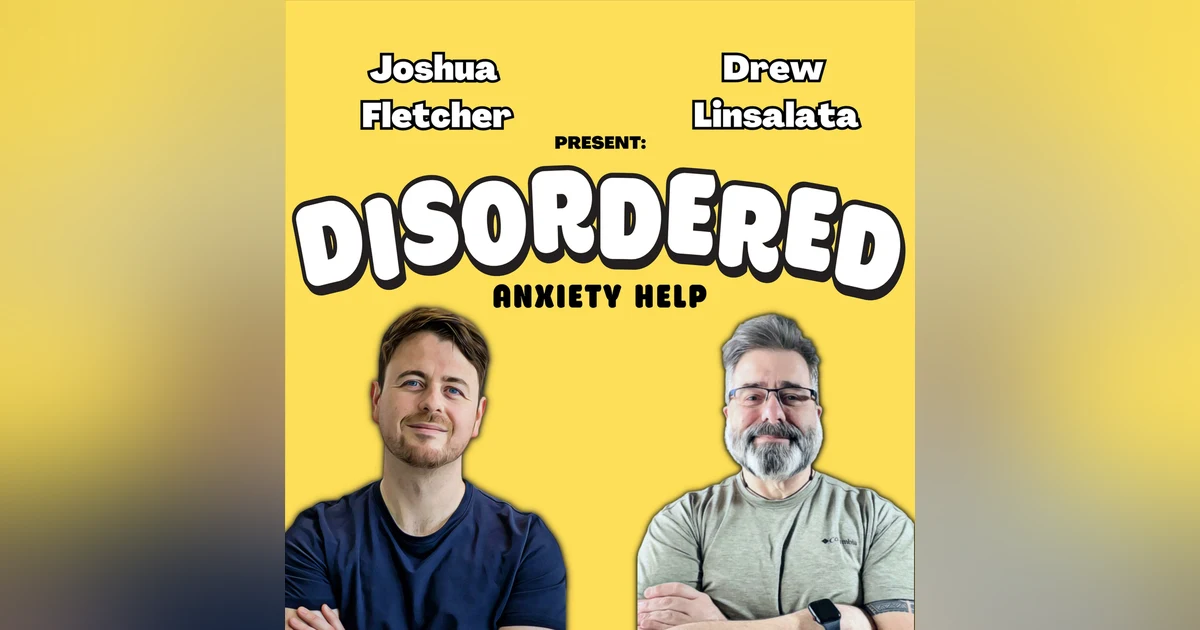
SPEAKER_06Welcome to Disordered. This is episode 73 of the podcast. Today we are doing anxiety questions and answers, which we haven't done for quite a long time. I am Drew Linsolata. I am a therapist practicing under supervision in New York, in the U.S., specializing in the treatment of anxiety and anxiety disorders. I am an author, a podcaster, a psychoeducator, advocate, former sufferer of anxiety and depression for many years of my life, but better now, and one of the co-hosts of Disordered.
SPEAKER_07And I'm Joshua Fletcher, also known as Anxiety Josh. I'm a psychotherapist based in Manchester in the UK, and I specialize in working with anxiety and anxiety disorders. I'm the co-host of this podcast and author of the book. And how does that make you feel? Welcome, Josh.
SPEAKER_06We have a lot to do today.
SPEAKER_07Yeah, let's answer some questions. We get lots of people submitting on disorder.fm did it anyways and questions, and they'd be piling up, so we thought we'd uh we'd answer a few because there's some good questions.
SPEAKER_06A lot of good questions that probably aren't long enough to be whole episodes, so we figure we'll just string a bunch of them together and answer what we can. But before we do, how about we do a did it anyway? Because it's a really good one, and we'll have a little celebration to start the episode. What do you say? Yeah, here we go.
SPEAKER_01How are you, lads? I love the show. My name is Ian. You can use my name if you like. I just want to share a quick data anyway, in regards to my sleeping issues. I was suffering with really severe hypnot jerks every time I would try to fall asleep. If it wasn't a muscle twitching, it would be my brain jolting me back awake when I drifted off. This developed into insomnia, which then developed into sleep anxiety. I could not even think about sleep without getting anxious. I was on sleeping tablets as well, just to get me, you know, a few hours' sleep. Two weeks ago, I decided enough was enough. I said to myself, I don't care if I sleep or not. I'm actually excited that at the possibility that I might be awake the whole night. And I didn't just say it, I kind of meant it, and I felt an instant shift in my anxious sensations. It actually did turn into excitement about not sleeping. I went to bed that night without a sleeping tablet, tried to keep my eyes open for as long as I could, and I fell asleep. And I've been sleeping like a baby ever since. I ditched my sleeping tablets, I ditched drinking my special teas before bedtime, I stopped going to bed early. I basically just stopped obsessing over sleep. And I've been sleeping ever since. So that's my data, anyway, guys. Thanks so much. I love the podcast. Cheers.
SPEAKER_07Good job, Ian. Yes, Ian. Drop the resistance. You know, and you faced your fear. Your fear was, what if I don't sleep? And then you're like, well, fine, I won't sleep then. And you drop the resistance, and I love that.
SPEAKER_06And I've slept like a baby. And we can confirm that Ian does not use his sleep tea anymore because he sends us a picture of him throwing it in the bin, as they would say over by you, which is really made me laugh. Great job, Ian, and thank you for re-recording and submitting for us and sharing. Very cool. Um, how about we start with a we'll do an audio question and then we'll go, no, you know what? We're gonna do a written question. How do you like them bananas? We can do that. Yeah, I'll read this one. Um, not gonna use people's names unless they told us that we can. Uh, this question is I watched your worry and rumination workshop yesterday again. Incredible. Thank you. That's a workshop that Josh and I did together. You can find it on our website. And when Josh said he ruminated all day, that was me. But I differ in that I just judged thoughts. And what does this mean? And not trying to find the magic thought. Mine was more superficial, superficial level, shall I say. I say this to explain that I've forgotten how to think and talk normal to myself and others, plus, anxious thoughts ruled. I lost my opinions. Can I ask how Josh got over this? And then I know you don't both like CBT, and we'll clarify a little bit. Um she says, I agree. I had it uh through work and it made me a lot worse and it was nonstop. But do you believe in challenging your beliefs, like believing your thoughts, only unhelpful beliefs? Good question. Thank you for sending it in. What do you think about that?
SPEAKER_07Yeah, I mean, first of all, I I love CBT if it's done with a good therapist and anxiety disorder informed. Um, yeah, good question. Uh, yeah, of course you challenge your beliefs. You can challenge them not only cognitive cognitively but with your behavior as well. You know, cognitive behavioral therapy. Yeah, you can do things cognitively uh and be like that's an unhelpful belief, an unhelpful belief about this thing that's worrying me. Maybe I'm drawn to the unlikely probability of this catastrophe. Maybe there's a belief that these certain safety behaviors are keeping me safe. Maybe there's a belief that by ruminating, thinking, overthinking, and giving this all my focus, I there's a belief that you're making that catastrophe less likely to happen because you're thinking about it. Challenging those beliefs and then turning it into a hypothesis with your behavior is super important. You know, let's see what happens when we don't do that. So for me, it was um yeah, I challenge not ruminating for a bit or a week, you know. Every time I catch myself compassionately ruminating, the inwards compulsion, I'd be like, no, I'm gonna see what I'm just gonna with intrigue see what happens when I don't do that. And um, and when nothing bad actually happens, the brain's like, oh yeah, maybe that mechanism of thinking and overthinking, ruminating isn't actually helping you anything, it's keeping you in a heightened state of alert because you're behaving like the inverted column's catastrophe is around the corner. When you stop behaving like the catastrophe is around the corner, your brain comes uh your mind and body comes to a place of homeostasis, which is where we want to be.
SPEAKER_06Yeah, yeah, I would agree with that. The CBT, you know, we both don't like CBT, which I like. I'm glad you clarified that. I like CBT. My big issue with CBT is old school CBT in the second wave, which was we will identify your irrational thoughts and then change them through restructuring. Not so much. Like that didn't have a very good track record on its own. So we work more on acceptance-based, like third wave things, or at least I do. And I would say that in this situation, it this the challenging of the beliefs is what Josh said. It's behavioral. And in this one, it's like, no, no, no, those tools that you learned when you did CBT, where you sit down and do thought records and show, you know, what's the evidence for and against this thought being true? No. I think here you're learning, I don't, I cannot engage in the process of evaluating my thought. Maybe it's wrong, maybe it's not, maybe it's an abnormal thought. Maybe I'm not thinking normally anymore. Maybe, maybe, maybe I don't know. I'm just gonna have to go back to what I what I'm gonna, I'm gonna just experiment with my behavior here. So I think in that situation, you are challenging the belief because like your belief seems to be that I have to make sure that I'm thinking correctly, which you can't be doing anyway. The irrationality there would be like, oh, somehow you're you're actually controlling the content of your thoughts during every waking moment to be okay. Couldn't do that even when you wanted to. So, like when your brain is saying, is this the right thought? Am I thinking correctly? I don't know the answer to that. But what was I doing just now?
SPEAKER_07And back to it. Yeah, you can't think correctly, lose that. That the belief, the wrong belief there is that humans must think correctly. Right. You can think about absolutely not so you challenge that. So go and do what non-anxious you would do whilst accepting that your brain can have any thought it wants to do. It's not the thinking and the thoughts the problem, it's our reaction and our belief about that. It's okay. If you struggle with intrusive thoughts, it doesn't matter, go to the family barbecue anyway. Yep. You know, if you struggle with uh if you have a belief that anxiety is gonna get so much that you're gonna lose control, well get behind the car and test that theory, knowing that actually you are safe, it's just a threat response. These kind of things. Um so yeah, and yeah, just to clarify, CBT is a huge umbrella of things, yeah. And which includes acceptance, commitment therapy, stuff like that. Um but yeah, the very core of where it comes from is uh maybe a bit outdated. But if I was to be asked to describe how Drew and I work, the principles uh originate from CBT.
SPEAKER_06Oh, 100%. They certainly do. And in this situation, the you know, the belief is that I have to ask the question if my thinking is normal. So nope, I'm thinking about my thinking. So you should go listen to the MCT episode we did with our friend Rihanna, and it was really good because it addresses some of this stuff. Like, no, no, I think my think that I have to think about my thinking.
SPEAKER_07No, I've done that, I've done that as well. Just it's just rumination. Don't just like, I'm just ruminating here. I'm I'm thinking about thinking, metacognitively analyzing, and then I this I always invite people, well, then metacognitively observe that you're metacognitively analyzing. I'm like, that sounds exhausting. I'm just gonna leave that alone and go and make a milkshake. I'm like, that sounds better, to be honest.
SPEAKER_06Yeah, exactly. So and that's gonna feel weird, but you know, feeling weird is part of the the behavioral challenge to your belief. So great question, though.
SPEAKER_07Good question. Drew was very um concerned that if we keep playing the piano music uh uh behind uh as the questions are being asked, that you get sick of it. So we thought we'd delve into the archives and uh put some more backing music from previous episodes on. Apologies in advance. That's alright.
SPEAKER_06In fact, here's one right now.
SPEAKER_03Hi, Josh and Drew. Sean from Scotland. Feel free to use my name. I'll try and speak English the best I can. I was hoping you could do an episode or share some insight on the sensation of dizziness. It's my most frequently occurring sensation and my most debilitating one. It's not quite 24 seven, but it's very close. It's not quite as bad as it was, but it's still a problem in my life. Both of you could work together and uh with your combined experience and knowledge, share some insight and uh how to better deal with the sensation.
SPEAKER_06Excellent question. What do you think about dizziness, Josh?
SPEAKER_07Dizziness. Well, first of all, do your due diligence, chat to your doctor, you know, make sure the dizziness isn't hasn't got like a physical origin, but it's a very common symptom. Um presuming that everything's okay and it's just a symptom of anxiety that we're fixating on. Um I would say the problem with dizziness is it's one of those self-perpetuating anxiety symptoms, isn't it? I'm really worried about my headache. Well, if you worry and concentrate on your headache, what's gonna happen to your headache? Really worried about my ectopic heartbeats and palpitations. If you sit there all day observing, threat monitoring your heart rate, you're gonna get more palpitations and ectopic beats. Same with dizziness, and so one I used to struggle with, um, particularly as I'm a tall guy as well. It's like that's a long way to fall down. And um, you know, just like with dizziness, is that yeah, you you probably will feel a bit lightheaded and dizzy when you're anxious, particularly when the sensory stuff is affected. Um, did a workshop the other day talking about um uh the per is it the per perennial perennial globe in your brain? Forgot parietal. That's it, yeah.
SPEAKER_06Uh you accidentally just talked about another piece of anatomy that is far from the brain.
SPEAKER_05What's the perennial? Oh my god, is that the don't edit that out. Welcome to gynecology with Josh. Hi, I'm your gynecologist.
SPEAKER_06Oh, that's terrifying.
SPEAKER_07Yeah, wait, is your belly it's not your belly button? Oh damn it. Anyway, parietal lobe. Yeah, which is uh when you're anxious, that part of your part of your brain functions less, you know, it's responsible for spatial awareness and balance. Prefrontal cortex is a is affected, uh, your temporal lobes affected. It's okay, you can still balance, just things look and appear a bit weird. If you're hyperfixating on the symptom of dizziness, it's gonna one amplify it and also encourage things like avoidance behaviors, micro avoidances, make sure I don't walk along, you know, next to somewhere I can fall over and things like that. I'm gonna guess the dizziness doesn't make you fall over and lose balance, it just feels like it, which again is very common with anxiety. Um, use your exposures, you know, but also it's a focus problem as well. How much are you focusing on this, really? Oh, I'm focusing on my dizziness all the time. I can't get on with my life until the dizziness goes away. I remember doing my initial exposures for agrophobia whilst feeling dizzy, whilst things looked bright, whilst I had the lopsided feeling as well. I just don't know if you ever had that, Drew. I just feel like I'm falling, yeah, like to my left. I'm veer me too. I was veering to my left. Yeah, yeah. It was all are you right-handed? No, I'm left-handed. Weird, right? Oh, all right. I thought I thought it'd be, I thought it might have been a right left. Anyway, um, yeah, so yeah, that's that's how I did it, is doing it, teaching the brain that all right, it's discomfort, this dizziness, but if I've had it for all this time and nothing bad's happened to me, let's see how much I can push this and do those exposures.
SPEAKER_06Yeah, I love it. I the only thing I would add to that is well, I had a little my own experience. What I had to learn to do was break the habit of stopping to evaluate it. So I would get that little like, you know, that that feeling. We all know what the feeling is. And then I would stop. I would literally almost stop, like, you know, I'd have that startle and I would stop and like it. Did it go away? Is my are my eyes still weird? Like, does it still feel weird? And I had to used to stop. Yeah, 10 paces and then stop and be like, Am I stable? Am I right? Is it going away? Is it oh, am I still dizzy? And I had to break that habit and like, yeah, I would still have that little like startle, but like I would just have to sort of keep going. Uh, hated it. And I I I will pass along something I got from a client, which was a huge improvement on this. This person visualized walking through a swimming pool. You know how when you walk in a swimming pool or you're in a lake or in the ocean and you cannot walk quickly, and so you're just sort of doing that slow mo through the water, like you know, going through the water. I love that this I'd swoon if I saw you doing that, Drew. Oh, who wouldn't?
SPEAKER_07But it's worth every penny of my holiday when Drew emerges from the water. From the water in my slow motion, not dizzy.
SPEAKER_06Look, and I'm not that's the first thing I say.
SPEAKER_07Yeah, that made me very hot and dizzy.
SPEAKER_06Whoa. The moving through the water slowly and in a more fluid way was the way this person implemented uh don't stop. Okay, just slowed down and I kept going and I let myself feel what I feel. That worked very well for that person. I'll pass it along. I thought it was a great visualization tool to me. Yeah, cool. That's cool.
SPEAKER_07Keep going for it, man.
SPEAKER_06Sure. Um, how about a written one? This is a good one, too.
SPEAKER_07Uh okay. Uh I've got one. Do you want me to read it? Yeah, go for it, sure. Hey guys, firstly, I want to say thank you so much for everything you do. I honestly feel as though I'm the closest to recovery that I've ever been. That's good to hear. My question is related to OCD slash GAD, and is when you're suffering from OCD slash GAD type symptoms, how do you cope when real life happens? My example is my work have asked me to undertake a degree, which is an amazing opportunity. However, obviously a lot of hard work. I do want to do it, but I have had so many sleepless nights worrying about it impacting my recovery, making me even more ill. I already suffer with many horrible symptoms, and my mum was really unwell last year. I can't make a decision which I know is a common symptom of GAD, and I can't stop ruminating and going around in circles. I do this with most life events that is thrown at me, so it's not just the degree. Well observed. How do you continue with recovery when real life stuff happens? I'm assuming it's the advice you've given on GAD generally, but would love more info on dealing with day-to-day things in recovery. Thank you so much.
SPEAKER_06Over to Drew. Great question. I will point out the assertion that somehow or other the real life event is a special condition, and it's not. So this person, and by the way, great question. Thank you for sharing and sending it in. This person is clearly identifying when I have to make a decision. I think that continually thinking about it, rumination and thinking and analyzing is a good plan. And then I hate that I've done that because it's making me anxious and giving me symptoms and uh it's making me sick. So the fact that it's a real thing and that's really cool opportunity, work is gonna, you know, tell you to go get a degree, maybe pay for it, that would be really awesome. Because it's a real life thing, this must be special, right? Because now, since it's real life, my gad slash OCD tells me that ruminating about it is really important and must be done. Or it's or it's not. So I would suggest that the belief that this person would be challenging is that thinking about it is it is it warranted now. Sleepless nights of intentional thinking, analyzing, and ruminating is warranted because it's real life. But is it? So when you you have to start to identify, like, when have I I can't, there's nothing more I can think about this, and now it's time to either choose or not choose and live in that decision, whatever that feels like. That's the trick there.
SPEAKER_07Yeah. It's interesting, like, because the the question Sandarina said, you know, on the closest to recovery that I've ever been, and there's like a fear of losing that. What I'm actually hearing is I'm afraid I'll get anxious again. Right. And but I'll confirm this very wisely. Recovery is living real life. That's exactly right. It is, and remember your golden rules. Do what non-anxious you would do. Non-anxious me would, yeah, continue my professional development and do my degree. Don't get me wrong, if there's a lot of things going on, you mentioned that your mum was unwell. Uh, you said it in the past tense, so I presume your mum's okay uh now, but this sounds like a fear of fear, isn't it? It's like you are measuring your recovery for the on the absence of symptoms and feelings. No, no, recovery is sometimes life will make me anxious and stressed, but I can tolerate it and I can deal with it. Go do your degree.
SPEAKER_06Yeah, a real life event will probably make will stress you and make you anxious about it. It's a big decision, it's a big life decision for sure. So, like, oh, but then my old habits kick in where like the stress and anxiety is not a thing I tolerate. So I will think more to try to alleviate this, to come to the point.
SPEAKER_07It's also anything but rumination. Yeah, instead of ruminating for two hours every night, three hours every night, you'll be studying. Your attention is external, you haven't got the inwards compulsion, and the inwards compulsion definitely applies to you, particularly if you're a ruminator on the ruminator episode. If you've got something that's external, productive, academically nourishing, it's bettering you professionally, whatever, much better to concentrate on that. And I would argue, less stressful. You are worried that this is gonna add stress and make you feel more anxious. I would argue it is more stressful to not do it and ruminate for three hours every night.
SPEAKER_06Oh, 100%. I think that's where you and again, if you go, I'm like this is a huge plug for Rihanna. You go back to the MCT episode, we talked about that, where rumination is the way I seek a better feeling, but then two days later I realize that I made a worse feeling and I wish I didn't do that. So, one thing that you might try, like it seems like, okay, just pick whether you do your degree or not and then live with that decision. But this person also was able to clearly identify, I do this with most decisions in my life. So, like, okay, what else do you have to decide? How about you just make those decisions recklessly? And I'm talking about giant decisions like buying a home or getting married, but what decisions day to day, minute by minute, hour by hour, do you find yourself overthinking and you don't like that you do that? Make some snap reckless decisions and then deal with them. As crazy as that's practice.
SPEAKER_07So yeah. And it sounds like you want to do it. It sounds like there's a part of you non-anxious you that wants to do it. So I'd say go with that.
SPEAKER_06Yeah, I'm with you. Okay, let's see. We got another. No, you know what? Let's let's play one. I'm just gonna I'm making this up as we go along today. I think this one does have music. Let's see.
SPEAKER_00Hi, Josh and Drew. Um, I just want to say a massive thank you for your podcast. It's been really helping me. Um I've uh just coming out the other side of uh huge. Episode of anxiety and depression, which has gone on for about six months now. And my question is a bit kind of like health anxiety related. I get like chest tightness, and a lot of my CBT sessions have been around because I'm always sort of thinking I've got something wrong with my lungs or I've got cancer or a serious disease. And what I'm confused about is I'm still getting tightness, even though I don't really feel anxious anymore. So the kind of physical symptoms are still lingering. I just wanted to know if that's sort of normal. And also my health anxiety is slightly different in that I do like a lot of avoidance. So whereas I think others sometimes sort of do a lot of Googling and a lot of um checking and going to the doctors for assurance, reassurance, I um slightly different in that I'm like really scared to go to the doctors. So would going to the doctors actually be an exposure for me, or how do I work out, or am I just like um reassurance seeking? I'm really confused, um, especially as I'm not having like chronic anxiety every day anymore. Mine is usually like gag.
SPEAKER_06Excellent question. What do you think, Josh?
SPEAKER_07Um to answer the latter part of the question, yeah, it is an exposure. If it scares you to go to the doctor, then that is an exposure, correct. Um, health anxiety presents differently in different people, and avoidance can present it is part of you know of doing it. Some people want reassurance as a compulsion. Am I okay? Is the symptom okay? And some people are so scared that they'll just avoid doing what they want to do. So, first piece of advice is yeah, go to the doctor and check up, make sure everything's okay. I mean, having tight chests and stuff like that is really common with anxiety. Um, but you know, two in one there, you know, go get checked out and also use it as an exposure.
SPEAKER_06Yeah, I would agree. Um, definitely be careful about my health anxiety is different. I would say it's maybe 50-50. Like everybody's looking for health reassurance, and maybe 50% of the people that I've seen and heard from are too afraid to go get it. So it's not unusual and not unique. And the other thing would be the whole, like, well, I don't understand why I'm still having this because I'm really not anxious about it anymore. But I'm afraid to find out what it is. And I and I am thinking about things like heart attacks and cancer. So sometimes it's, you know, well, it sounds like you are actually concerned about what this is. I mean, we can't know because we're not actually talking to you, but like, be nice to yourself. It's okay to be nervous about that. And the exposure, like Josh said, would be, yeah, go get it checked out. That's not reassurance seeking, by the way. If I saw a client that came in and said, I'm suddenly or I'm still having these chest pains or chest tightness, I would say, Have you been checked out? Well, no, I don't want to. Well, you have to be. You know, like we're not just gonna automatically assume anything, so you got to go check it out.
SPEAKER_07Yeah, just get it. I'd also I'd agree with Drew as well there. Like, you said you know, you said, like, oh, I'm not that anxious about it anymore. But actually, it kind of sounds like you you still are because you're constantly checking, observing, monitoring for it. It's good, it sounds like you've done some good work already and well done. But yeah, keep going, keep leaning into what scares you a bit there. Also with chest tightness as well, after you've been checked out, everything's okay. Because it's such a common symptom of anxiety. I always recommend doing the chest stretches. I love door frame stretches, things like that, because the a lot of the anxiety can manifest, I say the word loosely, uh, you know, it kind of can collect and manifest in you know, in our in our torso. Uh but for me, it was my stomach and my chest. I used to get chest pain, stabby pains, things like that. Because our postures, well, my posture is terrible when anxious, shoulders rolled forward, etc. So doing like little exercises like that to ease those things as well. But yeah, go to the doctor, use it as an exposure, and um, yeah, you got this.
SPEAKER_06Um, let's go on to a written question. Um, you asked one? I have another one, so I will throw this in. This is a good question, too. Um, glad to have found your pod in my wellness journey. I like that. This person uses air quotes around that. I've been dealing with GAD for some time now, and I feel like I had a good grip on it over this last year or so. However, a recent discussion with my partner brought up an action I performed in the past that I'm not proud of. And the anxiety and catastrophizing has been quite debilitating over the last month. What are some good tips to get back on track and get hold over my anxiety that I previously had? Keep up the great work. That is a great question.
SPEAKER_07I mean, if you're obsessive and compulsive, probably because you're listening to this podcast. Um depends on how debilitating it is. So if it's something that's been brought up and it's become a point of fixation, this could be could be, I'm not saying because I need to know more, but could be a subtype of OCD called real event OCD, where we obsess and go over something that we've done in the past. Uh, and because it's real event, the threat response is like, yeah, but it actually happened, so you need to give it all your attention because it actually happened. No, you don't, you know, we're none of us are perfect, and we you know, we treat yourself with compassion and forgiveness. It doesn't define you as a person. Uh so yeah, I'd be wary if it see if it is OCD and always recommend ERP therapy with an OCD therapist. Um and then also kind of look at how much you're ruminating on it, how much has this become the center of your life? And yeah, I'm not sure what it is, and don't even think it matters, but what does matter is that the threat response and our friend the amygdala has decided though no, there's urgency now to something that's already happened. That's not rational, is it? It's okay, it happened, and we leave it now. Leaving it's the tricky part, though, particularly when your threat response is like, no, no, come give this attention.
SPEAKER_06Yeah. I might ask, again, we don't actually know you, so this is a little bit hypothetical, but if you were sitting in front of me, I might ask you to describe what happened, right? So you get triggered. And then the question would be, well, what are you actually feeling right now? Is the first answer I'm feeling embarrassment or shame or guilt or remorse? That's one answer. Or is it I'm feeling very anxious right now? Because I think one of the things we might look at would be, are you really are you trying to work through the actual emotions of that past event, which you're entitled to have? You would expect that. Are you more worried that you are anxious when you remember the past event? So the anxiety is the problem, not the past event. And so there's no actual answer there. It just may be a hint like what's more concerning? You know, the fact that I feel guilty or embarrassed, or the fact that I now am anxious again and I'm trying to figure out how to stop being anxious again.
SPEAKER_07Yeah. Um you you know it's delving into OCD territory when you start ruminating. Um, does this make me a bad person? And it suddenly it becomes damning. Like this one behavior is condemning all I am as a person. What does it mean about me? And you go on the hamster wheel of rumination. That's usually a sign that it's OCD as well. Um, and and now, yeah, our thoughts become skewed and conflated. Like suddenly, this event that happened, and maybe you made a mistake or whatever, suddenly becomes defining of you. Well, then you know that it's OCD and anxiety because it's not, you're not defined by one moment. We've all made mistakes. I have made many, you know. And it's oh, even Struders made a few mistakes.
SPEAKER_06He's calling you out right now. I would, you know, that's so good. I love that because also it's the I'm having memories of a thing and emotions, like, oh my goodness, I'm so embarrassed, I can't believe I did that, or I have so much regret over this. And then the the disordered meaning making engine kicks in and then decides to draw a conclusion because of that.
SPEAKER_07So, like, I might think making engine-making engine is way off the rails, right?
SPEAKER_06In disordered anxiety. So, like, I might this like a lot of stuff that I did that I wish I didn't do. And I I have embarrassment over past if I can't bad person. That's the difference. I could say, like, oh, I cannot believe I even did that. I'm mortified when I think about it. I I'm so embarrassed when I have some of those memories, but I don't draw an inference from that that says, oh, this means that I am a horrible person or I'm hurtful or I'm injurious. It just means that I did something stupid that I still get embarrassed over many years later.
SPEAKER_07Yeah, because you can see it through the lens of rationality and from an even perspective. OCD will make convince you that this is defining, this is awful, you must fix this. There is an urgency to this. And you know that it's a kind of OCD anxiety because your partner brought it up and you haven't really been thinking about it. And suddenly they brought it up and bam, questioned you, your values, your morals, everything you are, and your threat response will try to defend that. Just I had a mistake and just made a mistake, it's all good. Threat response can bully me. Craig the critic can bully me as much as you want, but I ain't gonna fall into this OCD cycle anymore.
SPEAKER_06That powerful answer. Well, what but what if this means that I'm a horrible person? I don't know. Maybe it does. Maybe. Like, maybe is the best answer, I think, to those kind of thoughts. Because, like, yeah, maybe it stops the argument. What do you mean, maybe? I said maybe. I don't know.
SPEAKER_07There's nothing definitive in this life, so it doesn't matter. Like, yeah, it's all good. Just go easy, go easy.
SPEAKER_06So, what do we have? We have I have one more written one, and I have a audio question. How about we do the audio question? Okay, this one has music. Enjoy.
SPEAKER_04Hi, Drew and Josh. Firstly, thank you so much for everything you do for the anxious community. You have helped me so much, and I'm so grateful for all your help and resources. My question is around anxiety recovery. So I have had anxiety since forever, and I guess I have considered myself up until recently mostly recovered. However, two weeks ago my psychologist said that she's leaving and moving overseas, and I just spiraled into a severe anxiety attack that lasted days and it's still lingering. I guess I was wondering, can you have a response like that and still be considered recovered because you keep doing what not anxious you would do, you acknowledge what's going on, or would recovery be the absence of a response like that? I just feel like I don't know what to do more that I can be more recovered so I don't have that response because it just came from nowhere, and I really just struggle with it, and I'm still struggling with it.
SPEAKER_07Measuring your good question, measuring recovery on the absence of anxious symptoms. No, we don't do that. Absolutely not. We measure recovery on our willingness to tolerate symptoms. Now, yeah, okay, sometimes when you get big news, like your therapist leaving, you're gonna have a natural human response to that. That's okay. Um, but also I'd consider how much of the credit has been given to the therapist. I'm only functioning because my therapist is here and I get to see them when my therapist leaves. You know, my therapist is responsible for the absence of my anxious symptoms. Recovery is okay, you can still have human emotions, and we all feel anxious, but it's the willingness. That's why I love the term willful tolerance. How good am I at willfully tolerating anxiety? I get anxiety now and then. Does that mean I'm not recovered? No. Recovered means it doesn't mean that much to me. It's fine, I can leave it alone. It doesn't become the center of my life. And I feed those words.
SPEAKER_06Yeah. What I hear in this one, which is kind of interesting, and as Trudel has clearly has opinions, which is fine. I mean, you know what? Copper spends a whole lot of time chiming in on my podcasts, so that's fine. Uh, what I hear in this one too, a little bit is is uh being hard on yourself because what I hear is my therapist told me that they're leaving, and I had a response to that, and that response included a panic attack. And then the fact that I had a panic attack triggered a constant stream of panic. This is not supposed to be happening. I'm recovered, I'm not supposed to panic. I shouldn't feel like this. So now I'm back into the whole like the anxiety itself is the problem. So again, do you try that exercise of like, can I tease out the part where I'm sad about my my therapist leaving? I I'm uncertain. I don't know where I'm, you know, I gotta find a new therapist if I think I still need therapy. And I'm anxious because I'm anxious. I'm freaking out because I freaked out. It's okay to freak out. Sometimes we do.
SPEAKER_07Yeah. And I think I think it's just the barometer of what success is there. Or kind of sound like it's snowballed. A psychologist is leaving. Now I'm anxious. Now I'm getting anxious about being anxious. Oh my god, it's all falling apart. No, it's just things happen and you're gonna have a reaction to it. Now let's look at your reaction to your reaction and let's see what happens there.
SPEAKER_06It's no meta, isn't it? But it's true. It's okay. So it's okay to panic. It's even okay to panic. It's all right. Does it doesn't equal failure? Right. And it doesn't mean that your recovery has been shattered or you're less recovered than you thought. So don't sweat that. Be nice to yourself. Um, we got time for one more. What do you think? You got any? Yeah, okay, cool. I have one more written one, unless you have something.
SPEAKER_07No, you uh you uh there's a few, but you you read one now. Fair enough. Sorry, I've I've um not murdered my dog yet.
SPEAKER_06Oh, it's fine. Strudel has things to say, it's all good. Um, this is a good question about self-compassion. So uh hi, Drew and Josh, you can use my name. This is Armin. Thank you, Armin, for setting in the question. I was wondering if you guys could speak about something that I think is often looked over when it comes to mental health, and that is self-compassion. I struggle very much, especially since I've relapsed lately. Things I could do months ago uh are now hard again. I often think to myself, this isn't a big step. I have been this far from my home before. And here's the key part of the question in my eyes, anyway. What is the best way to be compassionate and mean it? Thank you guys for your work. Sorry if this has been asked before. No need to apologize. It's a really good question. I love the what's the best way to be compassionate and mean it? How do you interpret that?
SPEAKER_07That's a tricky one to answer. You know, about that. It's often to do with uh kind of an internal discussion with yourself, maybe looking at the blocks to compassion. I know in therapy, particularly therapists will look at what's blocking you from being compassionate. That's when we do kind of you know delve into things, um, listen to the look out for the origins of Craig the Critic. Look at kind of what you're thinking in response to stuff. Don't take don't techniquify compassion. Now I need to technique compassion. I need to compassion is just taking a step back, not demanding so much of yourself, and also reframing what the problem is. It's not never has been how far away from home you can be. The problem is that you've been addressing is I have a fear of fear. And okay, it just happens to be in this place right now, a place that I wasn't anxious before, but it's presenting me now a chance to do that. So don't again, similar to the last question, don't measuring progress is so important to do it correctly and reframing what progress is. And that once you know how to measure progress and you know that you're on the right track, I think it's easier to draw upon self-compassion then because things make sense. Um, but if it's a wider issue and you're someone who's really harsh on themselves or a perfectionist, or you want to get things done formulaically, um it's something that, yeah, it's a very personal thing to you why you can't access that self-compassion.
SPEAKER_06Yeah. And I think there's also for me, there's the what does it mean to mean it? How do you be compassionate, self-compassionate, and mean it? It's almost like, how do I feel more confident? Well, you don't. You can't make a feeling. So be careful about like, well, I used to be able to do this, and now I feel like I'm in a bit of a relapse, however way you define that, and now I'm struggling with this again. It's perfectly okay to make statements of fact. I don't like this. This is not acceptable to me. I want my life to be different. That has nothing to do with self-compassion. That's just, you're not denying your feelings or your opinion about this, but it sounds like maybe self-compassion is being interpreted in an odd way. So if I can conjure up the right feelings of compassion toward myself, I'll be okay with this and not judge it. No, you know, you're you're still, it's okay to not like that situation, but I'm working on it. So when I tell myself that I'm failing or oh, this is no big deal, you know what? I can't answer that question right now, brain. Like, I don't like this, but let's go keep doing the best we can. You know, oh, I don't feel right about this. Well, sometimes we don't. So be careful about trying to make a feeling, if that makes any sense.
SPEAKER_07It reminds me of uh Lou Van Houten's Can I Borrow a Feeling from The Simpsons?
SPEAKER_06I don't know this. Can I can I borrow a feeling?
SPEAKER_07Yeah, he made a he released a song that's on uh on on cassette tape. Can I borrow a feeling after his divorce?
SPEAKER_06Yeah, sometimes I think we think we like feelings are things that we could just make and they're not, unfortunately. But uh it's a really good question. Compassion and meaning it is a really good question. Meaning it, yeah, yeah, it's a good one. And I don't really mean it. So we have one more, we have a did it anyway and audio did it anyway. Maybe we'll wrap it up because we're just at about the 40-minute mark. So we'll celebrate someone's win. Maybe we'll uh hit the road. All right, let's hear it. Here we go.
SPEAKER_02Hi, Drew and Josh. My name's Josie from Yorkshire in the UK. Um, thank you for this wonderful podcast and the work that you both do. I'm really excited to share my Did It Anyway. Yesterday I had a root canal procedure at the dentist, which I've been anxious about for weeks. Uh, I often catastrophise and was worried about the worst case scenario, which for me was fainting and the anesthetic not working, and that I would feel pain. Well, both of my worst case scenarios actually happened, and then I fainted even requiring oxygen. My nerve was badly damaged, so it wouldn't numb correctly. I was in a bad state of panic, but the dentist was great, realised that this was what was happening and calmed me down. Um, I took some big deep breaths, had a word with myself, and I coped just fine after the panic had subsided. I just wanted to share this because I am so proud of myself for being brave and even going in the first place, and to share that even when your personal worst-case scenario happens, that you will cope. And I now feel amazing, my tooth problems are fixed, and I'm now one step closer to overcoming my anxiety. To continue this brave streak, I even treated myself to an iced coffee today, something that I wouldn't normally do as I am scared of caffeine making me anxious. But to hell with it, I'm doing it anyway. Thank you.
SPEAKER_06To hell with it, to hell with it. I will have my iced coffee.
SPEAKER_07My my favorite part of that was the very compassionate. I just wanted to share it to show that even when the worst case scenario happens, you can still cope.
SPEAKER_06Yeah, love it. I mean, recovering after the full-blown panic attack at the dentist, which I know if you're listening to disordered, there's a at least a 20% chance that this is right up at the top of your fear ladder.
SPEAKER_07Yeah, she's got some new chompers now as well. I hope you munching through some nice food.
SPEAKER_06It's interesting she was able to go back at the end and say, like, well, the dentist, you know, the nerve was damaged, so it wasn't responding to the numbing as opposed to like the panic was so awful, I'm never going to the dentist. Like, she was able to connect to the reality of the experience and like you know, bring it with her in that way. Like, oh, you had a tooth problem and it really hurt. So well done, Josie.
SPEAKER_07Yeah, super Josie. Well done. Uh tune in next week where we'll be discussing the perennial.
SPEAKER_06Tune in next week where we'll be discussing anatomy that no one needs us to talk about here. And there ain't enough therapy in the world after that. So, anyway, guys, thanks for listening. And if you have or want to send in questions or did it anyways, you could do that at disorder.fm, of course. I wonder if they should maybe leave us some podcast reviews. What do you think?
SPEAKER_07Uh it depends if you're cool or not. If you're cool, well dressed, charismatic, you'll leave a great Apple Spotify star rating for disordered.
SPEAKER_06That means I couldn't review my own podcast. None of those things. Anyway. Um, all right, guys, thanks for listening. We'll be back next week with something. Not sure yet what, but we'll be here, and uh, we'll see you next week.
SPEAKER_07See you later.