
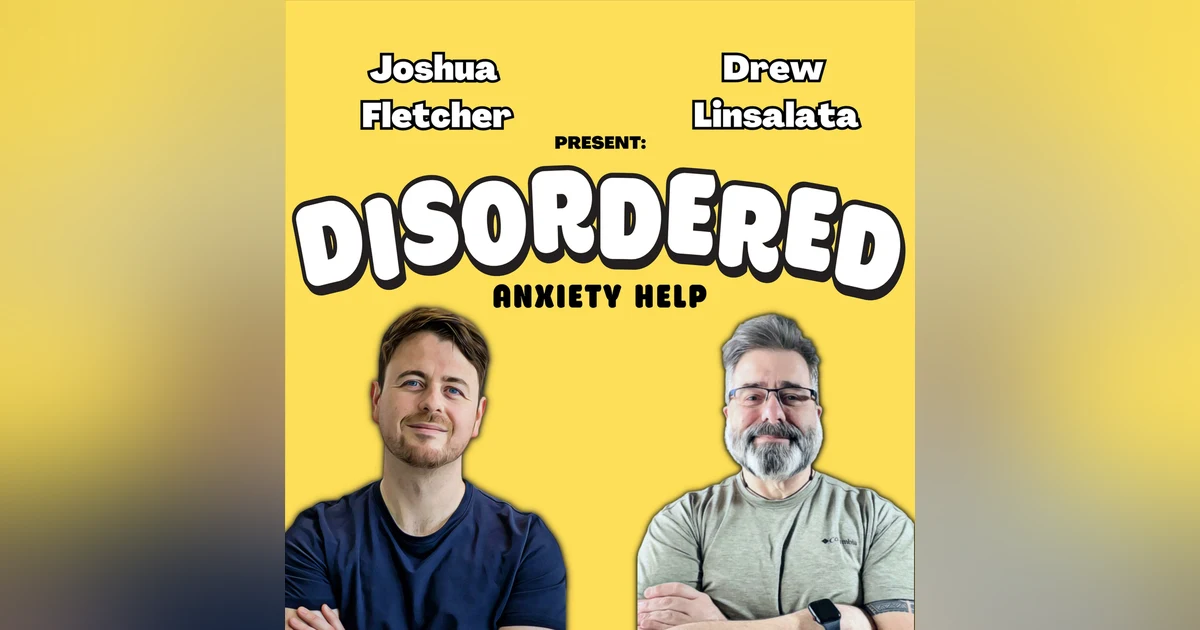
Anxiety and the Death of Curiosity (Episode 120)

 Apple Podcasts
 Spotify
 YouTube
 Amazon Music
 iHeartRadio
 RSS Feed
 When anxiety takes hold, one of the first casualties is our natural sense of wonder and openness to new experiences. In this episode of Disordered, lets explore how anxiety disorders systematically erode our curiosity about the world around us and our own capabilities.
Drew and Josh discuss how anxiety creates a rigid, self-focused mindset that asks only "How will this make me feel?" rather than "What might I discover?" They examine how this shift from external curiosity to internal fixation becomes a prison that keeps us stuck in patterns of avoidance and safety-seeking behaviors.
The hosts share practical strategies for rekindling curiosity as a pathway back to psychological flexibility, including:
- Asking "What would happen if..." instead of avoiding uncertainty
- Practicing willful tolerance while fostering genuine interest in experiences
- Using curiosity about the recovery process itself as a therapeutic tool
- Distinguishing between helpful curiosity and anxious rumination
Through inspiring listener stories, Drew and Josh demonstrate how curiosity can be gradually rebuilt, even during heightened anxiety states. They show how simple questions like "What just happened here?" and "What might I learn from this?" can begin to crack open the rigid thinking patterns that keep anxiety disorders alive.
This episode offers hope that the natural human capacity for wonder and exploration doesn't disappear with anxiety—it simply needs gentle cultivation and practice to flourish again.
---
Disordered Roundtables are here! Think of it as "Disordered Live", a way for members of our audience to spend time with us in an intimate virtual setting (attendance is limited) to engage in real time sharing and discussion on specific anxiety disorder and recovery topics. To be notified when new Disordered Roundtable sessions are scheduled, visit our homepage and get on our mailing list.
---
Struggling with worry and rumination that you feel you can't stop or control? Check out Worry and Rumination Explained, a two hour pre-recorded workshop produced by Josh and Drew. The workshop takes a deep dive into the mechanics of worrying and ruminating, offering some helpful ways to approach the seemingly unsolvable problem of trying to solve seemingly unsolvable problems.
-----
Want to ask us questions, share your wins, or get more information about Josh, Drew, and the Disordered podcast? Send us an email or voicemail on our website.
---
Disordered Roundtable is coming! Think of it as "Disordered Live", a way for members of our audience to spend time with us in an intimate virtual setting (attendance is limited) to engage in real time sharing and discussion on specific anxiety disorder and recovery topics. To be notified when new Disordered Roundtable sessions are scheduled, sign up for our email list using the form on this page.
I'm gonna try. What if I tried this? It's something that an anxious person tends to lose the ability to do.
SPEAKER_03Our curiosity is usually spread, spread across different things, curious about things in our life. I wonder what's going on. I wonder what the weather's gonna be like, I wonder what the holiday is gonna be like. I wonder what happens at work.
SPEAKER_02So we lose the ability to be curious in our actions and open-minded.
SPEAKER_03It's that lack of flexibility and curiosity outside the realm of how you feel, which is something we just want you to notice today.
SPEAKER_02No, no, no. I can only do things that I know with certainty turn out this way and make me feel a certain way, and I don't want to try anything outside of that.
SPEAKER_03We're getting emo on the podcast now. Um, that's also a band name. Uh, we'll be warming up for panic at the disco. Um, we're not, that's a complete fabrication. I'm Joshua Fletcher, also known as Anxiety Josh. I'm a psychotherapist who had two hours sleep last night. I am groggy, but we're all good. Um I'm doing what non-anxious me would do, and and that is insult Drew for a while before I press record. I'm joined by my esteemed co-host.
SPEAKER_02Uh, I am Drew Linsolata. I am a therapist in New York, specializing in anxiety and anxiety disorders. I got much more sleep than Josh last night. So I'm just gonna push him to the limit and see if we can get him to break on mic, because that would be good listening. Uh, what else? I've written a couple of books on these topics. I'm a former sufferer of the things we talk about here. I'm a guy with an expensive microphone. Let's just get into it. You guys know who we are. If you don't, go listen to the previous 121 episodes and you'll learn all about us.
SPEAKER_03Yeah, it's all good.
SPEAKER_02We don't have any time to listen to us talk about ourselves today. The Death of Curiosity, it's either a band name we could open for Panic at the disco, or it's a the name of a concept album, like Emerson Lakin Palmer from the like 1970s would put out.
SPEAKER_03The Death of Curiosity or a collection of lectures from some old intellectual Alan Watts.
SPEAKER_02That's like Alan Watts lectures.
SPEAKER_03Yeah, yeah, yeah. Uh, what do we mean by the death of curiosity? I mean, we talk about anxiety disorders on this podcast. Um it's when we lose our curiosity. Our curiosity is usually spread, spread across different things, curious about things in our life, things around us. Maybe we're walking around, curious about what's in the trees, what's in the landscape, what's in nature, what's our children doing, our partner, what's that squirrel doing? What am I doing later? I wonder how that's made. I wonder what's going on. I wonder what the weather's gonna be like, I wonder what the holiday is gonna be like. I wonder what happens at work. Curiosity, and it's what kind of drives us to enjoy each day as a human being. But anyone with anxiety, OCD, agrophobia, panic attacks, health anxiety, intrusive thoughts, productivity, anxiety, have you noticed that that curiosity, that beautiful human part of you, that you know, thriving, blossoming curiosity just withers and dies as we become fixated. We lose our curiosity. Um, the more we become internalized and in a sensitized state.
SPEAKER_02It's not, I think it's not just the curiosity that I wonder about, like wondering about things. I think it's also curiosity in like experiences. I'm gonna try. What if I tried this? It's something that an anxious person tends to lose the ability to do. Like, no, no, no. I can only do things that I know with certainty turn out this way and make me feel a certain way. And I don't want to try anything outside of that because I don't know how it's gonna make me feel. You know, we talked about that before. An anxiety disorder is so self-centered. The anxious people are not, an anxiety disorder is. Like, how am I gonna feel? How's it gonna make me feel? Is it gonna trigger my anxiety? Will this make me anxious? Is this gonna make me feel bad? So we lose the ability to be curious in our actions and open-minded. Like, so you know, and when you were at your worst, when a friend calls you up and says, Hey Josh, you want to go to this gig? Like, you know, hey, this band is playing it really like they're playing a Friday night. You want to go? Well, what did your anxious mind tell you to do?
SPEAKER_03We haven't got time for that curiosity. We've got to dig in and use all the curiosity we have to channel it into fixing, yeah, you know, and that's basically what we've that's what it would do. Fixing something's wrong with me. I want to stay indoors, you know. I'm not curious about anything else other than something that feels dangerous to me, you know, and we do. So if you're ruminating on an uncertainty, if you've got pure OCD or any type of ritualistic OCD or GAD or whatever, yeah, there's an element of curiosity enmeshed in your threat response. So it's like 100% curious. I'm really curious to find out if this symptom will kill me, if this is the first sign of me going insane and if I'm gonna have a brain aneurysm or have a heart attack or impumiliate myself. Yeah, one could argue you're really, really curious about that. Um, but it's that lack of flexibility and curiosity outside the realm of how you feel, which is something we just want you to notice today. Yeah, you know, we all this is why we say did it anyways, willful tolerance, stuff like that. In fact, I think the best way to approach anxiety and reach recovery, and I say that loosely because you know I kind of ban it, but for simplistic terms, yeah, is the practice of willful tolerance whilst uh fostering curiosity. So, like I'm walking down the street, I've got DPDR, my head's pounding, I feel like I've what if I ran someone over in my car and didn't notice, and blah blah blah, and then suddenly you know, I wonder how that bridge was built. What why are you saying that? You know, you could have killed someone, you might lose your mind with it. No, no. I wonder how that bridge was built. Yeah. 51% of my attention given to almost a a kind of imitated sense of curiosity, but the more you do it, the more it starts to feel natural.
SPEAKER_02Yeah, kind of the real version of curiosity or or flexibility starts to come back in organically. But you're right, at first you have to kind of manufacture it or fake it. It's all right to fake it though. Because I think what happens when you like, you know, act like a curious person again. Hey, listen, you know, experimentation, like what would happen if I is a really great question that might fuel progress toward recovery or whatever state you want to call that. What would happen if I? And a lot of times in the exposure world, exposure is often termed exp, you know, behavioral experiments. People will call exposures be experiments, which they are like, what would happen if I, you know, took the time to look at how that bridge was look at the stonework, and let me go check that out. Like, is that rough stone or smooth stone on my walk through a park? Well, what would happen if I gave that my attention instead of closely monitoring how I feel on this walk? What would happen if? So I wonder about what would happen if those are great questions that will can draw start to drive curious behavior, which is really experimentation, which kind of looks like exposure.
SPEAKER_03But a lot of those people would say it's like I've got I got like um the the image of Frank Grimes from The Simpsons, you know, like but what if it's what if it's irresponsible to be like what would happen if you know you're like a reckless child, like what would happen if I started balancing on this electric cable ten feet in the air, yeah, you know, but it often feels like that for anxious people. What would happen? It's the curiosity of rather than what would happen if I did that, it's almost like I wonder if something good will happen if I do this.
SPEAKER_02Oh, okay.
SPEAKER_03Rather than just having a full-on emotionally you know, a petri, it's not a petri-dish experiment. It's like something that you say, it's values-driven. I wonder what good thing will happen or can happen if I walk into that theater knowing I'm emetophobic or I might throw up or whatever. I wonder what will happen. Something good will happen if I do bathe my child and I'm suffering with POCD or whatever. Yeah, I wonder what good will happen if I do go on holiday, even though everything is telling me to stay in and fix and ruminate. So rather than saying, you know, it you can't force a sense of curiosity from something that's quite abstract, but let it tap into your values. I wonder what I can get out of doing something quite scary and invest the curiosity there.
SPEAKER_02Yeah, I'm with you on that. What can I learn is another great curiosity question. What would I learn if I went into this theater, even though I'm a metaphobic and I fear that I might vomit? Yeah, what can I learn from that? What might I learn about myself, about my capabilities, about my ability to be flexible and handle difficult things or tolerate? What would I learn about the nature of my fear? What would I learn about the nature of my thoughts? Like if I go and and allow that, do that to happen, you know, let that happen. Let's see what happens. So, but you're right. Like the death of curiosity is really an accurate. That's a genius title that you came up with for this episode because it really will strangle us. For me, I was not curious about anything, I wouldn't try anything, nothing.
SPEAKER_03Yeah. What do I do when lightning strikes me?
SPEAKER_02Sorry, seems to be the hardest word. Alright, even sleep deprived he can do an Elton John tune.
SPEAKER_03I think I'm singing because I'm sleep deprived. Can we get a community win, please? Okay. Speaking of a theater.
SPEAKER_01Hi, Drew and Josh, and all the listeners. I hope you're doing well today. My name is Blake, I'm a sufferer of GAD and OCD. I've been most of my life, but only diagnosed in the last couple of years. Um, just wanted to send in and did it anyway today to say that um a couple months ago my partner and I went to the movies, which is one of our favourite pastimes, and we decided to get dinner beforehand, uh, but the restaurant was unfortunately uh unexpectedly busy, and that made us late for the movie. Um and when that happens, uh Craig the Critic usually tells me not to go see the movie because it's not going to be the optimum viewing um scenario. And my partner could see that I was getting a bit stressed out and anxious um and and said we could go home, but I said no, we're gonna go to the movie, I'm gonna ignore Craig the Critic. And we went anyway. We turned up about five to ten minutes into the movie, uh, and I walked out of it, having loved it, and it was one of my favourite movies of the year so far. And I was pretty proud of myself when I think about that scenario often. Um, especially with my OCD, I tend to avoid doing things if it's not in the optimum scenario. So um I just wanted to yeah, remind myself and remind others that experiences are worth it even if they're not always perfect. So I hope everyone's doing okay, and and thanks for the show, Josh and Drew, and everything that you do. Keep up the great work.
SPEAKER_02Yes, how good was that? That was great. Experiences are worth it, yeah, aren't they?
SPEAKER_03Yeah, I love that. And also, it's paradoxical because that is perfect. Everything you did was perfect. The fact that you were accepting that it wasn't perfect makes it a perfect did it anyway, you know. Um, but of course, OCDing, like you pointed out, Craig the critic, are like no, no, this is the ver version of flawless that you must subscribe to and aspire to be. No, you did exactly using the principles as well, everything. I'm so glad you enjoyed it. Um, and yeah, it doesn't have to be the optimum viewing experience. Just like watching any Marvel movie is never an optimum viewing experience.
SPEAKER_02We think it's gonna, but it never is, right? Like the same thing with anything flavored cherry. If you pick up something and it says it's cherry flavored, you're expecting an optimal experience, and it's just never.
SPEAKER_03Well, I'll I'll call you on that. Have you ever had a cherry bakewell? I don't even know what that is. Oh, dude. Do I have to come there for that? When you come to the UK, no, that's optimum experience.
SPEAKER_02All right, fair enough. Cherry Bakewell.
SPEAKER_03Yeah, yeah. They are a bit of moment on the lips, lifetime on the hips, but they're very nice.
SPEAKER_02Oh, the cool thing about what Blake did tier two is like, where'd the curiosity there? Well, the curiosity there is shows up as flexibility. So when his OCD and his dad says, no, no, no, I can only be okay in the optimal state. Like I must have perfect conditions when I that's the only acceptable thing. And he was like, No, maybe not. Like, let's challenge that. There's curiosity in that.
SPEAKER_03That was that was gonna say that was the the curiosity pushed all of that.
SPEAKER_02Yeah, 100%. Like if I could if I hang on to this rigid stance that says, no, I can only be okay if I can only be okay if I if the the you know if the concert is only is 45 minutes away or less. 46 minutes, I will implode, so that is a no-go. No, no, but what would happen if I went to a concert that's an hour away? What would happen? Like, could I handle it? What would I learn? Can I be curious about this? I love when you talked about reckless. You used the word reckless. Uh I mean, way back when in my other podcast, The Anxious Truth. If you if you search it, I did an episode.
SPEAKER_03Was I describing one of your haircuts?
SPEAKER_02Yeah, but they're all reckless. The one coming up today will 100% be reckless. But everybody said uh I did an episode called Living Recklessly, in parentheses, but not really. So to the anxious person, when you start to act as if you're curious about your experience, it will feel very reckless, dangerous, wrong, and irresponsible to you, depending on your presentation. But the rest of us are looking at you like, what? So, like there is, this is not reckless, it's not irresponsible, it's not dangerous. It'll only feel that way. So deciding to say, well, let me try to be curious about my anxiety state might sound like patently absurd to you at face value, but it's okay. It's supposed to sound absurd at first.
SPEAKER_03Yeah, that's such a lovely reframe as well. Ah, if it feels reckless, it means I've not abandoned my curiosity. That's right. That's exactly right. If it feels reckless, if it feels reckless, it means I've not abandoned my curiosity.
SPEAKER_02Yeah, if it feels reckless to do a thing that you really want to do, but it feels reckless, there's a really good chance that you got to get curious about that and go ahead and do it.
SPEAKER_03Like and also don't forget your rational mind. Like, what's your rational mind saying about this? You know, there's nothing reckless about walking around a garden center. Told you. No, told you, and there's nothing reckless about doing what non-anxious you would have probably done a long time ago or is willing to do. Yeah, so always check in with wise mind, rational mind. Like, what check in? They're quiet in the corner. So, what do you think? Do you do you think this is reckless to go for a walk up the hill? No, yeah, you know, just go walk up the hill. All right. No, but Craig the critic in anxiety saying it is reckless. You know, what if you have to call the the air ambulance and you or you need to run for help and all that? And it's like, well, no, just walk up the hill, man.
SPEAKER_02Yeah, I think your rational mind will point you a little bit toward again, if you want to do this, I really want to do this. I used to love going on picnics with my family or whatever, and I really want to do that again, but it feels so reckless to do that. No, no, no. But if some part of you wants to do it, like no part of an anxious person is saying, Boy, I really want to go and like diffuse a bomb with one hand tied behind my back. I really wish I could do that again. No, like, yeah, that would be reckless and dangerous. And like no part of you is saying, Oh, I can't wait to be able to do that. I mean, maybe for the like 0.006% of you listening that are on the bomb squad, I want to go back to work. But no, like I want to go on a picnic, I want to take a trip, I want to go on holiday with my family. Those are things some part of you is yearning to do, even though it feels reckless. Get curious about it again. You know what? We can make this really meta. You can even get curious about the process.
SPEAKER_04Yeah.
SPEAKER_02Yeah. So what's going on here? Like, you know, we had Russ Harris on, right? The happiness trap. He talked about the act triflex, so we had Stephen Hayes on talking about that stuff. Get present, open up, open up is the curious step and act in the triflex. Open up. What are my options here? Do I have another option? Is there something else I could do other than what I insist I must always do when I feel a little wobbly? Do I have another option? This is a great question. That's a curiosity question.
SPEAKER_03It's really good. Yeah. Yeah, the part the the the role of curiosity. Um I've noticed not explicitly when I was, you know, overcoming anxiety, but like now I realized it it's a good marker of where you're at and why you're doing it. And if your day is much, and this is what and it all ties in, like I say, even your most anxious and sensitized, try you can still do 51% of your attention on something, and that is inadvertently treat training your curiosity. It's like I remember sitting there going, I've got to stop compulsively scanning and ruminating on these intrusive thoughts or obsessing how I feel or looking out for panic attacks. Uh, and I'd sit down and be like, right, okay, I'm gonna try and get 51% of my attention on the television on this really boring show. And it was a battle sometimes, flip, flip, flip, flip, flip, because it's a very attention-based, self-based condition, isn't it?
SPEAKER_02Yep.
SPEAKER_03And then about five minutes later, and we'd speak about the autonomic state shift. I forgot I was flitting and I was actually invested in the plot of this show because I'd the my curiosity was about the process. I wonder what happens if I try to give this show 51% of my attention, and lo and behold, because and like I say in my TED talk and what we said in the past, you can't see the exact moment the autonomic state shift changes, I just realize, oh, I'm watching the show, I'm actually quite invested. Don't get me wrong, it's like compulsing again. How do I feel? What am I going? But in there, it was the curiosity about the process and the show together that triggered the autonomic state shift, which I'm very and if you've not seen that uh wonderful TED talk by uh Man Cunion who's fantastic, uh it's in there.
SPEAKER_02I'll link it. I'll link it if you go to disorder.fm slash one twenty, I'll link your TED talk. It's consistent.
SPEAKER_03But but explain why you can't do it and why curiosity is your better is you is your best friend and not inwards fixing is is your enemy. Yep, yeah, yeah, I hear you.
SPEAKER_02I think anybody who's ever, if you've ever worked, I know you've had this in your practice for sure. Like, I one of the cool things about working with people individually is the part when they start to say things like, I, you know, I pan, I was panicking in the middle of the night, and then next thing I know, it was the morning, I fell back asleep. So, like, there's an element of curiosity in there where they decided to roll the pentamillion gun, right? Roll the dice. Oh, and say like Yeah, what would happen this time if I didn't get out of bed and get my ice packs or wake my partner or like scroll anxiety accounts on Instagram? What would happen if I didn't do that and I just laid here and let this happen? And the next thing you know, they they fell back asleep for another two hours. That's a great day when the when a client comes in and tells you that, or a client comes in and says, Lately I've been saying yes to things again. Ah, that's curiosity kicking back in. Like, I know I don't want to say yes to this, but what if I say yes? Let what will what can I get out of that? What will I learn from this? What if I do go to the thing or go to lunch with my friend, even though I've been saying no to that for two years? What would happen? That's how you know your curiosity is coming back.
SPEAKER_03You reminded me of the sleep anxiety people where I'm like, well, you know, they have this belief that no, I must all my attention must be inwards because I must get sleep tonight. It is important. If I do not get sleep tonight, things are gonna get worse and worse, and I'm gonna be a terrible parent and I'm gonna get sacked from my job. So I'm gonna lie in bed with the lavender mist and all that and meditate and go inwards. But have you noticed it doesn't work because you've lost your curiosity? Actually, to nod off to sleep, you you know, you develop curiosity in your thoughts or in your your kind of what's it, the uh hypnog hypnagogic hallucinations as you're about to fall asleep and the dream like state. Or for me, my curiosity when I'm let down is shut my eyes, um, listen to an audiobook, and that curiosity allows the parasympathetic nervous system to kick in, which is the precursor to sleep, unless you're listening to a horror, which I did uh accidentally because I was so engaged with it. My heart was pounding. And don't get me wrong, I was really enjoying it. Yeah, but it wasn't conducive to speak.
SPEAKER_02It's funny. I have a book like that right now. That's such a fascinating thing. I'm enjoying the book, but it's it's one of the few books ever that it is a bit emotional to read it. And I'm like, oh, this is not a good night book because it's making me think about my own life. And like it's emotional. It's fun. It's a really very well-written book. It's fiction. But like that's not a good thing.
SPEAKER_03It's mad, isn't it? Because the caterpillar was really hungry and you didn't think there was going to be an end. But there was a twist.
SPEAKER_02Well, I'll tell you, uh a little spoiler alert at the end of this book. Everybody really does poop. So it's any parent listening will understand that everybody poops reference. But uh curiosity though, like that's how you know your curiosity is coming back. Like, what if what would happen if I or like I always do it this way? I'm gonna I I don't want to do it that way anymore. Try a different way. I'm gonna lay here and like literally do nothing but count my breaths or pay attention to my breath, even though I want to get up and run and call the emergency services or wake up my safe people. No, no, what I'm gonna just try this. So in a way, you're you're poking at the process a little bit too, right? Like, what would happen, you know?
SPEAKER_03Yeah, yeah, yeah. The cue I love that the curiosity of the process. What are these two idiots talking about? You know, why what what maybe I should just go and concentrate and heal my nervous system and regulate myself and do the work and all that stuff, and then the feelings that I don't like will go away. Um, or just foster that curiosity, you know. That's why again, going back to like mindfulness and stuff, they always people that always forget the curiosity thing, like, yeah, yeah, I just want to do the mindfulness thing, or I don't want to be curious about holding a raisin or the sound of my neighbor lawn mowing or whatever. But actually, yeah, that that in itself is the foundation of foster, you know, this curiosity. And only now looking back did I realize, oh yeah, I can see why they bang on about that, and it does apply not explicitly, but it does still apply to anxiety disorders as well to take away from from worry.
SPEAKER_04Yeah.
SPEAKER_03Um, I'm very curious about hearing another story from the community. Well, speaking of sleep anxiety.
SPEAKER_05Hey Josh and Drew, this is Audrey. You can use my name. I am in the Midwest of the United States, and I guess this is a did it anyway. The first episode I listened to of yours was the episode on sleep anxiety, and it was when I was going through a lot of really bad insomnia from a nocturnal panic attack that I'd had. Um, I was like sleeping like one or three hours every night, so I was in just this constant panic of like, I'm never gonna sleep again. Um, I'm gonna go crazy because I'm not sleeping, and like all of those things, and just feeling terrible. But your episode really helped me um kind of reframe just how I thought about sleep and like not attaching like so much importance to it and just kind of um you know letting my body do what it does, and like if there are nights where I sleep bad, that's fine, like it's not gonna make me go crazy. And I think it really helped me um kind of get back to somewhat normal sleep. I mean, I'm not sleeping perfectly, but um, and then like a month after that panic attack, I had a trip to uh for work to the south, and I was getting really anxious about it. Like, what if I don't sleep before like the day-long meeting we're going to have there? And I just kind of decided to approach it of like if I don't get good sleep, like I'll still be able to show up to the meeting. Um, that's what coffee is for. And I was just trying not to put a ton of importance on that, so I think that really helped. Um, and I ended up sleeping pretty okay, not not great, um, but definitely not like in a panic all night, and just really able to like reframe how I was looking at that. So I really appreciate your help. Um, your podcast has been so helpful to me um in this season of my life with just uh working through different kinds of anxiety in different ways, and I just appreciate everything you do. So thank you so much.
SPEAKER_02What if what if I just have coffee and go to the meeting?
SPEAKER_03Yeah, Audrey, well done. Really great, really great. I love the attitude as well to that. Like that, and again, if you've not heard uh the episode on on the sleep anxiety that uh Audrey mentioned, or the attitudinal shift, that that's the thing that stood out for me, Drew, the most. Yeah, I agree. Like is the attitude shift like, well, you know what, you know, if I sleep asleep, I don't, I don't, I'll deal with it. Why am I why is all my curiosity in the past been hyperfixated on the one singularity of sleep? Whereas Audrey's curiosity has spread to actually, well, what I wonder if I can cope without sleep. I wonder what can happen uh if I can do that. I want and that's uh beautiful, beautiful did it anyway. Well done.
SPEAKER_02Yeah, very good. What would happen if I like? Well, I wanna my anxious mind is telling me to do it this way, but I will experiment with doing it this way the other way, and let's see what the outcome is. I can I handle that? Yeah, evidently you can. Really great. Curiosity. Well, like yesterday on my Substack, you that my Substack is free, you should check it out. But I I I post a little mental health thought every day, and yesterday's was a question, and today's is also a question. And it is the question that you could start with is what just happened? So when you get into a triggered state, the first thing to do, like people say, Well, how do I tolerate tolerate how listen me, Elmer Foot? How do I tolerate just to wabbit again? Crazy wabbit. Just to get that wabbit. You know, how do I tolerate how do I how do I surrender? How do I float? How do I do all those things? Well, start with the question, what just happened here? What just happened? Like, what just happened is, oh, I had a really scary thought, or I noticed something in my body that that I don't like, you know, that's disturbing me, and right now I'm really scared. What what just happened? That's what just happened. So, like the curiosity, as opposed to, well, it feels like I'm going to have a heart attack, it feels like I'm going to go insane. Like, that's a very rigid, repetitive, this is the way I automatically jump to that interpretation. This is the this is how I'm going to describe it every single time. Wait, stop. And actually ask the question what just happened here? Oh, I had a sensation that that disturbs me, I have a thought that disturbs me, or I don't know, somebody I'm watching something very emotional right now, and I I got really upset, and now I'm starting to get anxious because I notice a change in my body. Describe what's happening with curiosity. Like when people say lean in to your experience, this is what we're talking about in therapy. Like, no, no.
SPEAKER_03Through a metacognitive lens.
SPEAKER_02That's right. Like, what is happening right now? What is actually happening? Just the facts here. Forget your interpretation. Like, start with what just happened here. Which it in itself is that meta-curiosity about the process. What if I preempt my interpretation that this is horrible, unbearable, and dangerous, and I tried to describe it in a different way? What would I learn from that? So you know, there's so many different ways that this plays into it, I think. It it plays into all the different types of therapy that we use to do. Every one of them fosters psychological flexibility and therefore curiosity.
SPEAKER_03Yeah.
SPEAKER_02Yeah. It opens your mind. The mindfulness thing that you mentioned, there's a concept called beginner's mind in mindfulness. When I teach my practical mindfulness class, we start in section one. I say you got a beginner's mind. My mindfulness teachers would always say, you go through the eight weeks. Don't tell me if it's working or if it's good or bad. Just do the eight weeks with a beginner's mind, open mind. And then at the end, we'll talk about what your experience was. Just don't tell me if the exposure worked or didn't. Do it the best you can. And then afterwards, let's see what you can learn from it. Curiosity.
SPEAKER_03And you never lose that curiosity. Yeah, because some people they lose the curiosity. They're like, the exposure didn't work. Yep. The curiosity dies, and they just listen to Craig the critic and about how much of a failure they are or whatnot.
SPEAKER_02Yeah. Because I have a very rigid, I can't be curious about the experience. I'm going to do the experience because everybody says you have to face your fear and do exposures, but I have a very rigid interpretation of what it must look like. It can only go like this. And I mean, like there can be no other way. Oh, it didn't work that way. So it doesn't work. Exposure doesn't work for me.
SPEAKER_03Curiosity is like the ether of the anxiety recovery cosmia.
unknownOoh. Yeah.
SPEAKER_02And let's let's just let's live.
SPEAKER_03I dil I delivered that very lame sentence with more gravitas than it desired than it desired.
SPEAKER_02It sounds really good. I feel like we need to get really close to the mics now and talk that way.
SPEAKER_03Let's break that up with someone else's voice. Um, hi Drew and Josh. My name's Sabrina, and you can use my name. I've dealt with OCD and intrusive thoughts for many years. However, last year I developed panic disorder and GAD. That's fun, isn't it? If OCD and intrusive thoughts weren't enough, let's get some more. Life became overwhelmingly scary. I had a fear of fear itself, and it felt like everywhere I turned, my body was looking for a threat that didn't exist. Through the help of you guys, I've made some significant progress over this past year, but of course, anxiety has its ups and downs. I wanted to share a did it anyway with you. A few months ago, I went to a bachelorette party in NYC. That's your neck of the word. And and for my now sister-in-law, I was with five other girls I didn't know in a hotel in the middle of Times Square. I was experiencing panic the entire time. I felt like I was gonna puke and I was shaking, waves of fear washing over me, even after I would start to feel somewhat settled. My mind wandered right back to how I was feeling, and boom, I was panicking again. The loop of peaking anxiety. Well, despite that, I managed to put my best face forward for my sister-in-law, who I love so much, and somehow found myself laughing and engaging with the others. It's almost like you're no shut up. They point, Josh. Cure about curiosity. The anxiety did not go away, but I was able to have the experience I wouldn't have if I'd have ditched the party. Memories were made that night, even amidst the fear. And I'm so glad I went. And I'm so proud of myself. She got married to my brother yesterday, and I did have moments of panic at the wedding, too. But I dealt with it just like before. Anyway, thank you guys for everything you do. Changed my life. Uh, I find myself crying at every I did it anyway. Well, I hope you're crying at your own. That would because you should be very proud. Uh, and Billy Mays would be very proud too. Uh, and you don't feel alone when other people are sharing their experiences. Yeah, we love that too. Uh, thank you so much, Sabrina. Oh, very good. Sabrina gets applause.
SPEAKER_02Some tears in the audience as well. Yeah, very good. Really, really good. And like such a values-oriented thing. I love my sister-in-law. I did a big family event, it's a happy day. I want to participate in that, which means I'm gonna have to try something different.
SPEAKER_03Really good. Curiosity killed the cat, but it doesn't cats don't have anxiety disorders.
SPEAKER_02No, cats are assholes. We know that. So no, they're not. Leave cats alone. I'm a dog guy and I'm allergic to cats. I don't hate cats.
SPEAKER_03I like them both. They're both nice, they both have positive traits and annoying traits, just like you and I.
SPEAKER_02100%. Everybody's like, oh, the disordered podcast hosts their assholes. That's true. That's true. 100%. Um Do we have anything else in the vault? We do. We have an audio question. We can maybe end with this question because I think it's one that gets asked a lot in general. This is particular to her situation, but in general, so let's hear the question.
SPEAKER_00Hi, Joanne Josh. Uh, my name is Desiree. You can use my name. I discovered your podcast this past spring. I was experiencing some anxiety related to some health issues I've had in the last year. I had a miscarriage that was later termed that resulted in emergency room trips, emergency surgeries. That was super unexpected and very difficult. I also had some neurological symptoms start up about 10 months ago and they weren't like super bothersome at first, but they got more and more bothersome, especially as they didn't go away. I'm lucky enough to live through all the testing done. Um nothing is seriously wrong with me. But then the problem is like we don't really know why this is happening, but we know it's nothing for easy or something. Which is wonderful. But then we have to be symptoms that nobody knows why they're happening. You know, even though I know it's something serious, they're they're constantly they bother me, and there's always that like pitch in my feet of like, what if what if it's something that they haven't found yet? And it creates like this anxiety spiral. Um my question is when you have non-anxiety related symptoms, what are some strategies to cope when you experience symptoms that you don't really at the moment have a hope of going away and you need to learn to live with them and integrate them into your daily experience. Anyways, I love your show. Thank you so much.
SPEAKER_02It's a good question.
SPEAKER_03It's a really good question. I can't wait for you to answer it.
SPEAKER_02Throw it back to me. Um, okay. So, like sometimes not all anxiety is disordered anxiety. That's we say that all the time here, right? So sometimes we do actually have health issues and we do have physiological issues that cause changes in our bodies that we do not like and maybe learn to fear. But they're here, right? So if there's nothing you can do about it today, and it's good that Desiree is working with her medical team and they're working on it, and it's good that she knows it's not like super dangerous, nonetheless, it's impactful. So I would say start with acknowledging the fact that I don't like this. Start by acknowledging the fact that this is impacting me. I wish it wasn't here. You're allowed to wish it wasn't here. But what can I do now? Like, I hate to be, you know, that dude that's like, well, he's gonna talk about mindfulness again. But when we look at pe when we apply principles of mindfulness, specifically in like formal mindfulness-based stress reduction, to people who are dealing with chronic illness, chronic pain that isn't easily medical medically managed, even things like terminal illnesses, we get an a positive outcome in that their quality of life uh subjectively improves as they learn to watch their resistance to this experience and modulate that. Like this is what I got. I hate it, but I fighting it isn't helping me. And if I learn to watch that mechanism and and turn that fight down and like put my attention in other places because I'm practicing focusing my attention, your quality of life tends to improve, which is a subjective thing. But when you have a zillion people since 1979 say the pain is still here, but my quality of life has improved. It's hard to argue with that. So notice when you are looping through resistance again and again and again, but what's the point? I don't like this, I wish it was gone, but since it's not and I can't make it gone right now, what are my choices now? From a curiosity standpoint, what can I do now? Yeah.
SPEAKER_03Good answer. I'd only add I would say to myself, okay, I'm gonna get physical symptoms now. Is this my rational brain being curious, or is this secondary fear latching on? Yeah. And you know it's secondary fear latching on because you started to do compulsions. And I know we talk about compulsions over and over again, but if you're checking it for the hundredth time and you have the same reaction to it, and you're going over and over and you're trying to seek certainty, even though you've got assurances and things like that, that's when you know secondary fear has taken over. So list your compulsions, and then we try each one to behave in a way where we don't use those and direct our attention and curiosity elsewhere.
SPEAKER_02Yeah, I I think that was a great addition. There's the I hate this, and there's the I hate that I hate this. So that's a secondary fear, right? So very good. Hang in there, Desiree. But and thank you for sharing, appreciate that.
SPEAKER_03I think we're good. Really good. Thank you for tuning in, guys. As always, you can get us at disordered.fm if you would like to leave a voice note or leave a message. We try our best to get through them all. Um, I'm gonna start posting again on socials at some point, and um, but I'm just enjoying this. Um, um, big thank you to my co-host, uh Drew, and we'll be here every Friday, like always.
SPEAKER_02Yeah, we'll be back next week with another one. Thanks for listening, and uh, we'll see you next week. We're out.