
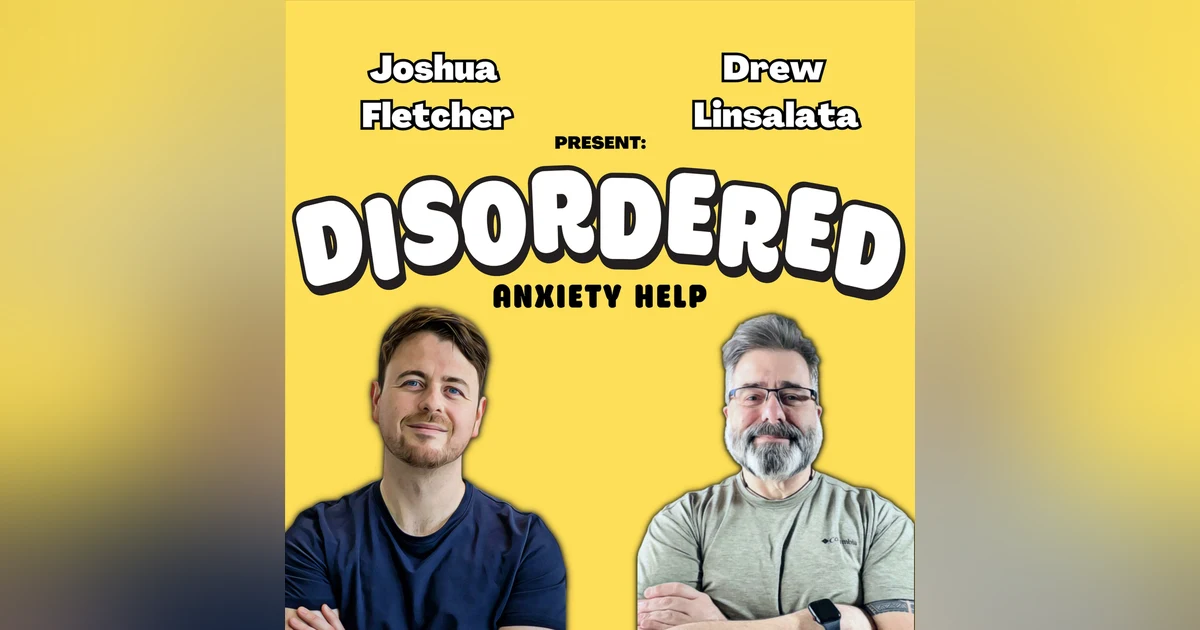
Self-Soothing When Anxiety Appears? (Episode 102)

 Apple Podcasts
 Spotify
 YouTube
 Amazon Music
 iHeartRadio
 RSS Feed
 How can I learn to self-soothe when I get anxious and I'm terrified of my body or my thoughts?
Well ... while it might seem like launching into a soothing technique designed to control the fight or flight response is a good idea, this week Josh and Drew are talking about why the concept of self-soothing doesn't automatically make sense in the context of anxiety disorders.
Self-soothing, supporting yourself while you naturally work through difficult moments and experiences, is awesome. There are a few excellent examples in this episode of what that might look like (including a reference to Josh in a cozy onesie), but when we feel like we must immediately escape from feelings inside us because we are in what feels like an urgent situation, self-soothing can be counterproductive.
If you're struggling with the idea that you should be learning how to forcibly soothe your anxiety and frustrated because you can't find ways to reliably or consistently do this on demand, this episode is worth a listen ... even if it took us almost 30 minutes to mention crying, which is one of the greatest organic natural soothing responses of all time.
---
Disordered Roundtables are here! Think of it as "Disordered Live", a way for members of our audience to spend time with us in an intimate virtual setting (attendance is limited) to engage in real time sharing and discussion on specific anxiety disorder and recovery topics. To be notified when new Disordered Roundtable sessions are scheduled,visit our homepage and get on our mailing list.
---
Struggling with worry and rumination that you feel you can't stop or control? Check out Worry and Rumination Explained, a two hour pre-recorded workshop produced by Josh and Drew. The workshop takes a deep dive into the mechanics of worrying and ruminating, offering some helpful ways to approach the seemingly unsolvable problem of trying to solve seemingly unsolvable problems.
https://bit.ly/worryrumination
-----
Want to ask us questions, share your wins, or get more information about Josh, Drew, and the Disordered podcast? Visit us on the web:
---
Disordered Roundtable is coming! Think of it as "Disordered Live", a way for members of our audience to spend time with us in an intimate virtual setting (attendance is limited) to engage in real time sharing and discussion on specific anxiety disorder and recovery topics. To be notified when new Disordered Roundtable sessions are scheduled, sign up for our email list using the form on this page.
When is it okay to self-soothe? And when is it being counterproductive towards your recovery or accessing your life again?
SPEAKER_04So there's self-soothing and then there's control. And control usually tries to kick in when it feels urgent. That's an indicator that you might be engaging in counterproductive control as opposed to soothing.
SPEAKER_03Self-soothing as a way to not feel bad in the midst of an exposure, then we don't do that. You're coming home and you're tired and the exposures are over. I'm going to put on my onesie, make a nice hot drink, be cozy in my little hermit mode and watch TV. Yes.
SPEAKER_04That's not control. That's let me let me support myself as I get through this experience, as opposed to I gotta stop this experience right now.
SPEAKER_03Welcome to Disordered. This is episode 102 entitled Self-Soothing. I'm Joshua Fletcher, also known as Anxiety Josh, and I'm a psychotherapist and author who specializes in the topic of anxiety and anxiety disordered disorders? Disordered? Disorders. Disorders. Disorders. Oh, I specialize in something along those lines anyway. Um, really happy to be a co-host of this wonderful podcast. I'm looking forward to talking about this subject today.
SPEAKER_04We're gonna do self-soothing. I'm Drew Linsolata, the other dude behind the mic at Disordered, also a therapist in New York, practicing uh in the area of anxiety and anxiety disorders. I'll make sure I say it right. Former sufferer, an author on the topic, social media guy, you know the deal. So what are we gonna say?
SPEAKER_03Hold on for saying it correctly, Drew.
SPEAKER_04No problem. I'm happy to correct you in public whenever chance I can. What are we self-soothing? This is a really good topic. Credit to you for thinking of it as you were strolling through Manchester.
SPEAKER_03Yeah, I mean, it's good because I mean there's nothing wrong with self-soothing. It's a really you know me, I bang on about compassion. I think it's a really compassionate thing to do, to be your friend, to self-soothe. Yep. But obviously in the world of anxiety disorders, it's um it's nuanced, isn't it? What when is it appropriate to self-soothe? What does it look like for anxiety disorders? Uh, and yeah, let's talk about it today.
SPEAKER_04Yeah, I agree. I think a really good uh example of self-soothing where it becomes helpful, maybe we could start with that, would be I, you know, I have a tendency to maybe my temper gets out of control a little bit, somebody bothers me or something pissed me off a little bit. And without even thinking, I just I spout off and then an hour later I'm really sorry that I did that, and I wish I didn't, and I gotta apologize to people. In that moment, if I can, if I could work on being able to like work through that that feeling that I have and sort of soothe myself or talk myself off the ledge or work it through on my own, maybe I wouldn't act out that way and then have to apologize and oh, I didn't like that I did that. That's a perfect example of like self-soothing or self-regulation. We could use the word regulation.
SPEAKER_03Um, yeah, because it appeases the fight part of fight or flight, you know, whether you're fight, flight, freeze, and fawn, people with anxiety disorders, I think you'll agree, Drew. You know, most of us are in flight. Yeah. We want to run away, we want to escape, we want to resist the feelings. Um, whereas for a lot of people, particularly if you've got kind of problems with anger and stuff like that, you're in fight mode. And I think sometimes when you're angry and irritated, it's oh you know, it's okay to soothe that that part of you. Um, but I think if you're someone who constantly goes into flight mode, like Drew and I used to do many years ago, sometimes that it can turn compulsive and go against us. So yeah, today's gonna be a discussion of when is it okay to self-soothe and when is it being counterproductive towards your air quotes, recovery or accessing your life again?
SPEAKER_04Yeah. And I think before we even start the discussion in depth, it's okay to not know. Like you might get that wrong from time to time because you know, emotions and thoughts and feelings in like human life is not black and white. So how do I know if I'm self-soothing properly or or appropriately? Well, maybe you don't, but like we're gonna experiment and let the chips fall where they may sometimes and soothe sometimes, and over time you begin to learn and and gain that that ability to discern oh, when am I trying to like resist anxiety and frantically calm it down? And when am I just working through my emotions in a self-soothing kind of way? But if you don't know for sure, it's okay to get it wrong. It's all right, that's how we learn.
SPEAKER_03Yeah, great. Should we should we kick off with a community win and and and get into this topic? I think we should probably do that. We have a really good one to start, and here it is.
SPEAKER_01Hey guys, I'm working on a win right now. I've just kind of gotten to the point where I would rather the bad thing happen than keep living like I have been living, and just like being afraid of my body constantly focused on it, and every little twinge or feeling weird just like sets me off, and you know, I don't enjoy things, or maybe I don't do something that I want to do, and like I'm just like tired of it. So I'm at my daughter's gymnastics gymnastics class. Uh I feel DPDR, just weird, and honestly, I don't know what's gonna happen. I'm gonna roll the pentamillion gone, I think, as Josh usually says. Um, I might have a stroke, I don't know, or a brain aneurysm, or I might faint, or I don't really know what the future holds for me, but I would rather take this chance and take the chance of gaining my freedom and my life back than keep doing what I'm doing. So I'm just gonna sit here for the next 45 minutes and see what happens. And thank you guys for your encouragement and keep doing what you're doing.
SPEAKER_03I mean, no, you keep doing what you're doing, right? That's amazing. That was so good.
SPEAKER_04I was uh wow, that that ged me up that it did, that when you know, I guess I could have a brain aneurysm or a stroke. I guess I'll have to take that chance. You know, that that's amazing.
SPEAKER_03If you want willful tolerance in a nutshell there, and then roll the and and thanks for reminding us about the pentamillion gone as well. That was just some some ad lib that Drew and I go off on. And and actually, yeah, you're right. Like, am I a hundred percent certain that the bad thing won't happen? No, but am I willing to roll the pentamillion gone that you know probability is on my side? Yep. Yeah, I will. And um, yeah, well done. That's so good.
SPEAKER_04I think it's important to point out that you know, a little bit of, and I appreciate the I don't know what the defiance in that. Like maybe I'll have a stroke or or brain anymore, but I don't care. I don't want to, I don't want to run away from that anymore because I'm tired of doing it that way. A lot of people might listen in earlier stages of recovery or along the path here and say, like, but how could you allow a stroke or an aneurysm? No, what this person is acknowledging is like, I'm gonna allow the thought about a stroke and an aneurysm, which does make me afraid as if it's real, but I'm I'm gonna have to learn that the thought isn't a predictor. So it is very important to always point that out. She's not allowing an actual stroke, she was allowing the thought or the fear of a stroke, which is very different.
SPEAKER_03Also, it's compassionate to allow yourself. Like, I don't want to keep living like this. For me, it's not sustainable. And if that comes at the cost of what feels like a risk, feels like if that comes at the cost of what feels like a risk, then I'm willing to do it because I know it pays dividends. If I'm happier in myself, I'm a better mum. I'm I'm better, I'm happier for me. And yeah, if that's if anxiety is telling me that this is a risk, then I'm tired of that. I'm tired of avoiding and it's willful tolerance and it's compassion.
SPEAKER_04It is compassion. Compassion isn't always gentle and calm and soothing, and you know, it's okay, take a rest. It's not always that, you know. Oh, this is terrible. Sometimes compassion is I'm gonna like root for myself and cheer for myself while I do a really hard thing and like encourage that experience so I can learn from it. That's a really nice thing to do for yourself. Nothing else.
SPEAKER_03Yeah, compassion is is is the arch enemy of Craig the Craig. Craig the Craig uses guilt and be like, well, if you're doing that, you're you know, you're not only putting yourself at risk, you're you're putting your values and your family at risk. And it's like, no, actually, the compassionate thing to do here is is to roll that dice because I know it's it's worth it. It's not even a gamble, it's not even a close gamble, you know. Yes, there's a small chance, like everyone else has, but for I'm allowed to do this for me and for everyone close to me.
SPEAKER_04Absolutely. Thank you for sharing. That was really great.
SPEAKER_03So I really enjoyed that one. No self-soothing during it. Screw it, I might have a stroke. Let's see what happens.
SPEAKER_04Yep, that's exactly right. The context is going to be the clue when it comes to self-soothing. When we were talking before we hit the record button, like, where's the nuance in there? How can you tell when you're doing that? Like when it's a compulsive or it's a non-productive insistence on control. So there's self-soothing and then there's control. And control usually tries to kick in when it feels urgent. When it's really urgent, you have to do something about the feeling right now because something bad will happen or it just feels too overwhelming. That's a that's an indicator that you might be engaging in counterproductive control as opposed to soothing.
SPEAKER_03You're right about the urgency side of things as well. Um, if you are techniquifying self-soothing as a way to not feel bad in the midst of an exposure, then we don't do that. If you have done really hard work and gone through a lot and you've done exposures all day, and you're coming home and you're tired and the exposures are over, and you're like, you know what? That was really self-soothing for me. I'm gonna put on my onesie, my favorite dressing ground, make a nice hot drink, and watch some nice TV, and be cozy in my little hermit mode and watch TV. Yes, 100% get that. Because that's not a technique, that's you self-soothing after a tricky day of doing difficult things if you're in the midst of an anxiety disorder. Self-soothing is great as long as it's not an urgent techniquing approach to to try and get rid of that secondary fear.
SPEAKER_04Yeah, that's control. And I think self-soothing starts with the acknowledgement that like I feel dot dot dot, put in whatever that is. I'm exhausted, I'm tired, I'm upset, I'm afraid. Like, I first have to acknowledge that I'm feeling a thing. This is in fact my experience right now. And now, if I try to control it, I'm trying to turn the switch off. I'm wrestling it to the ground, I'm trying to banish it from my experience, but I can't do that. Like, we don't have the ability to really do that. So, like, if you go put on your onesie tonight, which that was an image I'm not gonna be able to get rid of, you're you're recognizing how you feel. Like it's been a long day, and I just want to hang out and just be cozy and relax and unwind. That's not control. That's let me let me support myself as I get through this experience, as opposed to I gotta stop this experience right now. That's not soothing.
SPEAKER_03Yeah, also there's nothing wrong with hiding. I love hide, I don't know about you, Drew, but I I love hiding away in a dark room. It's great. Not because I fear fear, I just like it. It's a kind of soothing thing for me. You know, I will sit in and Drew and I sometimes play games online and just sit in a dark room. That's fine, but that's a choice. It doesn't feel like I that's the only choice, you know. Like and I like that I I balance it. So today I've been into into Manchester and done some talks and had a lot of conversations and I enjoyed that. But now maybe, you know, it's been a stressful day, it's been a lot on. Um, yeah, I'll go go home, relax, uh, and self-soothe. That's okay because I do feel it. I still feel it now in this podcast. Like I'm like stressed. I don't fear the stress, I don't fear the symptoms. But for me, I know that my mood will be better later on or tomorrow if I provide that balance. Yeah. Um if I was in town today and I started having a panic attack and was then was like, Oh, I need to find a chair and self-soothe, that's when it becomes compulsive. You know, and that's when it can become tricky. Uh but it's also a nuance because if you are someone who struggles with other conditions, you know, maybe maybe you're you're you're struggling with other things where you require a uh a DBT technique. So for some people that maybe maybe you're struggling with um another disorder alongside anxiety disorders. Um that's also okay if you feel like you're on the verge of exacerbating an existing technique, uh not a technique, an existing condition. But in general, if it's just the fear of fear and you are fully aware of what non-anxious you could be, then we don't use those self-soothing techniques. Um, I just thought I'd put that disclaimer in there, Drew, because for some people, um, like one of my good friends, uh struggles with bipolar, for sometimes that's okay to literally stop and self-soothe. But for the majority of the people listening to this podcast, that probably won't apply to you.
SPEAKER_04Yeah, I think you're probably right. In in the end, you know, self-soothing in the productive or like everyday regular, non-anxious sense usually looks kind of passive. It's not passive because you're doing things, that's true, but it's an acknowledgement that that this experience that is difficult for me at the moment, stressed or upset or anger or whatever, is going to wind down if I take some time and be nice to myself and do something I enjoy. I will shift, you know, from this state to that state over time. But I don't have to make it happen any faster. Whereas in a state where like, no, no, no, this state that I'm in right now, I cannot allow. It can't be this. I must get rid of it quickly. Then it becomes really active. And then you're, you're, it's counterproductive because you're trying to control things that were never designed to be controlled that way. And then it gets even worse. So soothing becomes the opposite. I'm trying desperately and frantically and urgently to soothe, and it's actually having the opposite effect because I have to keep checking to see if it's working and checking to see if it's working, and that's not soothing at all. And then it's not working fast enough or at a satisfactory rate for me, or working enough, and now I'm failing, and now I'm even more scared. So if OMG, OMG, oh my God, oh no, if that's involved, self-soothing is probably not a good thing to aim for. Oh no, oh no, oh no.
SPEAKER_03Since we last spoke, Drew, um, I did my own did it anyway and did the did a TED talk in in Manchester, and it is directly linked to what you just said. Um, the reason why self-soothing doesn't work, and this is probably the core point of my talk, um should have been there, Drew. You know, me and the me and the guys at TED, you know, we're kind of in. I know I said that in the last episode, and I keep saying it. Um anyway, no, actually, it wasn't they had no idea what I was gonna go and talk about. It was completely nuts compared to them. I was the only guy who didn't have slides either. So I just walked on. I was like, oh my god, I am raw dogging a TED talk. Let's do it. Uh I have no little remote to hold. Is it even a TED Talk? No, I had no remote. I just had me, and I think my zip might have been undone. I hope it wasn't. I don't want to, you know, do that. Uh anyway, I went on, and the basis of the talk was um talking about the autonomic state shift. So if you're someone who's confused about self-soothing, what Drew was saying there is that you know you're trying to self-soothe and then you're checking to see if it's worked. But here's the magic thing the magic fact that people don't tell you and influences don't tell you, and a lot of therapists don't tell you, probably because they don't know, they're not keeping it from you, is that you can never observe directly the autonomic state shift. So when you're really angry, have you ever been really angry and you've kind of just imagined this annoying revenge arc? Someone cut me up in the road, and then you start imagining like getting revenge and burning down their house and stuff, maybe just me. But and then suddenly your favorite song comes on the radio and your attention goes on that song, you then forget. Oh, I was distracted. Because what happened was the autonomic state shift occurred as a result of your attention. The same happens with anxiety, you can never directly observe the moment the sympathetic nervous system switches to the parasympathetic nervous system. So while we're desperately trying to observe calm, because that's what we want so much, we're waiting for it. We're like a puppy waiting for its owner to come home. And yet it never happens when we're staring at the door. It never happens when we're staring at it because it happens when our attention is elsewhere. Um, and I said on stage in front of 1800 people and live on YouTube, soon stop trying to observe ass. Observing ass never leads to anything good. That's right. And then I've just got loved ones in the audience going, oh no. But but the point is that when we self-soothe, we're soothing, and then like Drew said, checking to see if it's working, you're trying to observe the autonomic state shift and trying to techniquey, and so and it will have the opposite effect.
SPEAKER_04Yeah, and I think in in like more organic but automatic autonomic state shift, ASS ass, for those of you confused. Let's make that a thing. Yeah, just say no to observing ass. How are you doing today, honey? Not good. I'm staring at ass all day. Or I'm trying to, but it's very elusive. You want to stare at ass, but you can't. It's the perfect that's what I I thought it was a level of genius that Ted couldn't understand. Um Ted himself, he was absent that day. But when the producer was there going, oh fuck, you know, it's funny because in like organic or like non-anxious self-soothing, there's an awareness of like a gradual change. Like I think that soothing is a thing that happens like a DJ, like fading out the first song and then fading up the second one. But but when you're super frantic and like, oh, I need this to end right now, you're hoping for like an actual demarcation point where the the fear ends and calm kicks in. It doesn't work that way. Like anybody who gets good at willful tolerance and like curiously observing their experience instead of resisting it can tell like there's a moment where you can tell you begin to calm down. But there's no moment where you calm down. It doesn't happen that way. There's a moment where you might recognize, and I don't know when that moment was, somewhere in the last eight seconds, my discomfort level dropped a little bit. I still don't know what exactly.
SPEAKER_03I don't know the exact moment.
SPEAKER_04But it seems like it's dropping a little bit. And if I do that's, but it's not still here, then I'm gonna crank it right back up again because I'm trying to soothe it to zero. I can't do that. It's impossible in this state. We would never have made it to the top of the food chain if we were able to forcibly and manually soothe the fight or flight response to zero on command with a special technique. We would have never made it because any human that was ever afraid would have gone and tapped their cheekbone and got eaten by a tiger and we'd have been done. So yeah, it's really important to recognize that.
SPEAKER_03And that's why, again, a lot of like the when we look at the wellness sphere, social media. Um, again, you know, I know I know I know you're dying to ask Drew, so I'll just answer it for you. At the start of the TED talk, well, will you I play I played a montage of all the stuff off TikTok and Instagram of ice packs and I've showed you Drew, you know, he's really good. Actually, actually made me very emotional in a weird way. You know, ice packs, do this, pull on your ears, stimulate your vagus nerves, stuff like that, which are soothing style behaviors, aren't they? Soothe, do this, press this part of your body, stimulate this, do that. But what what we're what I was saying here with that is that again, we're doing this with the wrong intention. We're doing this, and we're actually signaling to the brain, our friend the amygdala, that this is a threat and it must have an urgent reaction. You know, uh, and that's what that's what the problem is. If if we're having an urgent reaction, we're telling the amygdala, if you're immediately trying to self-soothe, then this feeling is wrong. And this feeling is wrong and it's dangerous, and we should never have it. And that's why it always backsfires. Well, not for everyone, but for particularly people in our community, it backfires.
SPEAKER_04Well, because in in the context we're always in, it becomes the state itself is the problem. It's not the saber-toothed tiger. Why is the saber toothed tiger is always the example, but it's not the wild animal coming to get you. It's not that you're hanging off the edge of the Grand Canyon by your, it's not that at all. It's the internal way you feel, the internal experience is the problem. So we're always operating in that context. And you're trying to control, and that that advice, I think, is while it sounds Like soothing, I think somehow we have this hubris that, like, well, in 2025, we've gotten so smart, which I think is really just defined as more people have microphones and cameras now. We've gotten so smart that we have found the secret hidden knobs and levers and sliders that manually operate the fight or flight system and the nervous system and the endocrine system. Like we know now, we're we've left, we know it all now. So here, just twist this knob and turn this slider and do it to hit this button three times, and you will instantly switch to a ventral vagal state and you will feel better. But that's not really true. If you want to look at like those attempts that sued, if nothing else, it might be just an expression of the fact that I actually have a say in this process. Except the say is not what you think it is. The say is if I back away and stop trying to turn all the knobs, that's a that's agency, that's a choice you can make, and that's a much better way out of out of the experience that we're always talking about.
SPEAKER_03It's just not an instant say. It's like running it, it's like running a bathtub. Yes, I can fill this bathtub, but I can't do it now. If I turn the if I turn this tap and leave it for 10 minutes, yeah, without I don't need to be there staring at the bathtub filling up. Yep. That's boring. But I know if I leave the bathtub on for 10 minutes and come back, it's full. I could have got on with my life for 10 minutes as opposed to staring at a bathtub filling up, which is dope. And it's the same. It's like I can have that. I can turn on the top, I can I can influence this bathtub filling up, but I can't fill it up instantly unless I blow a hole in my roof during a monsoon. Then maybe I could do it a little bit quicker. But in general, no. So you can't biohack the amygdala with urgency using soothing techniques, but you can influence it in the long run. That's the that's what's difficult to get your head around, isn't it? It's like you can control the amygdala, but you can't do it on command. You've got to do it, you have to set the conditions in place to almost manipulate it to do what you want, and that's how it works.
SPEAKER_04Yeah, all you could do is almost like set an example for it, right? Like and and let it follow. But again, it's gonna have to follow it multiple times. We just haven't heard from this guy in a while, so amygdala. It's just been a long time, and I've been itching to push the button. So we need to make t-shirts, man. How about how about the self part in self-soothing? Because I think that's an important part. Like it's not just the soothing part, the word self is important, and I think that's where it can really apply to our if I'm having a panic attack, I want to go and soothe a dog. No, yeah, that's what it is. Yes, that's having a panic attack, but you, stranger in the street, you need to need some soothing for that. What I mean by the self part is in our community, in our context, often the need to be instantly soothed is is we we give that to some other thing, right? So in self-soothing, while today we might be saying, well, in the context of an anxiety disorder, we have to be careful about that. The stealth part, I'm a big fan of because this is the who gets the credit or what gets the credit thing. Like, no, no, no, you can in fact self-soothe. It doesn't look the way you think it does. So we got to adjust what that is. But the self-part is super important because even if your safety person or your partner or your trusted person or the rescue person or the mints or the water or the oils are not there, you are still going to have the ability to ride through that triggered experience and get to the other end, which would be self-soothing. Like the self-part is super important. You can do this. You don't need, we can't soothe you. Like putting on an episode of Disorder to hear our dulcet tones, that's not self-soothing. That's you there you go. You're hoping that that we will calm you down, or that listening to us talk will calm you down. The self-part is important, I think.
SPEAKER_03You can do it, yeah. And it's a bit like if you've been stung by nettles or stung by a wasp, it feels so good to scratch that thing. It is soothing to scratch that scab bite thing, but you know if you keep doing it in the long run, it's not helping. The most soothing part you can do if you have that sting or that scab or something, is yeah, the most soothing part in the long run is to leave it to heal itself. Because if you start scratching, and don't get me wrong, we'll do it a couple of times. I do it if I'm stung by a wasp or nettles or something, I'll scratch, scratch, scratch, scratch, scratch. And then I and then there's a part of my brain that knows if I keep scratching this, I'm gonna inflame it and it's gonna become a bigger problem. And it's the same with anxiety, like you might catch yourself compulsing, you might catch yourself doing those things, but then there's got to be a part of your brain, that metacognitive awareness that goes, I keep I need to let this heal on its own a bit because I know in the long run that's the soothing. I will feel soothed when I leave it.
SPEAKER_04Yeah, it's pretty good. And maybe the soothing in that respect, soothing is in fact an active thing you could do. But maybe instead of trying to learn to soothe the feeling directly, maybe what we're learning to soothe or quiet or calm is the resistance response. So, like we're working, we're practicing not going into like five alarm, instantly push back. No, no, no, no, I have to fix it. There's no other choice. This is automatic. I have to do something to make this go away. Maybe what we're really soothing in a productive way in the case of the anxiety disorder community is I'm trying to watch that and then not fuel that. So what I'm really soothing is my response to the feeling, not the feeling itself. If I try to operate directly on the feeling, I'm kind of stuck. I'm screwed, and I'm on a hamster wheel that I can't seem to get off. But if I can work on toning down my response to it, well, over time, that response begins to quiet and quiet and quiet. And then the feeling itself begins to morph and change. So it's it's nuanced, it's really complicated. It's it's if you don't get it right, you don't get it right. It's okay.
SPEAKER_03You know, what does it look like then? And I agree with that totally. Like, what if you're in the midst of an anxiety disorder, OCD, agrophobia, fear of fear, cad, whatever, what does self-soothing look like every day fly on the wall?
SPEAKER_04I think that it starts to look like the ability to notice. First of all, I have to recognize when I'm triggered, which I think everybody kind of can, you know, because it feels really bad. And then can I start to notice what I want to do? I want to soothe this so badly right now. Of course I do. Be kind to yourself. Of course I'm gonna have that reaction. I'm not supposed to be able to turn off the want of soothing. So that's really important.
SPEAKER_03Yeah, that's important. Yeah.
SPEAKER_04Yeah. People somehow think that if, well, if I listen to the disordered and read the books and blah, blah, blah, then I will learn to not care and not try to calm down. No, that you're really gonna want to calm down. It's okay to want it. But self-soothing looks like I can recognize the urge to instantly try to manually fix this, but I can practice not doing that and watching the experience play out the way it normally will organically, and learn that I can handle this. So I think that's what self-soothing looks like, as crazy as it is, because you're doing it yourself. You can ask for people to cheer for you while you do it. Nothing wrong with that. And hopefully you do have people cheering for you while you do it. But at the same time, the self-soothing part is I did that myself. I made a conscious choice to respond differently, and I gave it a chance to play out so I could see a different way through this than I did yesterday. And over time, you will likely be generally more soothed, if you will. But in that moment, it might mean I got to ride through this for the next 15 minutes. But I'll give myself a chance to do that this time. How about that?
SPEAKER_03Yeah, I like that. And also other occasions, like if if you're new to anxiety, you've done something scary. Do you know what is self-soothing? Well, it's not even self-soothing, but it kind of is. But like, do things like you know what, I do want a hug from a loved one, I do want to hang out with my dog, I do want my favorite meal, I do want those things. Those things are cool too. That is self-soothing. We a hundred percent advocate for that, you know. Um and in the bits in between not making your life about anxiety, it is okay to have that connection, that compassion, and have those self-soothing bits in your life, you know, as if you want to hug a loved one, hug your mom, hug your partner, hug your kid. That's completely okay, particularly if you've had a tricky day. Absolutely.
SPEAKER_04I think that's really good because there's the soothing in the moment of the sort of air quotes emergency, and then there's like, hey, I did a hard thing. Uh I'm gonna do something nice for myself. Hey, I you know, I drove two more miles today than I've done in 15 years. You know, how about a hug? Right, those are great moments for that.
SPEAKER_03I remember doing one. I remember doing um, I did a really scary exposure. And what was do you know what was really soothing during the exposure? I just I was really tearful and I just hug someone, not to get rid of the anxiety, just as an outlet for how emotional they can be. Yeah, sure. That's really important. Just like sometimes it really taps in to your core fears, particularly when you suddenly realize and have an epiphany that you are stronger than you think, you're capable of what more than what your critic and anxiety has told you, and when you suddenly realize that that's a really emotional thing, and and I think it's a lovely self-soothing thing to bond and to share that, and to and actually even crying is self-soothing. Yeah, forget that crying is a self-soothing thing to do, and there's nothing wrong with that, you know. I agree, you can cry your way through an exposure, that is fine, yeah. Thank you. Yeah, yeah, yeah, yeah. And that in fact, we how we've we've got to 30 minutes and not mentioned that is baffling. Crying is a self-soothing thing, it's the most natural thing your body does. Yeah, you're crying through an exposure. I've done it. I'm a six foot two, 90 kilogram man, and I've cried through an exposure. And yes, I'm still doing the exposure, but crying during it is not a safety behavior, that's a human behavior.
SPEAKER_04Yeah, thank you so much. That is oh, how do we get this far? You're right and not talk about that. I cannot tell you the number of people that's try so hard to control that. And you're probably right, crying is probably the most natural release of tension we have designed into us for healthy 100%. So if you are a tearful, triggered person, you might not like that, but it's much more kind and soothing if you let yourself be a tearful, anxious person. Like people like in therapy sessions that try so hard to not cry. And then lo and behold, when they do, they might be uncomfortable crying, or maybe even in front of me. But then invariably it's always like, Well, how are you doing now? Like, oh, I feel a little better now. Almost always. Almost always. So cry if you must, it's okay.
SPEAKER_03I'm really proud that I've got to a place now where I don't care if I cry. And that puts me in the in a very small category of people. I think because I do it tastefully, I'm smoking a cigar and doing it outside in a film noir style thing. So you cry and I'm like, what's it do you? He only cries in black and white. I don't know how he does rain, Sin City, the tear looks like blood. Like, yeah, like I make crying look cool, man.
SPEAKER_04Yeah, it's like yeah, it's like the 300, like Gerald Butler in the 300. That's an animated thing. I don't know how he does it, but he manages to do it. Right. Crying is important. If you're a crier, be a crier, it's okay.
SPEAKER_03Like very soon. Does it make you any less of a person or weak or vulnerable or all the dumb stuff though?
SPEAKER_04My big concern before we get to like the last of the things is you said you hugged someone. Is that why your probation is just about to end? It was somebody you didn't know, right? It was so awkward. He just grabbed I hugged someone.
SPEAKER_03Like well, it's funny that I said the same anecdote to the guys at TED and they left. And so good. We're gonna get a lot more messages of that begin with hi, Drew, and Josh now.
SPEAKER_04Yeah, for sure. The audience is gonna try and counterbalance this massive ego boost.
SPEAKER_03Full transparency, though, had full imposter syndrome there, didn't feel like I should have been there, loads of academics, loads of stuff, and I'm joking about it. But it was one of the scariest things I've ever done. But I'm glad I could represent our community because it was honestly so maybe you're proud of that and you should express it.
SPEAKER_04We joke, but I'm glad you're proud of it.
SPEAKER_03And I cried, I walked off stage, and there was all those all the other TED speakers weren't nervous. They they literally one of them was kind of nervous, they were like, Oh, I'm cool. I walked off stage and I was bit, you know, and um they were like, Are you okay? It's like I'm fine. Yeah, that's what happens when you do something scary, yeah. You know, and um, yeah, anyway, community wins.
SPEAKER_04Yep. Well, we got uh you have a written did it anyway. We can do an audio did it anyway, and I think we have an audio and a written question, right?
SPEAKER_03So uh I've got a written did anyway I can do quickly while you load up the audio. Let's do it. Um hi Josh and Drew, thank you for doing this very helpful podcast and for making me laugh with your weird sense of humor. Thank you. You're just as weird if you're laughing at us. So welcome. I'm enjoying it very much. My doing it anyway, I'm going through a medical thing that's a bit scary. In such situations, my brain sometimes starts generating strange deja vu type feelings that can go on for days. Um, it freaked me out when it happened for the first time a few years ago. What the hell is this? Am I going crazy? But I've understood that it's probably just the brain desperately trying to find something similar to make sense of the situation and predict what might happen next. How good is that observation? That's pretty good. It's still uncomfortable, but it does not scare me anymore. And instead of sitting in the corner panicking, I'm just doing my normal everyday activities: working, washing the dishes, cleaning cat poo out of the litter box, etc., which I think is a great detail. Wow. While feeling all the time that I'm a weird in a weird matrix that keeps glitching. Brains are weird, but I know it's okay and it will pass.
SPEAKER_04Oh, that's really good.
SPEAKER_03Definite applause for that. How solid was that? I can relate to that totally as well. Deja vu is to trigger my OCD. Yeah. Like, yeah, yeah. Like, oh, when actually, when you realize what deja vu is, it's just a trick of the occipital lobe in your brain.
SPEAKER_04Yeah. That's really good. And I think the other thing to keep in the uh if you're listening to this, is you know, anxious brains, sensitized brains, call whatever you want, high alert brains. We are evaluating all of the thoughts and the experiences. So there's a really good chance that you will continue to have deja vu now and then, just that you won't see it as like worthy of some sort of analysis. So feelings of sadness is really common. Like, oh, I gotta analyze why I'm sad. Am I sad? Am I too sad? Am I sad enough? Like, no, after a while, you just learn that like sometimes I'm sad, sometimes I'm happy, sometimes I'm angry, sometimes I'm anxious, sometimes I have deja vu. Sometimes I forget things. Okay. It's not worthy of analysis. Very good. Thank you for sharing that. I think people can relate to that for sure.
SPEAKER_03Yeah, they didn't give permission to share the name, but really well done. Thank you. Very well done.
SPEAKER_04Let's do an audio did it anyway, then we'll do some questions. So here we go.
SPEAKER_02Hi, Josh and Drew. Wanted to share a did it anyway. My name is Sophie. You can use my real name. Um I struggle with extreme health anxiety and OCD. And yesterday I had to get the results of a blood test and go to a doctor. Um, I was so panicked for the three days I had to wait between taking the blood test and getting the results, um, especially on the day, could feel panic rising, but I did it anyway. I went to work, I sat in meetings, let the panic rise and fall and rise and fall again. At one point, um I reached for my phone to try and book an early appointment. That's one of my compulsions is to try and get earlier appointments with doctors to shorten the waiting time. But I put my phone away and decided I would wait it out and see how I went. And um I went really great. Um, I got to the doctor, bloods were fine. I noticed my anxiety kicked up even after that and started um giving me what if scenarios. But I decided to just push through and put those thoughts in the background. I just felt really proud of myself because that was a really hard thing for me to do. Thank you so much for everything you do. Um, really appreciate your help and advice. It's been so helpful in my recovery journey. Thanks.
SPEAKER_04Good job. Get in. That's really good. That's a did it anyway. That's about almost not doing anything. It's like a not doing it anyway. It's really good. What did you do? I just waited. Seems pretty passive, but that's a big deal.
SPEAKER_03It was the moment she realized she picked up a phone and was like, nah. Yeah, yeah. Nope. Nah, I I'm gonna sit with uncertainty and practice willful tolerance.
SPEAKER_04Oh it's a really good example of how sometimes do it anyway is literally doing a thing that you didn't want to do. Sometimes it's not doing a thing that you wanted to do.
SPEAKER_03Yes, particularly with OCD and uh OCD and health anxiety. Yeah, a lot of it is doing, yeah.
SPEAKER_04I don't uh I want to do this, but I'm not gonna do it. Very well done. Thank you for sharing.
SPEAKER_03And that's a compassionate thing to do as well, isn't it? It's like I know it's better for me to not do this. I'm willing to feel like crap now. Yep. Because it pays dividends later.
SPEAKER_04Yeah, and I will look at this experience and see what I can take from it. Very important. Don't forget that part. Um, let's do an audio question and then we'll do the written question. Here we go.
SPEAKER_00Uh good morning, lads. Um, it's uh Jonathan from the UK. I just want to talk about willful tolerance, what that looks like in practice. I am the definition of a technique if I'm how can I avoid making willful tolerance into a technique? Um, more than happy for you to use my name. Um have a great day, and thanks for all the work you do.
SPEAKER_04What do you think? You're the willful tolerance dude. No, you're not gonna wear it. What have you learned? What have I learned about willful tolerance from hanging around with Joshua Fletcher? Um, first of all, we're lads. I've never been a lad, so I appreciate this. Uh you're one of the lads. One of the lads, clearly. Honorary Brit, I hope. Um What have I learned about willful tolerance? And now how do I not techniqueify it? I think it's awareness. How do I not techniqueify anything? It's awareness and intent. Can I be aware of my intent? Can I be aware of my resistance? Can I be aware of the fact that I automatically want to fix this? If you can build that awareness, then you will start to shy away from using it as a technique, but it has to start there more than anything else. So yeah, nuanced, not easy because you're breaking a long-standing like mental and emotional processing habit, but but that's how you do it.
SPEAKER_03Yeah, in a great answer. And willful tolerance is an attitude. Yeah, it's not a doing. If you're I love how this person said, you know, I'm a self-admit admitted technique if I'm a doer. You don't do willful tolerance is an attitude. Willful tolerance is an attitude. I'm approaching the attitude here where I willfully tolerate the uncertainty whilst doing what non-anxious me would do. Yeah. You know, like, oh, okay, I'm not gonna, and then for some people, it has to be explicit. Write down your compulsions, write down them on a piece of paper. And if you're doing any of those things on the piece of paper, then you know you're trying to technique if I can get rid of that feeling. Willful tolerance is I'm doing none of these compulsions I've written down. And the attitude is, oh, I'm gonna just do stuff whilst feeling uncertain.
SPEAKER_04Yeah, question. Notice the paradox too, because you can't say I want to do willful tolerance and then try to use it as a technique. Well, break it down. Willful tolerance of what? Of the discomfort. Willful means I want, I want the I'm asking for the discomfort. I'm not trying to get rid of it. So just notice the words by itself. Like if I'm gonna do something willfully, I can't do it willfully and also hope that it makes the thing I'm willfully accepting go away.
SPEAKER_03Yeah, absolutely. I can't do willful. There's no such thing, it's a paradox. You can practice willful tolerance, yep. Like because you're not gonna get it right. But I'm practicing willfully tolerating, not compulsing, and not trying to get rid of this feeling. And that that's it.
SPEAKER_04I can do a good question. Yeah, I can do tolerance by refraining from my compulsions and safety behaviors. The willful part is the that's the attitude.
SPEAKER_03Well, I'd argue we all do tolerance. Everyone here who does have a choice. That's right. Everyone, everyone who listens to this podcast has 100% tolerance skills. That's right. They have tolerated everything life has thrown at them up until this moment. I'm just suggesting, we're suggesting we'll do it willfully, see what happens.
SPEAKER_04Or like stop resisting the fact that it's really hard. Yeah, tolerating is hard. It is freaking hard, but you've always done it. So the willful part is the part where you stop insisting that like it should feel different.
SPEAKER_05Yeah.
SPEAKER_04There you go. Question though. Yep. Uh, do we have a written question or no? We got time for that, we think we can do another question.
SPEAKER_03Uh, we might want to save that for next time, I think, because uh we've been gabbing off. Um but yeah, we'll we'll do some more on the next episode. Uh self-soothers, save it for the appropriate time, you know, during it's okay, don't technique if I also be kind and compassionate to yourself when you're triggered. Know that you are the coping technique. Um, and yeah, if you've got this far on the episode, we really appreciate you tuning in.
SPEAKER_04If you really like you hung in there with us for 44 minutes almost, like if you're watching on YouTube, by the way, because a lot of people are listening on YouTube now. I had no idea. I guess hit the idea. Yeah, we we have people listening to the podcast on YouTube all the time. We do have a YouTube channel. I think if you go to disorder.fm, you'll find it there.
SPEAKER_05Do we have a YouTube channel?
SPEAKER_04We have yeah, yeah, yeah. We have a YouTube channel, guys. Um we set it up when we first set up the podcast, and it just automatically pushes over there. I know we're not there hanging out, like answering questions and stuff, but you can't listen to us on YouTube if you want. If you're listening on like a platform that lets you rate a review, I don't know. We appreciate all the cool reviews. Maybe leave us a good review or a five-star rating or something, and come back and listen next week. What else? Thanks, guys. Catch you soon. We'll see ya. We're out.